
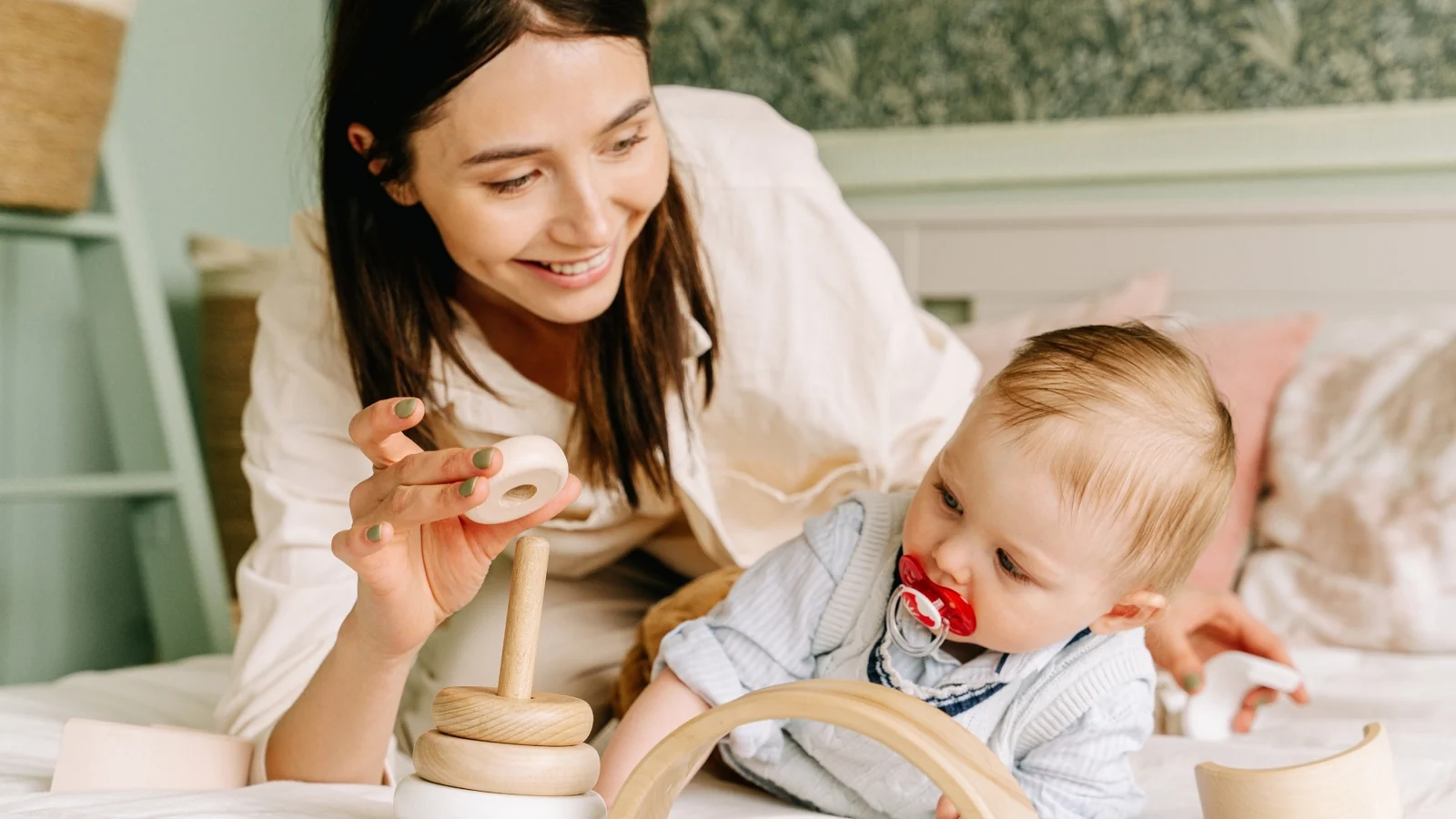
Babies give new toys a very short audition. A grab, a quick taste, one bang on the floor, and their attention drifts back to the cardboard box the toy came in. Or the dog.
If you were the one who unwrapped it and said “Look what I got you!”, that stings a little. Maybe they don’t like it. Maybe it was the wrong age, or money you shouldn’t have spent.
Most of the time, the toy is fine. What needs changing is the first few minutes: how it arrives, how much you say, and how fast you get out of the way. Montessori families have a name for doing those minutes on purpose: a presentation. It works in any Montessori playroom, whether that’s a whole room or one low shelf by the couch.
 Save
Why do slow hands matter when introducing toys to toddlers?
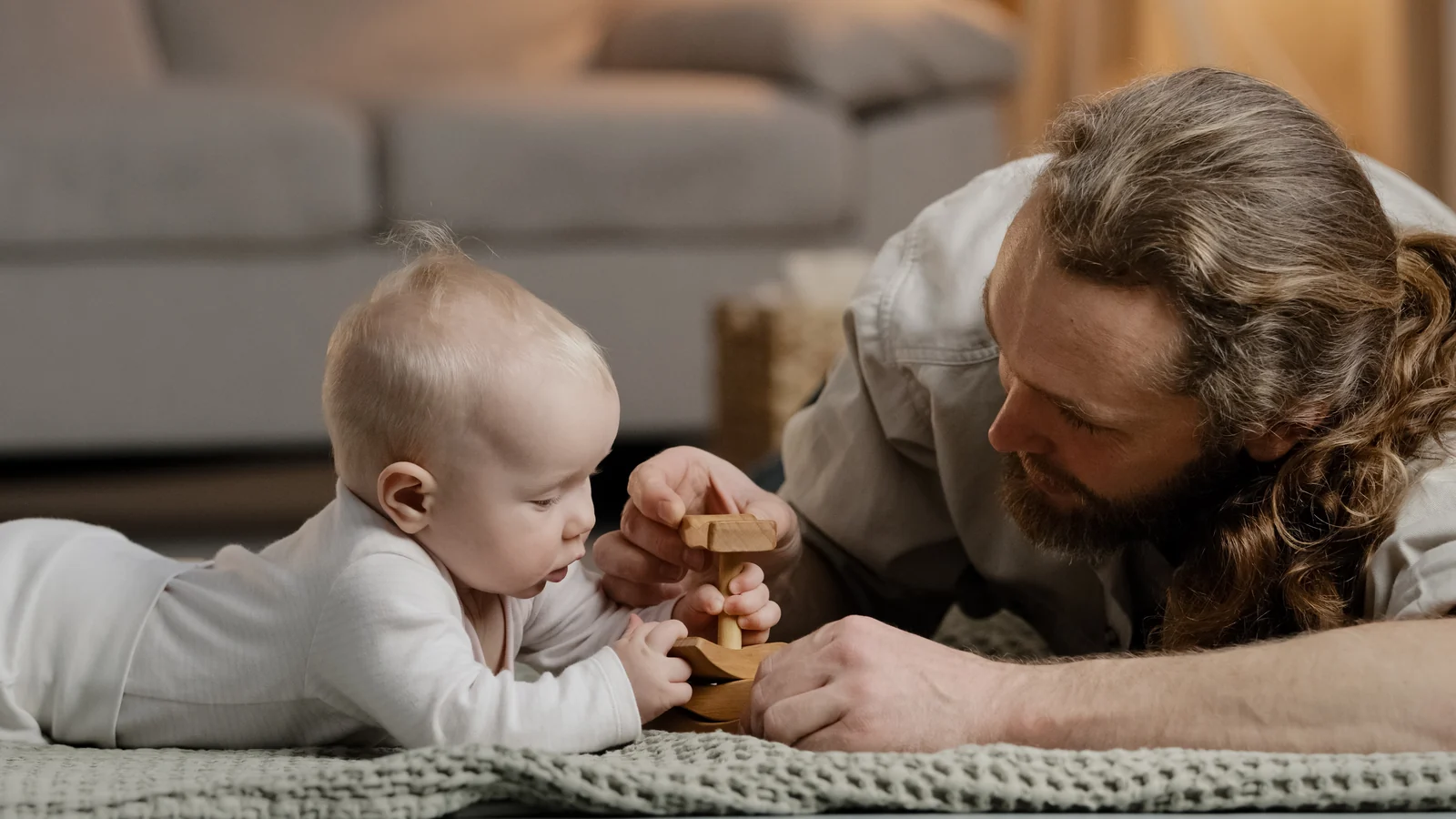
A presentation is a short, nearly silent demonstration: your slow hands show how a toy works, then your child takes over. Young children watch hands closely, so quiet, slow movements give them one clear thing to follow.
Anyone who has eaten a cracker in front of an eight-month-old knows how closely babies track your hands. In Montessori classrooms, a presentation is the moment an adult shows a child how a material works, with careful hands and very few words, before stepping aside. Think of it as show, don’t tell, for babies.
Maria Montessori wrote that in her classrooms, the teacher showed tasks like washing and setting the table “with few or no words at all, but with very precise actions.” For a buttoning frame, she described the teacher sitting at the child’s side and moving “very slowly and deliberately,” one part of the movement at a time.
Her classrooms were for preschoolers. Simone Davies, a Montessori educator and the author of The Montessori Toddler, works mostly with under-3s. On her blog, The Montessori Notebook, she writes that she uses very few words with them: she says “Look!” and then shows the activity with slow, precise movements.
“Slow down the movements. If you think you are going slow, go even slower.”
Simone DaviesMontessori educator, author of The Montessori Toddler, The Montessori Notebook (2019)
When your hands are the only thing happening, your baby gets a clean look at the movement and a fair shot at doing it. That can mean a little less frustration once the toy is theirs.
 Save
How to introduce a new toy, step by step
Pick a calm moment, set one toy on a tray, show it with slow hands and almost no words, slide it toward your baby, then sit back and watch. That’s a whole Montessori presentation, start to finish.
- Choose a calm, alert moment. Fed, rested, curious. Skip the witching hour and the stretch before a nap, and if you’re running on empty, wait for a better moment for you, too. A simple observation journal helps you learn when those moments tend to come.
- Bring out one toy, on a tray or mat. Take it from the shelf where it will live and set it on a small tray or work mat. One new toy at a time. Davies describes Montessori shelves holding only a few activities, just what the child is working on or interested in right now, so a new toy has room to stand out. Shelf height is its own question, covered in choosing a Montessori shelf.
- Show it with slow hands and few words. Say “Look!” and then do it in small pieces: lift the lid, pause, pick up the ball, pause, drop it in. Keep your words for afterward.
- Invite them to try. Slide the tray over and take your hands off it. If they crawl away instead, that’s their answer for today. The Association Montessori Internationale (AMI) says that from birth to 3, children in Montessori classrooms grow within “an evolving framework of freedom and limits.” Its definition of freedom adds that children choose their own work by their own rhythm and tempo. At home, that becomes letting your baby decide whether to try right now.
- Step back and watch. Scoot back and rest your hands in your lap. Davies writes that with under-3s she does more observing than full demonstrating, helping when a child can’t get further and then stepping back. Do the same: help with the stuck part, then retreat.
If I could keep only one of these five, it would be the last. Step five is where your baby does the learning.
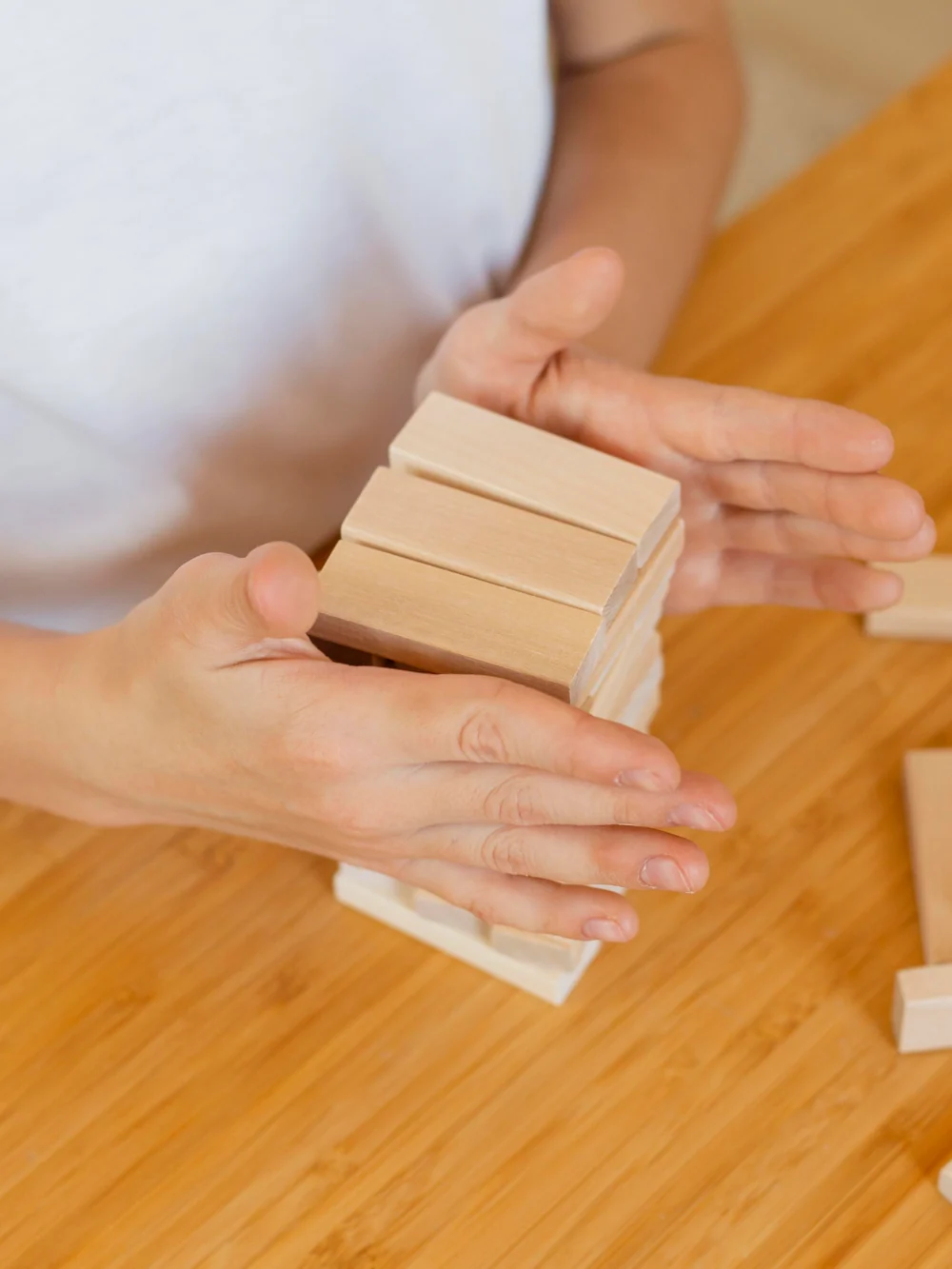
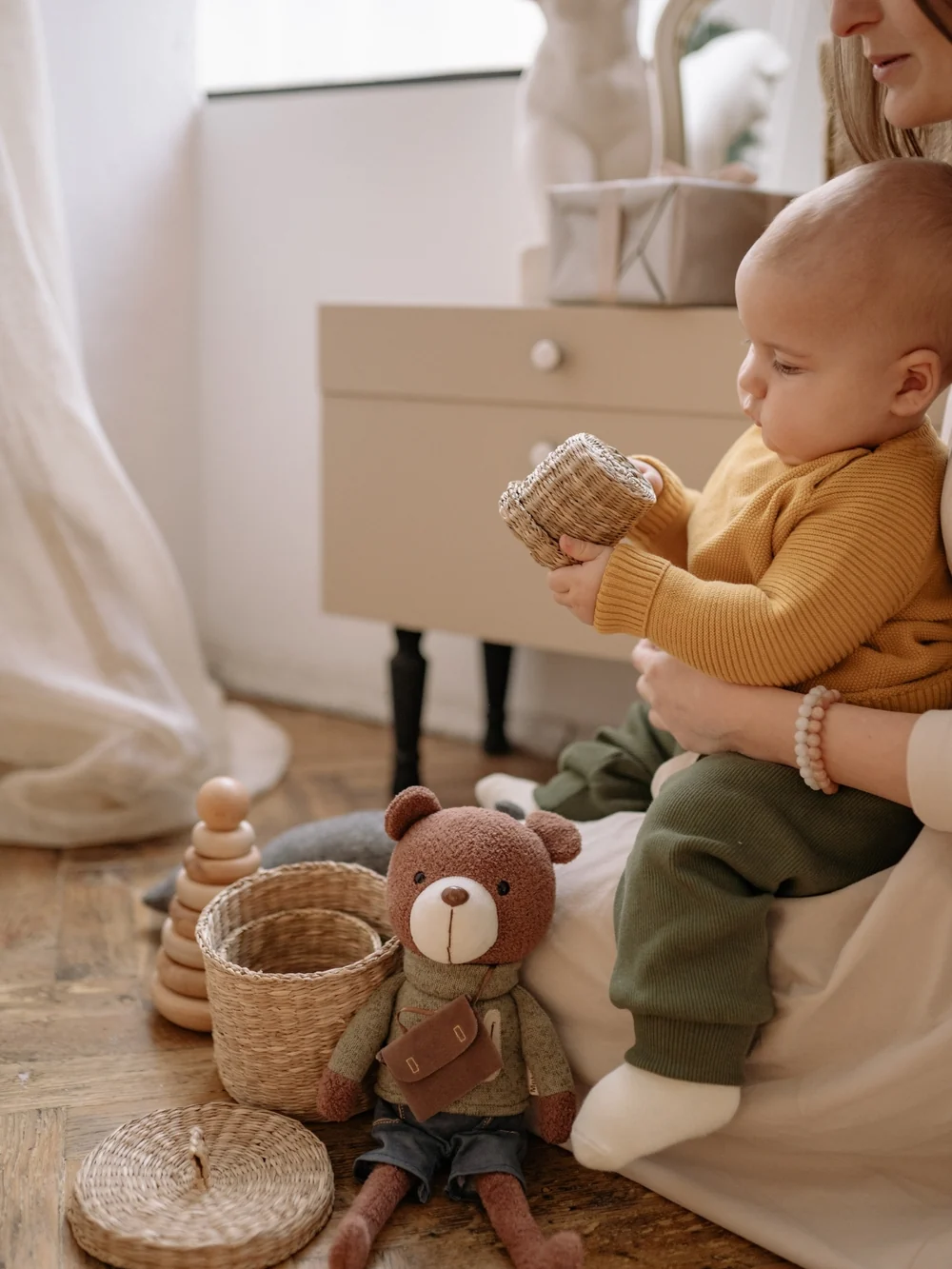
“Look!” Then nothing but slow hands. Once it’s in their hands, let them explore it their own way.
A tip Montessori parents keep passing along: practice the whole presentation on your own first, from carrying the tray over to putting it back on the shelf, and go slower than feels natural. You’ll find the fiddly step before you have an audience.
Miri’s Tip
When your baby is done, the toy goes back on its tray and back to the same spot on the shelf. That way they can find it again tomorrow without you.
Presenting Montessori materials at home: three examples by age
Check every piece for choking hazards first. After that, the five steps stay the same at every age; only the toy and the movement change. Treat the ages below as rough guides and go by what your child is doing.
Each example is a single movement you can show in under a minute.
Object permanence box (around 6–12 months)
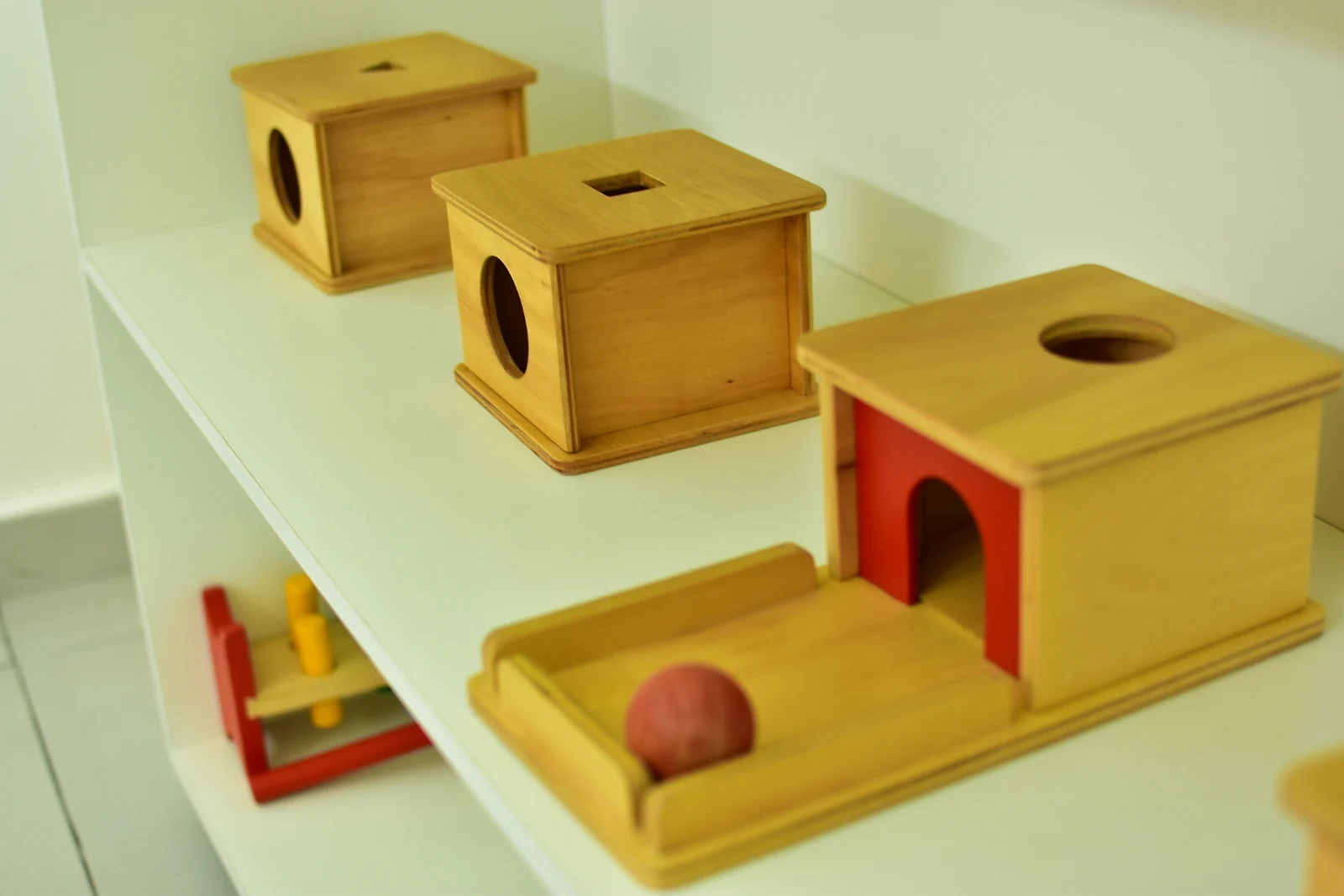
An object permanence box is a small wooden box with a hole on top and a tray at the bottom: a ball goes in, disappears for a beat, and rolls back out. Sit beside your baby, so they see your hand from their own angle. Hold the ball up. “Look!” Move it slowly to the hole and let go. Then pause and let the box do the talking as the ball vanishes and reappears. Pick it up just as slowly and set it near your baby’s hand. If they bat the box or mouth the ball instead, that’s fine for today. Just make sure the ball passes the small-parts check in the safety note below.
 Save
Knob puzzle (around 12–18 months)
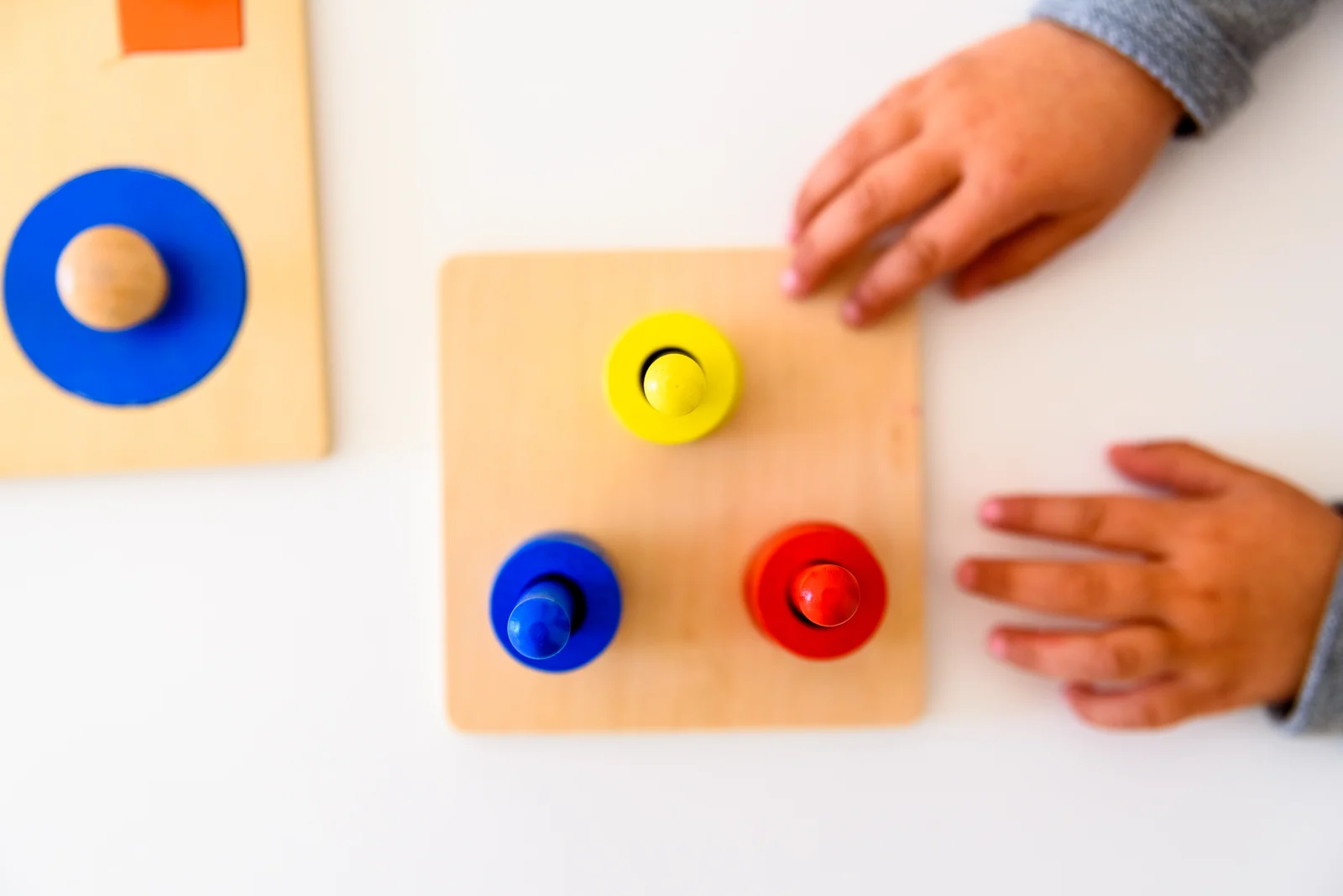
A knob puzzle is a wooden board with cut-out shapes, each with a small knob on top. Pinch one knob slowly with your thumb and two fingers, so your toddler can see the grip. Lift the piece straight up. Pause. Lay it on the mat. Then pick it up again, lower it toward its hole, and turn it gently until it drops in with a soft wooden click. Slide the board over and lean back. Plenty of toddlers pull every piece out and leave them scattered on the rug. That still counts. Fitting pieces back in is the harder half, and it comes in its own time.
 Save
Pouring or sorting (around 2–3 years)
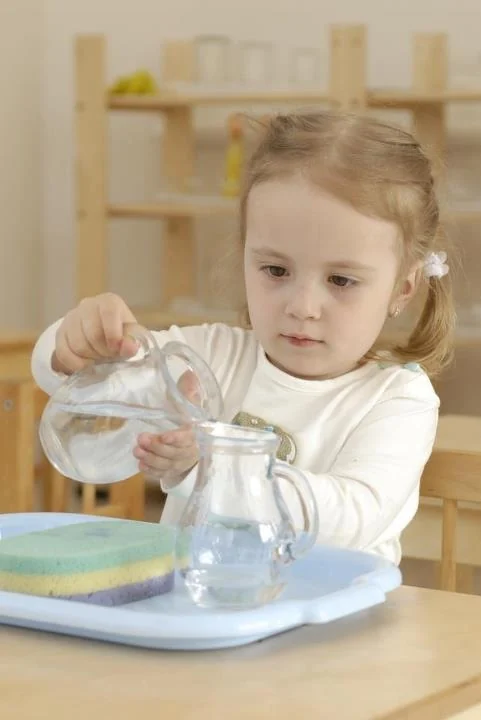
For pouring, set a small pitcher with a little water, a cup and a sponge on a tray. Tip the pitcher slowly until the water reaches the cup, stop, and set it down. Then wipe the drips, slowly, because cleanup is part of the job they’re learning. An adult sits right beside your child for every water activity, start to finish.
Sorting works the same way. Pick up one chunky piece, look at it, and place it in one of two bowls. Place the next one in the other bowl. Show two or three, then hand over the rest. Sorting sets are where tiny pieces sneak in, so check each one first.
 Save
Check every piece before you present it. The American Academy of Pediatrics (AAP) lists coins, beads, buttons, pins and pills among small objects that can cause choking or poisoning. That includes the coins for a coin-slot box and every piece in a sorting set.
The U.S. Consumer Product Safety Commission (CPSC) calls anything that fits completely inside its small parts cylinder a small part. The cylinder approximates the fully expanded throat of a child under 3, so if a ball, coin or sorting piece fits, keep it away from your under-3. Water play always gets an adult sitting right beside your child.
What if your baby uses it “wrong”?
Safety first: if the “wrong” use could hurt someone, put the toy away and try another day. If it’s only different from what you showed, let your child keep exploring while you stay quiet.
When Will was a toddler, I did presentations the way the books describe. I’d ask him to sit and watch, then move my hands like a slow-motion movie, lifting the lid off a box or dropping a coin into a slot, without saying a word. The quiet really did keep his eyes glued to my fingers.
His patience for watching felt like about ten seconds. Usually I was only halfway through when he lunged in and grabbed the toy to do it himself. So I leaned back right away. I didn’t take it back to make him watch the rest.
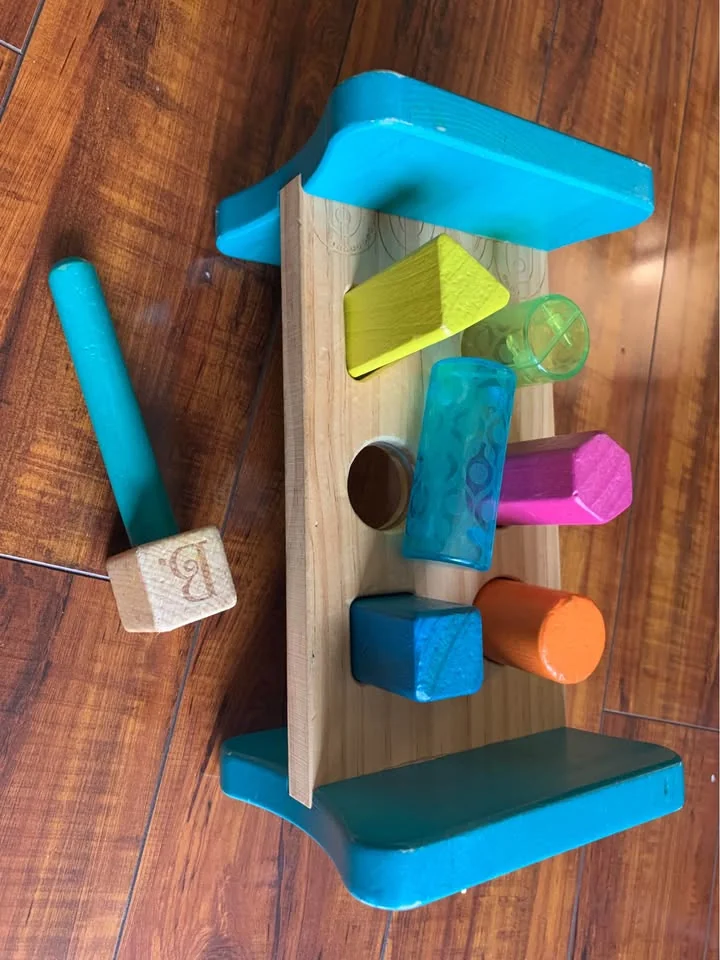
Then there was the pounding bench. Instead of hammering the pegs into their holes, Will took one and banged it on a stainless steel pot. Bong, bong, bong. I sat still and watched, and I didn’t correct him.
 Save
In Montessori classrooms, many materials have what AMI calls a control of error: the material itself gives instant feedback, so the child can notice and fix a mistake without an adult. A peg either goes into its hole or it doesn’t, and your child can see that without your help.
There’s another reason to hold back. In one experiment with 4- to 6-year-olds, published in 2011, children who watched an adult deliberately teach one function of a new toy mostly stuck to that function, while children in the other groups explored more broadly. The researchers concluded that teaching helps children learn efficiently, at a cost: they’re less likely to discover something new. That was preschoolers at a museum, so it can’t say much about a baby on your rug. It’s still a nudge to keep the demo short.
Some “wrong” uses do need a stop, like mouthing a small piece or throwing a wooden toy at someone. Calmly put it back on the shelf and offer it another day. That’s the “limits” half of freedom and limits.
Once the toy is in their hands, the lesson belongs to them.
Mistakes that turn a lesson into a lecture
The usual culprits are narrating every move, finishing the demo after your child has grabbed the toy, and correcting them mid-try. Each one keeps you in charge of a toy that’s supposed to be theirs now.
Every one of these comes from a good place: you’re excited about the toy and you want it to go well.
- Narrating. “Now the lid comes off, and look, the ball goes in!” is sweet, and it can split your baby’s attention between your voice and your hands. Save the talking for afterward, when you can name what they just did.
- Finishing the demo anyway. When they grab the toy halfway through, the presentation is over, and that’s a good sign. With Will, that was most presentations. Pulling the toy back to “do it properly” turns interest into a tug-of-war.
- Correcting mid-try. Moving their hand or nudging the piece into place takes the problem out of their hands. Let the toy give the feedback.
- Too many new things at once. Three new toys on one morning means none of them gets a real introduction. One new thing, then wait.
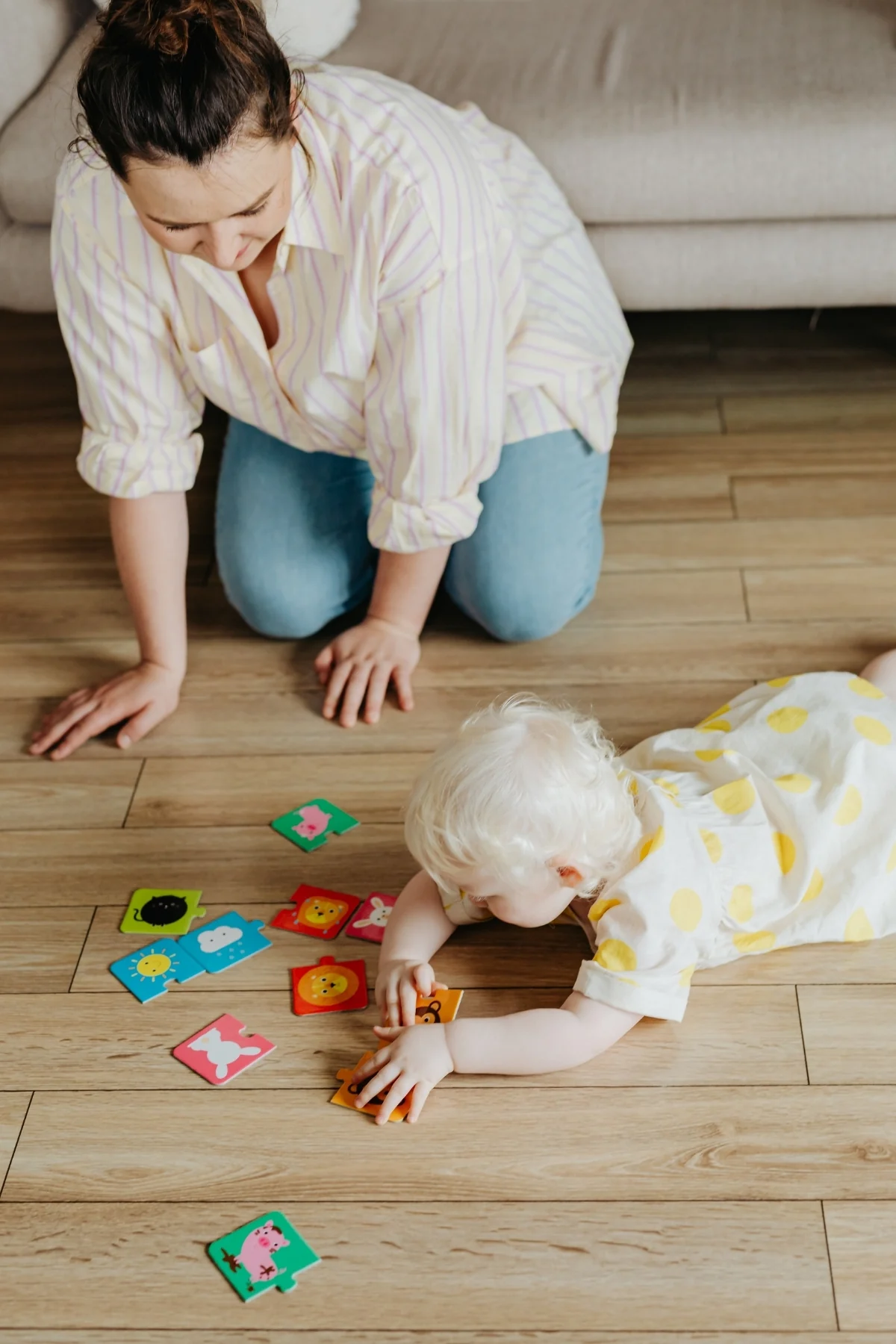 Save
Does a rotated toy need a presentation, too?
Yes, a short one. A toy coming back from storage is “new” again for your child, so give it the same slow, quiet introduction when it returns to the shelf.
The American Montessori Society (AMS) puts “new” in quotation marks when it writes about toys swapped back out of storage. After a break, your child meets the toy with fresh eyes, and a slow re-introduction takes about a minute. How often to swap, and how many things to keep out, is covered in how toy rotation works at home.
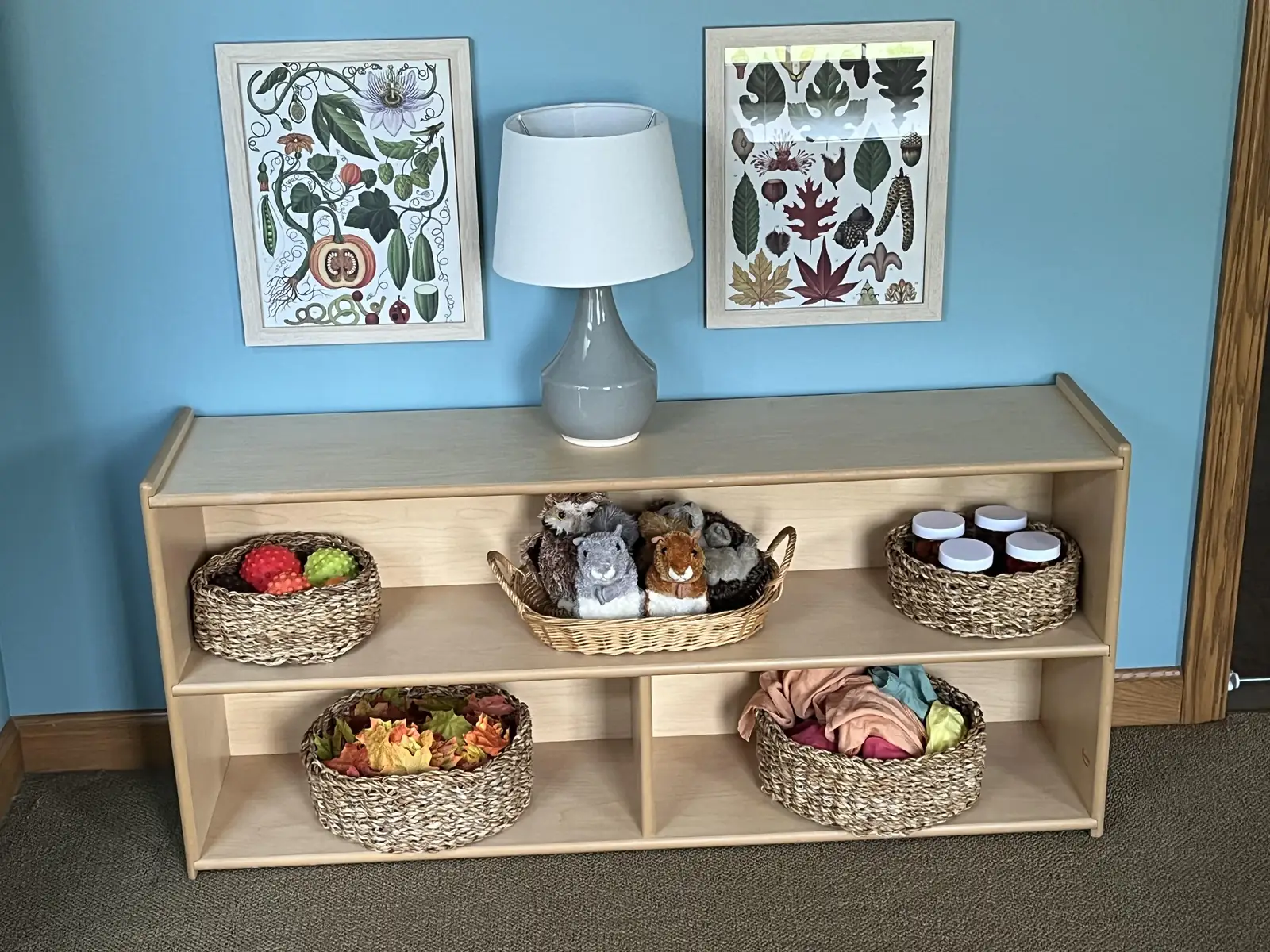
A shelf with only a few things on it makes each return easy to notice. Sit down beside your child, say “Look!” once, and show it again.
 Save
One low shelf, a tray, and a toy that comes out slowly is all a presentation needs.
Frequently Asked Questions
How do you present Montessori materials?
Present Montessori materials one at a time: bring the material to a tray or mat, say “Look!”, show the movement slowly with very few words, then slide it to your child and step back. At home, keep it short, and let your child stop you as soon as they want to try it themselves.
How do you present a Montessori lesson?
A Montessori lesson at home is really just a presentation: one short, quiet demonstration of one skill, like dropping a ball into a box or pouring water into a cup. Break the movement into small parts, go slower than feels natural, and save your words for afterward. No script or lesson plan needed.
Conclusion
The next time a box shows up on your doorstep, try one thing differently. Count slowly in your head while you show the toy, then sit still and watch what your baby does with it. Some days they’ll copy you move for move. Some days they’ll find a pot to bang on. Both are a toy doing its job.
Be gentle with yourself on the days you talk too much. Slow down next time, sit back, and enjoy watching what they figure out.
Miri
Fewer toys, deeper play.
Further Reading & Resources
See all 9 sources
- Montessori background: Tips for Montessori activities and Montessori storage and toy rotation (Simone Davies, The Montessori Notebook) · Dr. Montessori’s Own Handbook (Maria Montessori, Project Gutenberg)
- Montessori terms: Control of Error and Freedom (Association Montessori Internationale glossary) · The Importance of a Simple Environment (American Montessori Society)
- Research: The Double-edged Sword of Pedagogy: Instruction limits spontaneous exploration and discovery (Bonawitz et al., Cognition, 2011)
- Safety: Home Safety: Tips for Families With Young Children (American Academy of Pediatrics, HealthyChildren.org) · Small Parts (U.S. Consumer Product Safety Commission)