
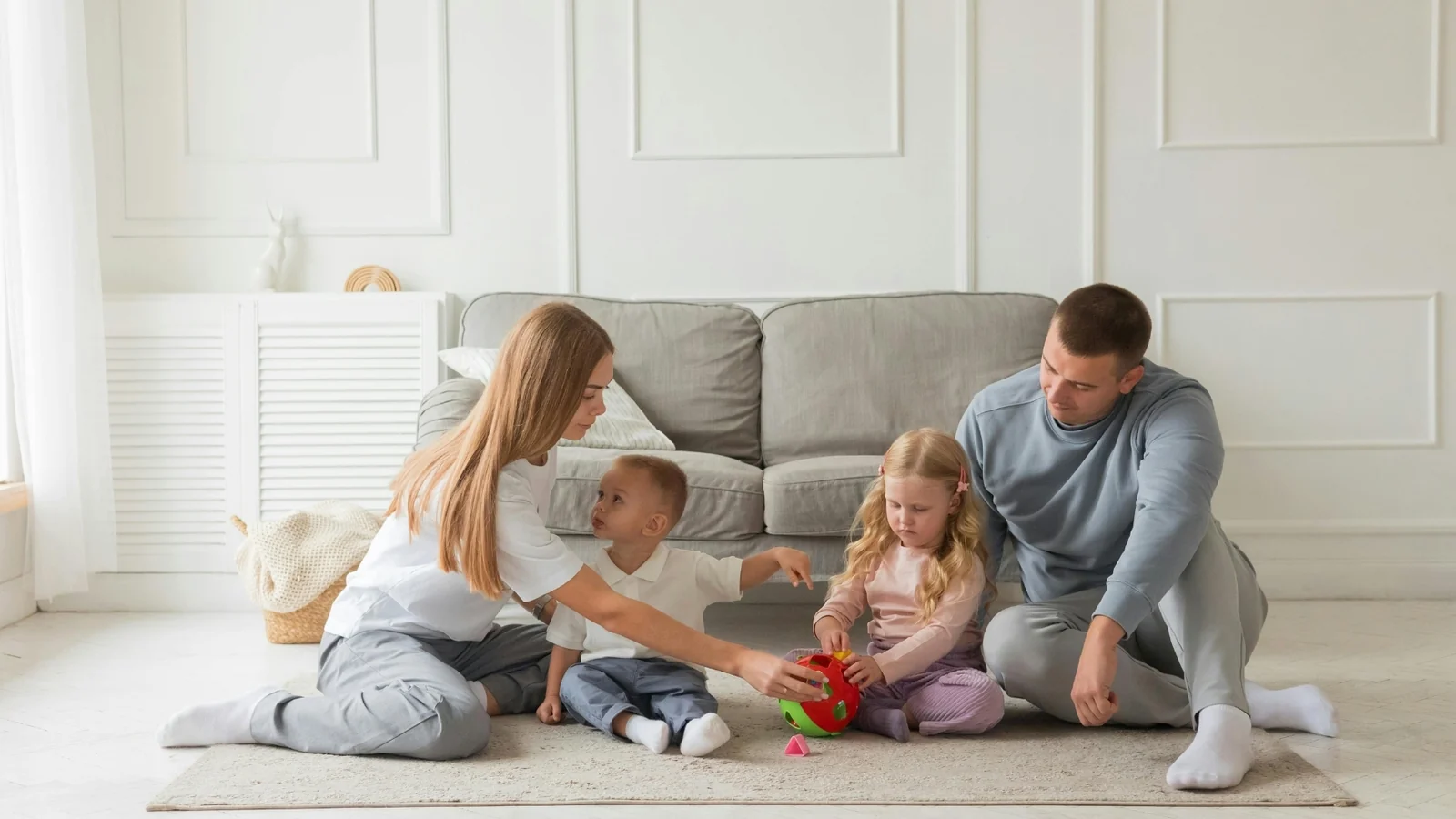
Your toddler has parked a dump truck on the coffee table. There’s a basket of board books tipped over by the couch, a stroller taking up half the hallway, and one tiny sock under the armchair that nobody can explain. Meanwhile, the Montessori playroom you keep picturing has a whole room to itself: pale wood, one low shelf, a big rug with almost nothing on it.
You look around. There’s no spare room. Some days there’s barely a spare corner.
So the playroom turns into a someday project, waiting on more space, matching furniture and a free weekend with a paintbrush. Until then, it can feel like Montessori belongs to people with bigger houses.
It starts much smaller than the photos suggest. One shelf your child can reach, a patch of open floor, a few toys that each have a home. Our house isn’t huge, and Will doesn’t have a playroom. His corner is in the living room, right where the rest of us are. I’ll show you where to start and what’s worth buying, then walk through the rest of the house one corner at a time: sleep, meals, getting dressed, books.
One low, open shelf and one rug in the room your family already lives in — the American Montessori Society suggests open shelves at your child’s eye level and fewer toy choices at home.
you’re about to buy a full matching set of “Montessori” furniture before you’ve seen what your child actually plays with. Watch first, then offer.
What is a prepared environment in Montessori?
A prepared environment is a space an adult sets up so a child can do things on their own: child-sized, within reach, orderly, and holding only what’s needed. Montessori classrooms are built this way, and at home it can start with one corner.
The phrase comes from the classroom. The Association Montessori Internationale (AMI) describes the prepared environment of a Montessori classroom as one the adult gets ready for the children, with “all the essentials for optimal development but nothing superfluous.” Everything in it is child-sized, to help children do things on their own.
The American Montessori Society (AMS) describes its infant and toddler programs in the same spirit: “Furniture and learning materials are child-size. Everything needed to complete tasks and achieve success is accessible.” Children get freedom within limits, “always in the presence of an adult.”
Maria Montessori had a short way of describing the order part. In The Secret of Childhood, quoted in AMI’s glossary entry on order, she described it as “things in their place.” She meant a child knowing where each object belongs, so they can find their way around their own surroundings. She called the love of order “a vital need at a certain age.”
Those are classroom descriptions. At home, I turn them into a quick test for any corner: can your child reach it, use it and put it back where it lives? If the answer is yes, you’ve got the heart of it. The wider philosophy lives in Montessori at home, and this guide sticks to furniture and floor space.
 Save
At Moje Montessori, we rate each idea by how much evidence stands behind it, so you can see which parts come from research and which come from Montessori philosophy.
| Idea | At home, it looks like | What it’s meant to do | Evidence |
|---|---|---|---|
| Fewer toys out at once | A short row of toys on the shelf, the rest put away | Longer play, and more ways of playing with the toys | Some research |
| Everything has a place | Each toy on its own tray, in its own spot | Helps a child know where things are and put them back | Montessori philosophy (not tested at home) |
| Child-sized and within reach | A low open shelf, a small chair, low hooks | Builds independence, so a child can do more without asking an adult | Montessori philosophy (not tested at home) |
| Room to move | Open floor around the play corner | Freedom of movement and choice, which AMS ties to development | Montessori philosophy (not tested at home) |
“Backed by research” means studies with babies or toddlers support that piece. “Some research” means part of it is supported. “Montessori philosophy (not tested at home)” means there’s little or no research on it in family homes yet.
Do you need a separate Montessori playroom?
No. A corner of the room your family already lives in is enough for a baby or toddler, and it comes with a bonus: your child can see you while they play, and you can see them.
A lot of the photos you’ve saved show a Montessori-inspired playroom built in a spare bedroom. Nothing wrong with that. The ideas underneath travel well, though, and a reachable shelf with a grown-up nearby fits into a living room or the end of a dining area just as easily.
That last piece, the grown-up nearby, is the one I’d protect first. A toddler can keep playing while you cook, and you don’t have to keep walking down the hall to check on them.
Our playroom is the living room
We live in a single-family house in Colorado that isn’t huge. It has a basement, which helps, and three bedrooms: ours, Will’s, and one we’re getting ready for his baby brother. None of them is a playroom. This is what we did instead.
- Step 1: Move out what you rarely use. Our less-used things live in the basement, so the shared rooms stay open, with space for a toddler to run around. No basement? A closet shelf or a lidded bin under a bed does the same job.
- Step 2: Give the shelf the best spot. Will’s two-tier wooden shelf sits in the prettiest part of the living room, so he can play and still see me cooking in the open kitchen or folding laundry on the couch.
- Step 3: Keep the corner small. One shelf, one small rug. That’s the whole playroom.
If you’re working with less space than we have, there are more small playroom ideas for apartments and shared bedrooms.
 Save
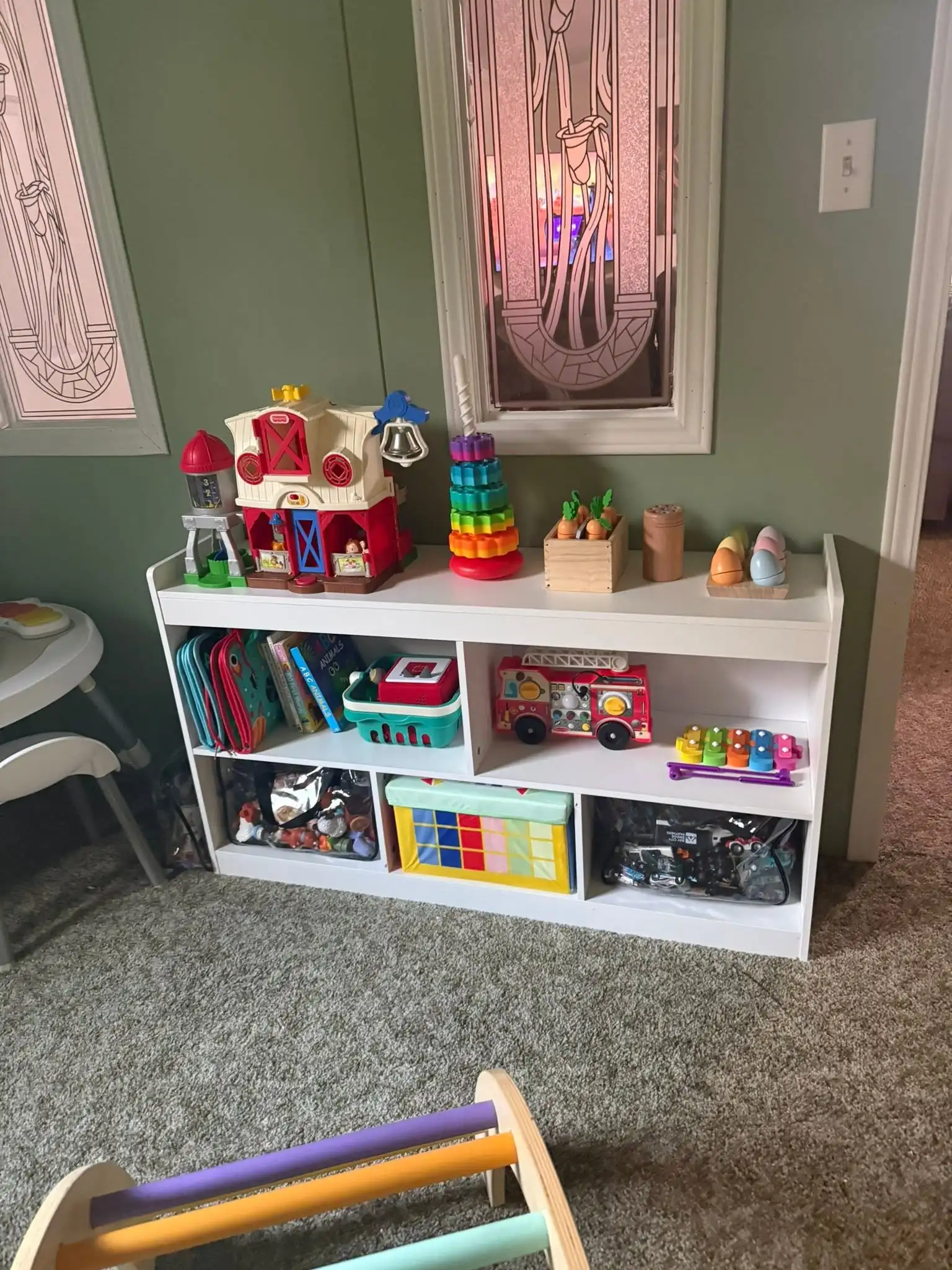
Worried that toys in the living room will turn it into a rainbow-colored daycare? Keep 6–8 things on the shelf and one small rug under the play. That’s been enough to keep our corner tidy and looking like it belongs with the rest of the room.
Miri’s Tip
How to set up a Montessori playroom at home
Pick a spot in a room you use every day, put one low, open shelf against the wall, lay a rug in front, set out a few toys with a home for each, and anchor the shelf before the first toy goes on.
You can do most of this in an afternoon, with things you may already own. In order:
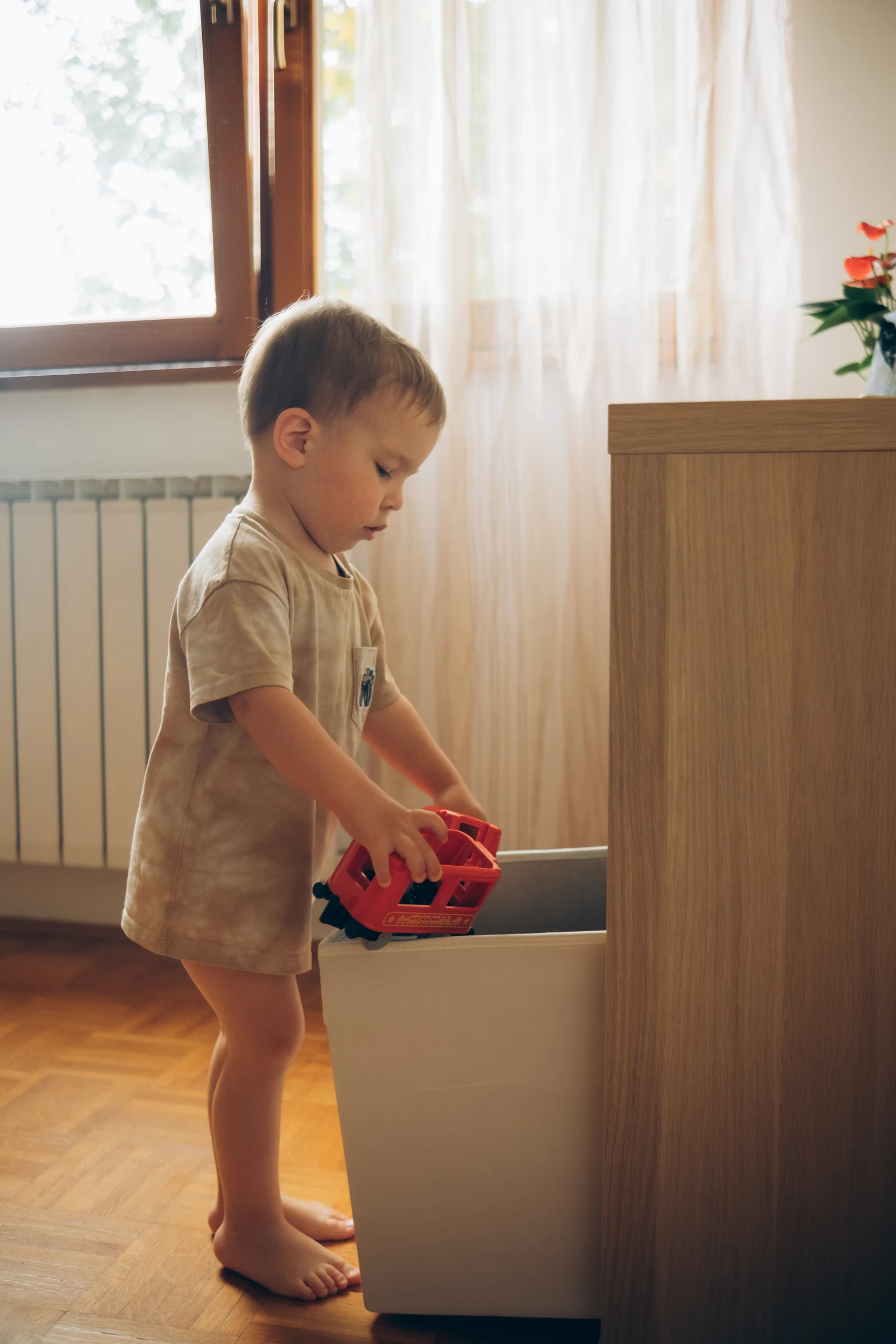
- One low, open shelf. For families, AMS suggests open shelves at your child’s eye level for easy access and tidying. Ours is a two-tier wooden shelf, about 16 to 20 inches tall, which came up to about Will’s hip when he stood beside it. Children grow fast, so stand yours next to any shelf you’re considering and watch them reach the top.
- A rug and some open floor. AMS infant and toddler programs treat freedom of movement and choice as support for a child’s development. At home, the rug marks where play happens, and the floor around it gives your baby room to roll, crawl and cruise. A whole area where they can touch everything safely is called a yes space.
- Fewer toys than you think. In one small study, 36 toddlers played in two setups, one with four toys and one with sixteen. With fewer toys, they played for longer stretches and found more ways to play with what they had. An article on the AMS site suggests tucking away 30% to 50% of a child’s toys, because children may become more interested in what’s left on the shelf. Bringing them back out is toy rotation.
- A place for everything. AMS also suggests sorting small items into trays or baskets. Ours are small wooden trays and rattan baskets. When each one goes back to the same spot, your child learns where things live, which is “things in their place” at toddler height.
- Anchor it. Even a low shelf gets fixed to the wall before the first toy goes on. Then run through the short babyproofing list below.
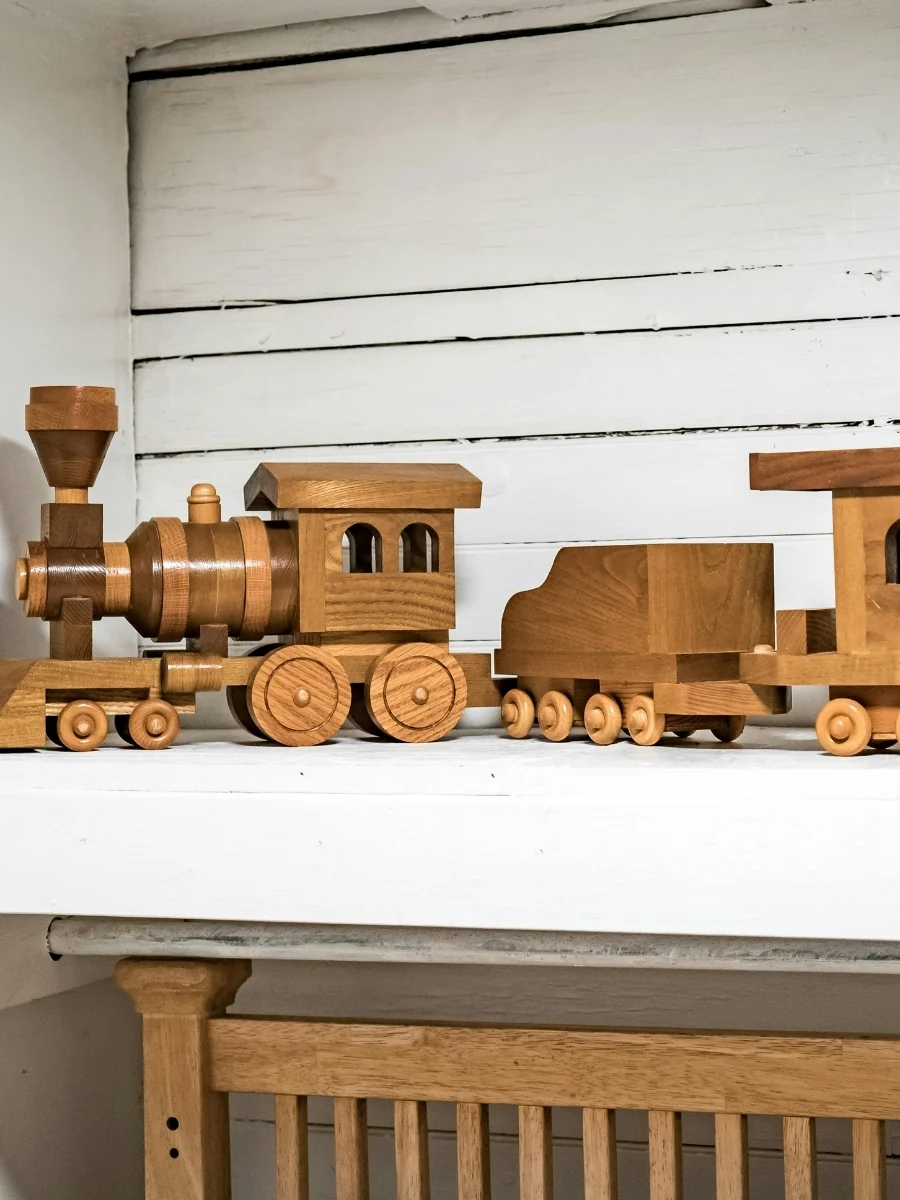
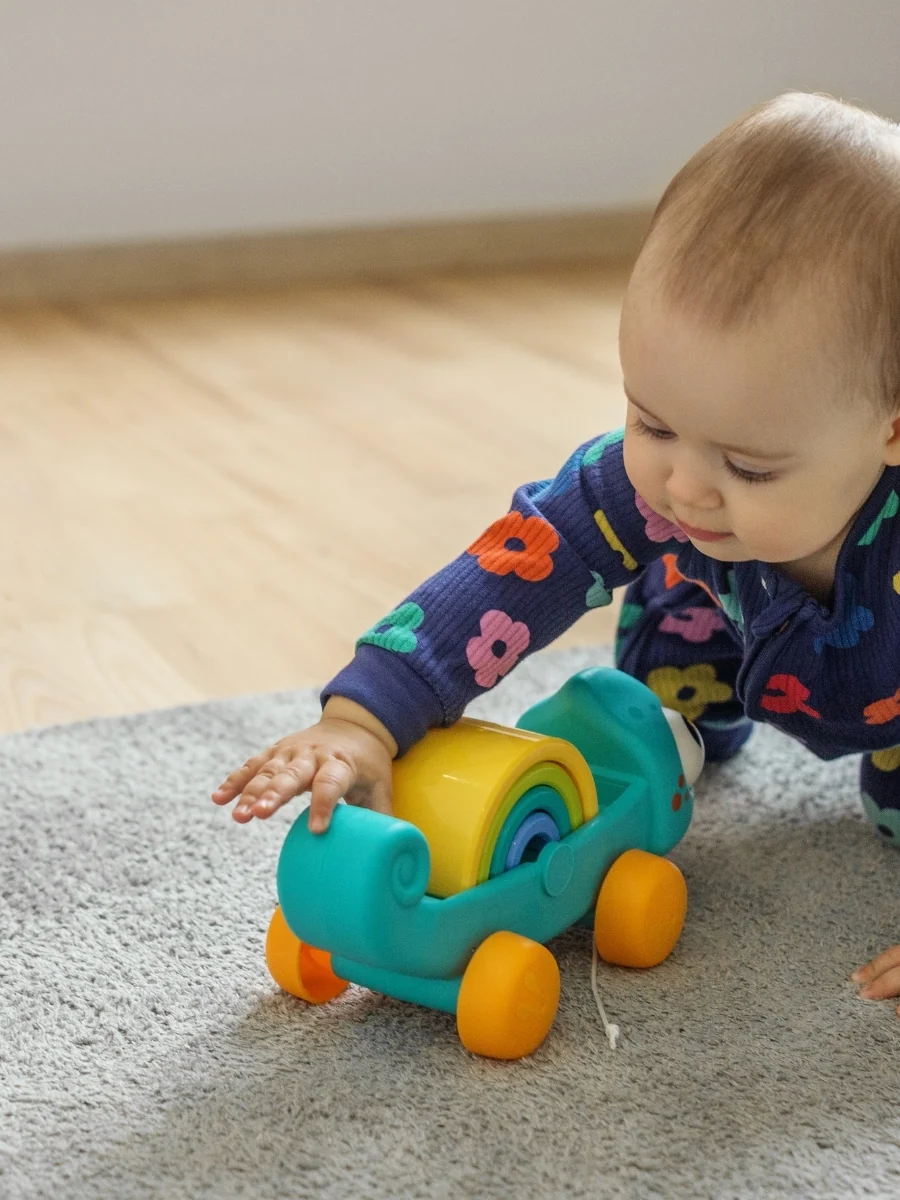
One wooden toy with space around it is easy to notice and easy to pick up. Give them a little open floor and see where they take it.
Anchor every shelf, bookcase and dresser to the wall with an anti-tip kit, including the low shelf in your play corner, and keep heavier things on the bottom. In a 2024 news release, the U.S. Consumer Product Safety Commission (CPSC) called furniture and TV tip-overs a deadly hazard and said children make up most of those deaths.
Once your child is crawling or learning to walk, gate both the top and the bottom of any stairs. The American Academy of Pediatrics (AAP) recommends gates firmly mounted to the studs and says to avoid accordion-style gates, which can trap an arm or a neck. Use non-choking-hazard plugs in unused outlets, and keep cords out of reach and sight.
What’s worth buying, and what to skip
Montessori playroom furniture is where budgets quietly go sideways. A matching set looks lovely, and it’s also the fastest way to spend money before you know what your child will use. Save your money on the set for now.
The accountant in me spends in this order: shelf and rug first, then nothing for a few weeks while you watch what gets played with. After that, add only what solves a real problem. If space allows, AMS suggests child-sized tables and chairs for meal preparation, snacks and clean-up. Some families also use a small table like that as a weaning table. It’s lovely to have, and it can wait until you’ve seen whether your child would actually sit there.
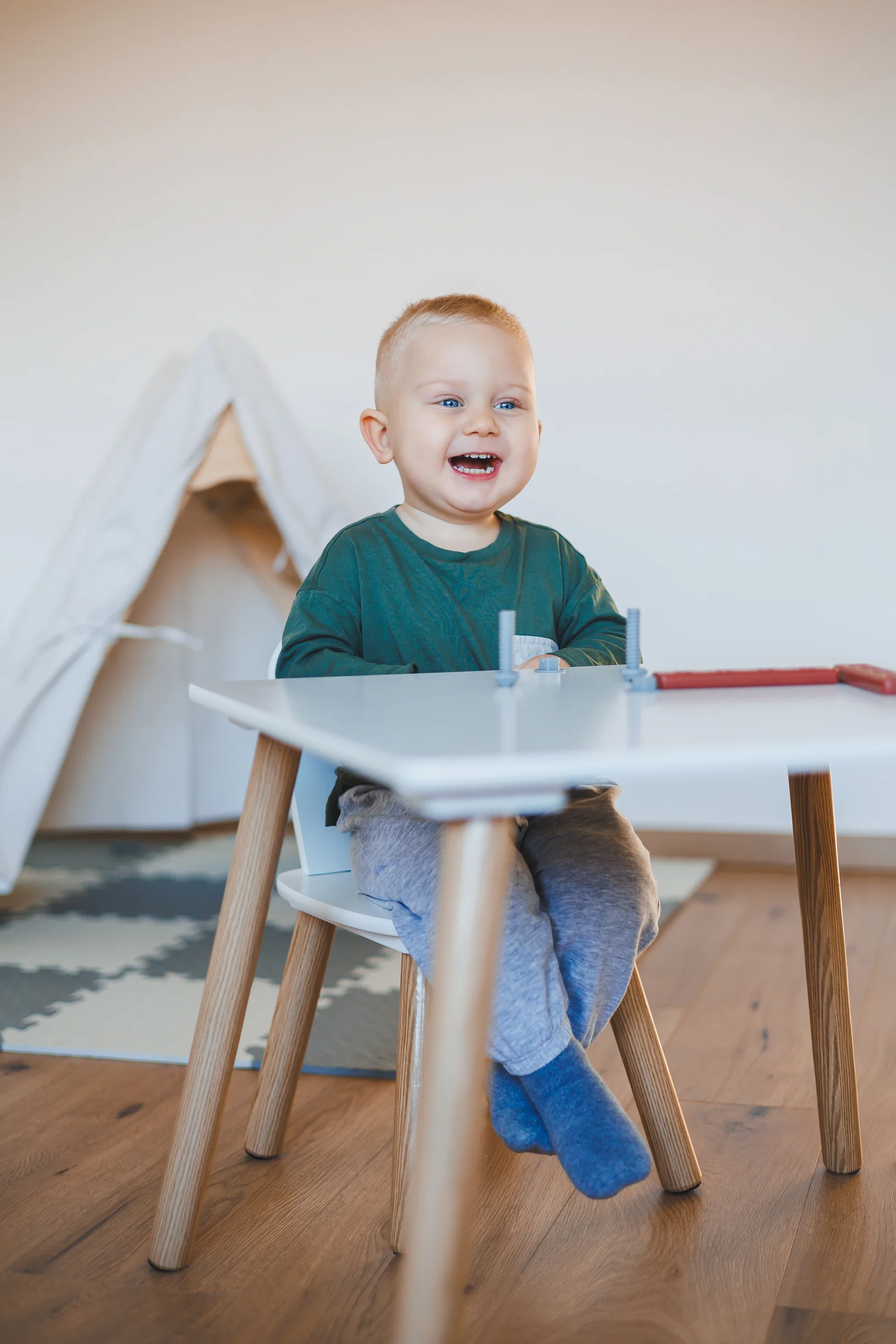 Save
A word on plywood, since it comes up a lot when you shop for shelves. Ours is birch plywood. Hardwood plywood and MDF both count as composite wood under an Environmental Protection Agency (EPA) rule, and composite wood made or imported for sale in the US since June 1, 2018 has had to meet formaldehyde emission limits. So ask the maker one question: which formaldehyde standard do the panels meet? A clear, specific answer tells you they know their materials.
Shelf and rug first. The rest of the room can wait until your child shows you what they need from it.
Our Montessori home setup, room by room
Our Montessori home setup is five small corners at Will’s height, spread across three rooms, and none of them took a renovation: a shelf, a mattress, a tower, a low rod and a few books.
This is the map of our house, the way I’d describe it to a friend at the front door. If there’s such a thing as a Montessori playroom design for a regular house, this is ours. Each row is one corner, and the full story lives in the guide in the last column.
| Room | The corner | What’s in ours | Read next |
|---|---|---|---|
| Living room | Play corner | A two-tier, light wooden shelf, about 16–20 in. tall, with 6–8 things on trays or in small baskets and one small rug | The Montessori shelf |
| Living room, by the big window | Reading nook | A low front-facing wooden bookshelf with 6–8 books, covers out, over a soft rug, anchored to the wall | Front-facing bookshelves |
| Will’s room | Floor bed | A firm mattress, about 4 in. thick, right on the floor. We moved Will from the crib at about 14 months, after making the whole room safe | Montessori floor beds |
| Will’s room | Self-care station | An open wardrobe with a low rod, two fabric drawers, low hooks and an acrylic mirror on the wall beside it, the whole corner about 35–39 in. tall | The Montessori wardrobe |
| Kitchen | Learning tower | A wooden tower with a rail across the back, climbed only with an adult standing right beside it, and pushed into the corner by the fridge when we’re done | Learning towers |
Some of these line up neatly with AMS’s advice for families: low-hanging clothes in the closet so young children can choose and put away their own, and a stool near the counter so they can help with washing dishes and food prep. Our tower is our version of that stool. The reading nook might be the easiest corner to justify, since the AAP recommends that pediatricians encourage shared reading beginning at birth and continuing at least through kindergarten.
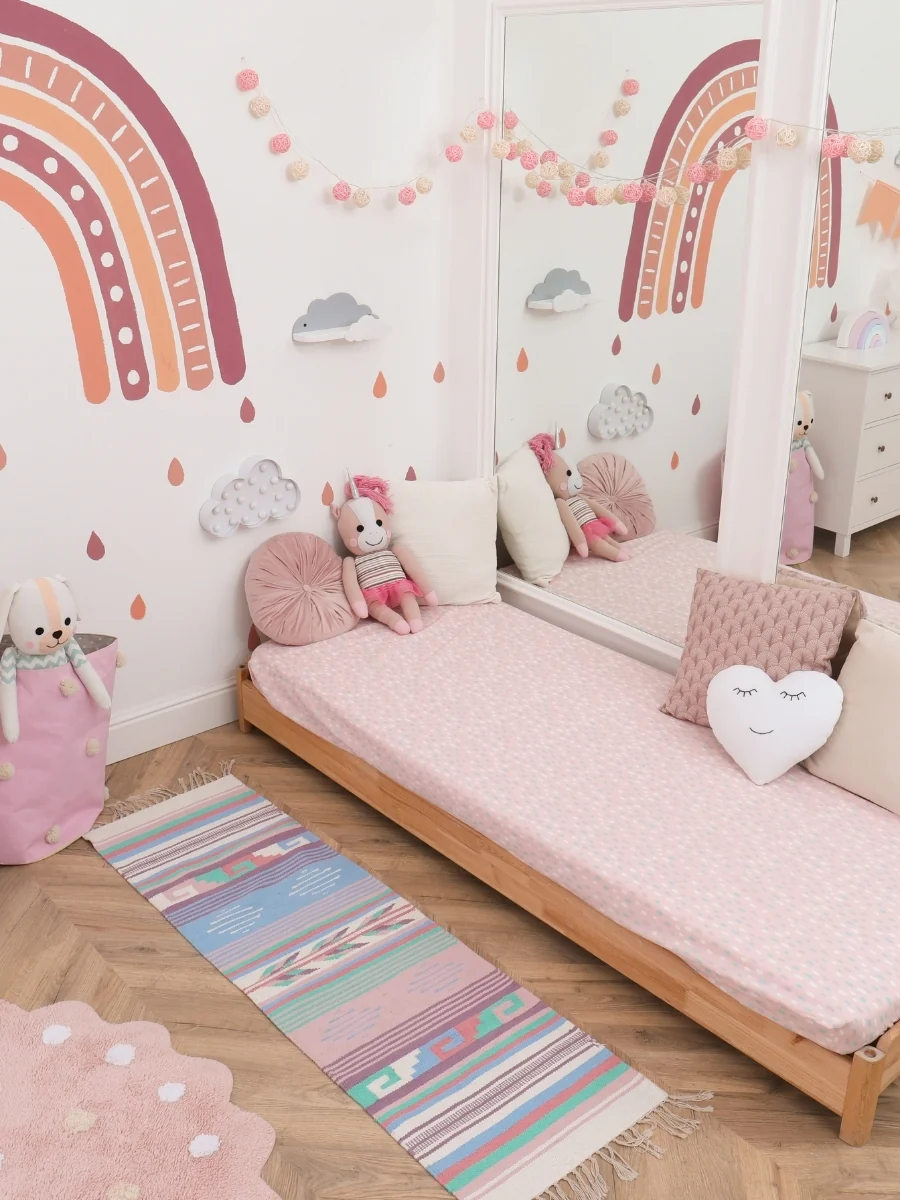
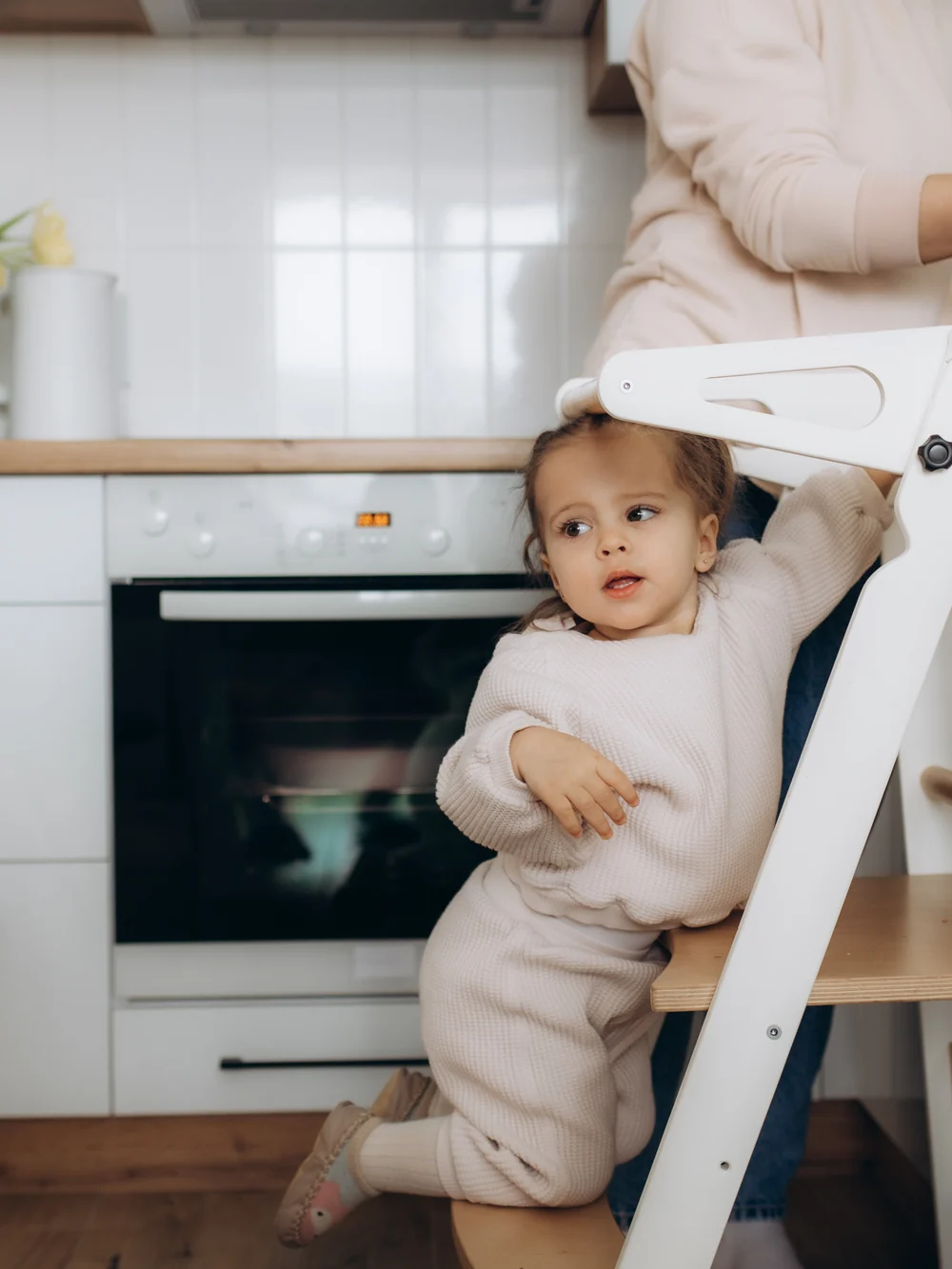
With a floor bed, the whole bedroom needs to be ready for a child who can get up and wander. At the counter, the tower is for climbing only with a grown-up right there.
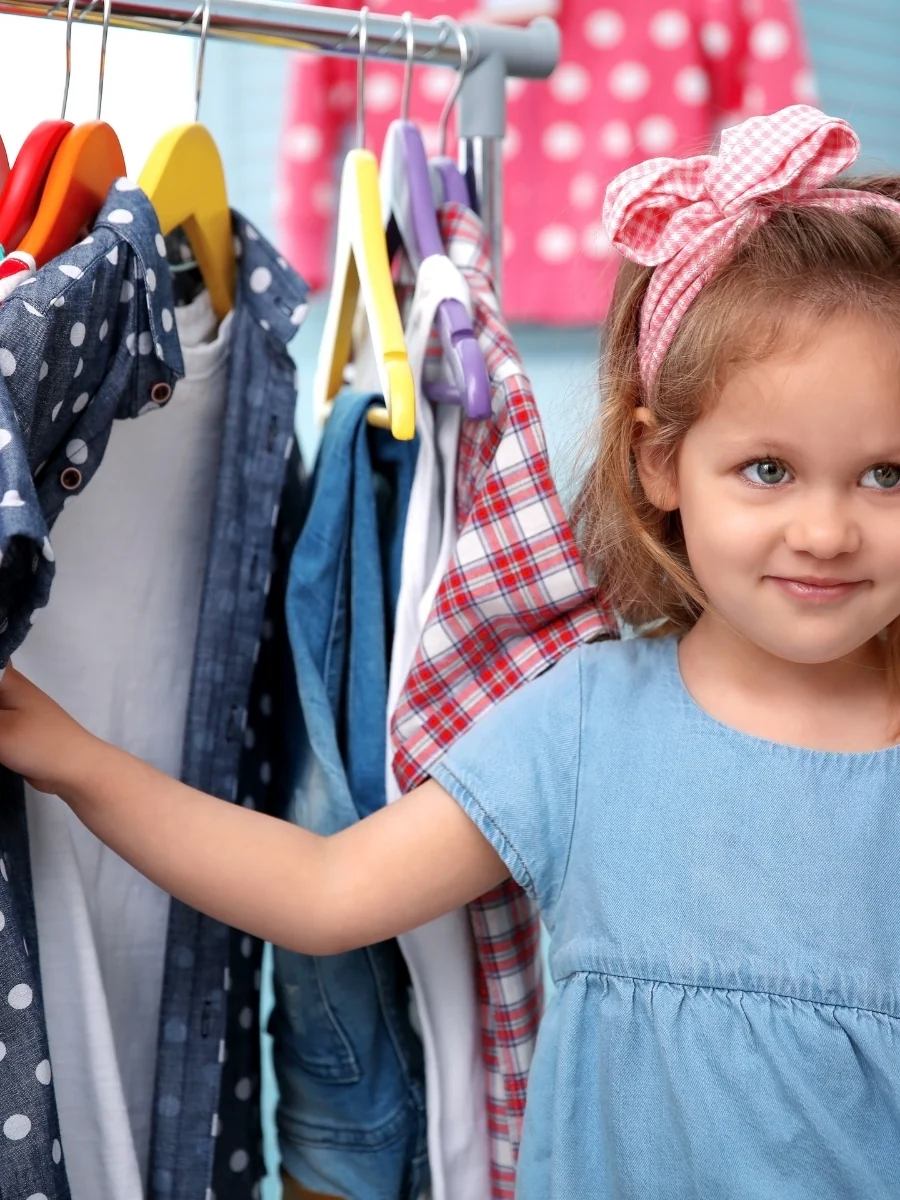
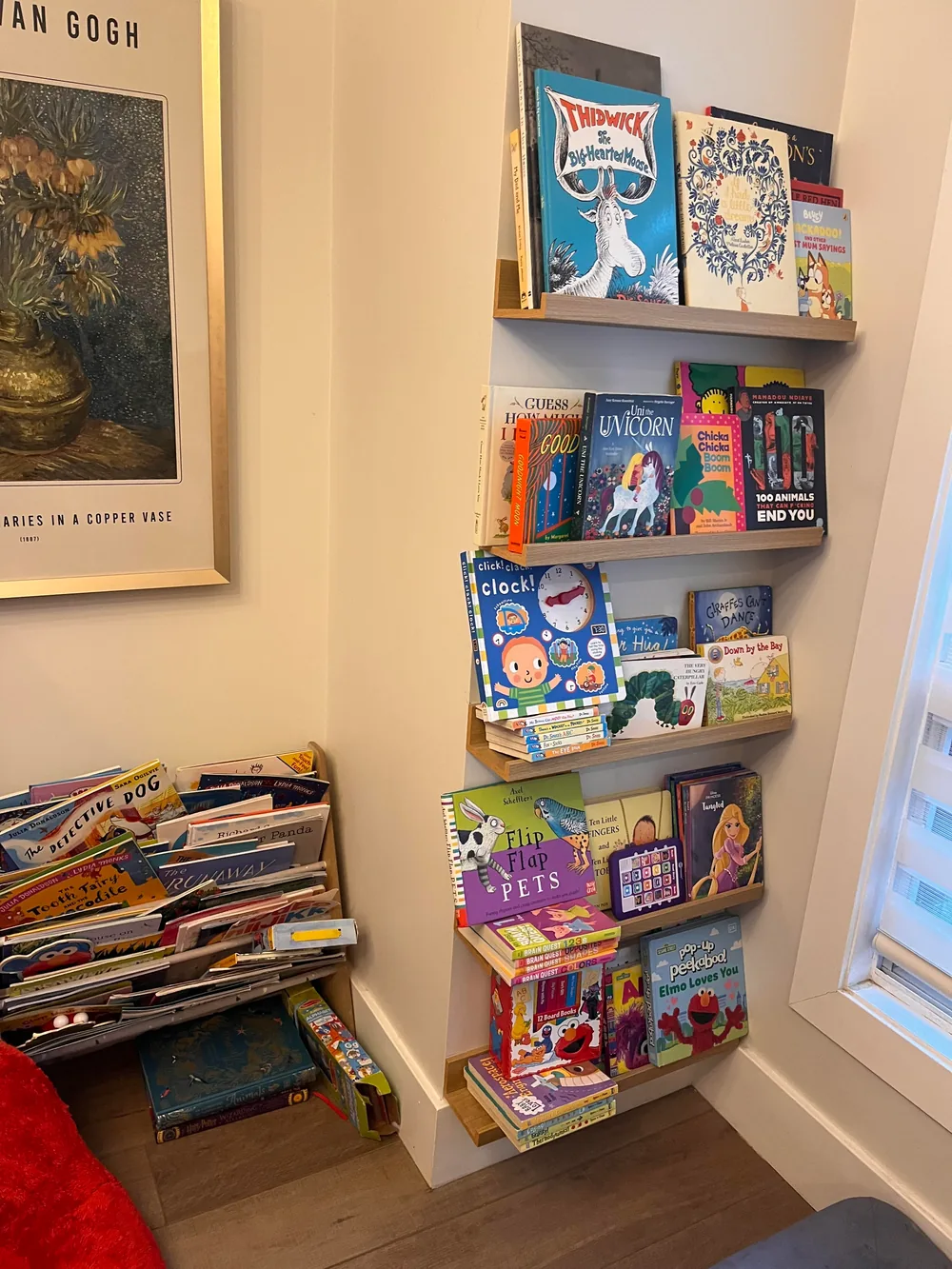
Clothes hung where a child can see and reach them make dressing a little more their own. Books with their covers facing out make a small reading corner a child can see and reach.
You’ll notice the table has no age column. I haven’t found a good source that maps a home by month, so each guide handles the ages for its own corner, including when a floor bed or a tower makes sense. Two more guides fill in the gaps: setting up a Montessori nursery before the baby arrives, and a Montessori corner at the grandparents’ house.
Which toys promote engagement in a Montessori playroom?
In a Montessori playroom, the toys that hold attention are few and fit what your child is working on right now. Round them out with other kinds of work: a real job, a book, one new thing at a time.
Most Montessori playroom ideas worth copying are cheap ones. Before you buy anything, look at what’s already on the shelf and ask whether your child is still working on it. A toy that keeps getting chosen has more to give. One that sits untouched day after day can take a break in the closet.
When the shelf looks a little bare to you, it probably looks just right to your toddler.
Age matters more than brand. A baby who’s just pulling up to stand and an older toddler who wants to pour their own water need very different shelves, so choose for the child in front of you this month. Wooden toys are my soft spot, with their real weight in a small hand and the low knock when one lands on the floor. Give them the same checks as any toy: loose parts, rough edges, anything small enough to choke on.
Variety comes from more than toys. AMI describes practical life as everyday work like dusting, sweeping and laying a table, and says it builds coordination while asking for patience and focused attention. AMI is describing a classroom, but a toddler’s version at home might be rinsing fruit with you at the counter or wiping up their own spill. Books count too, and so does one new toy at a time, brought out the way a Montessori presentation does it.
 Save
When you’re ready to add furniture, add it one corner at a time, starting with the corner your child uses most.
Frequently Asked Questions
How do you design a Montessori playroom?
Design a Montessori playroom around one low, open shelf against a wall, with a rug in front and open floor beside it. Give every toy its own tray or basket and its own spot, keep the choices few, and anchor the shelf. AMS suggests the same basics for homes: open shelves at eye level, trays and baskets, and rotating the extras.
How do you make a Montessori playroom?
Make a Montessori playroom with what you already have: one anchored shelf, one rug and the toys in your house right now. An AMS article suggests tucking away 30% to 50% of them, since kids may become more interested in what’s left. Give the rest a spot each. A small home and a small budget are plenty to start.
Conclusion
You don’t need a bigger house or a matching set to start. This week, pick one corner of the room you already live in, clear it, and give it a low shelf and a rug. Put out a few things your child already loves, each with its own spot, and give yourself a couple of weeks to find your groove. When you’re ready for the next step, start with picking the shelf itself.
Whatever your corner looks like by Sunday, it counts. A low shelf in a busy living room is a real Montessori space, and you built it.
Miri
Fewer toys, deeper play.
Further Reading & Resources
See all 11 sources
- Montessori background: Prepared Environment, Order and Practical Life Exercises (Association Montessori Internationale glossary) · Montessori Infant and Toddler Programs (American Montessori Society)
- Montessori at home: Montessori at Home and The Importance of a Simple Environment (American Montessori Society)
- Research: Dauch et al., 2018 (Infant Behavior & Development)
- Home safety: Ahead of Sunday’s Game, CPSC Reminds Families to Tackle the Deadly Hazard of TV and Furniture Tip-Overs (U.S. Consumer Product Safety Commission, 2024) · Home Safety: Tips for Families With Young Children (American Academy of Pediatrics, HealthyChildren.org)
- Reading: Beyond Literacy: Shared Reading Starting at Birth Offers Lifelong Benefits (American Academy of Pediatrics, HealthyChildren.org)
- Materials: 40 CFR 770.10, Formaldehyde emission standards (eCFR)