Three browser tabs, three shelves, and every listing says “Montessori.” One is $49.99. One is $97.99. The third is pale birch plywood, and it’s the one you keep clicking back to. All three look Instagram-worthy. The space you actually have, though, is one stretch of wall between the couch and the window.
What you really want to avoid is buying twice. A shelf so tall your toddler can’t use the top. One so deep that toys drift to the back and disappear. One that tips the first time they hang on it.
In Montessori classrooms, everything is child-sized so children can do things for themselves, and at home that idea usually lands on one piece of furniture first. The shelf is where a lot of Montessori playrooms begin, especially when the “playroom” is a corner of the living room. That’s where Will’s shelf lives, since we don’t have a playroom either. Here’s my pick up front, with the reasons right after.
Piccalio stackable shelf (one tier) — at 16 inches it’s the lowest of the three, and the maker names both the wood and the finish; anchor it to the wall like any shelf.
you plan to stack a second tier and your child can’t reach the top one standing beside it. The same test rules out the 30 1/8-inch KALLAX as a play shelf for a small toddler.
Our picks at a glance
- Piccalio stackable Montessori toy shelfBest for the lowest wooden option of the three1/3 checks
- IKEA TROFAST storage combination with boxes (22 in.)Best for toys that live in pull-out bins1/3 checks
- IKEA KALLAX shelf unit (30 1/8 in.)Best for storage, or a child tall enough to reach the top1/3 checks
Moje checks: the maker names the wood and finish · states US safety testing (ASTM F963) · the toy grows with your child. From public product info, not a lab test.
What is a Montessori shelf?
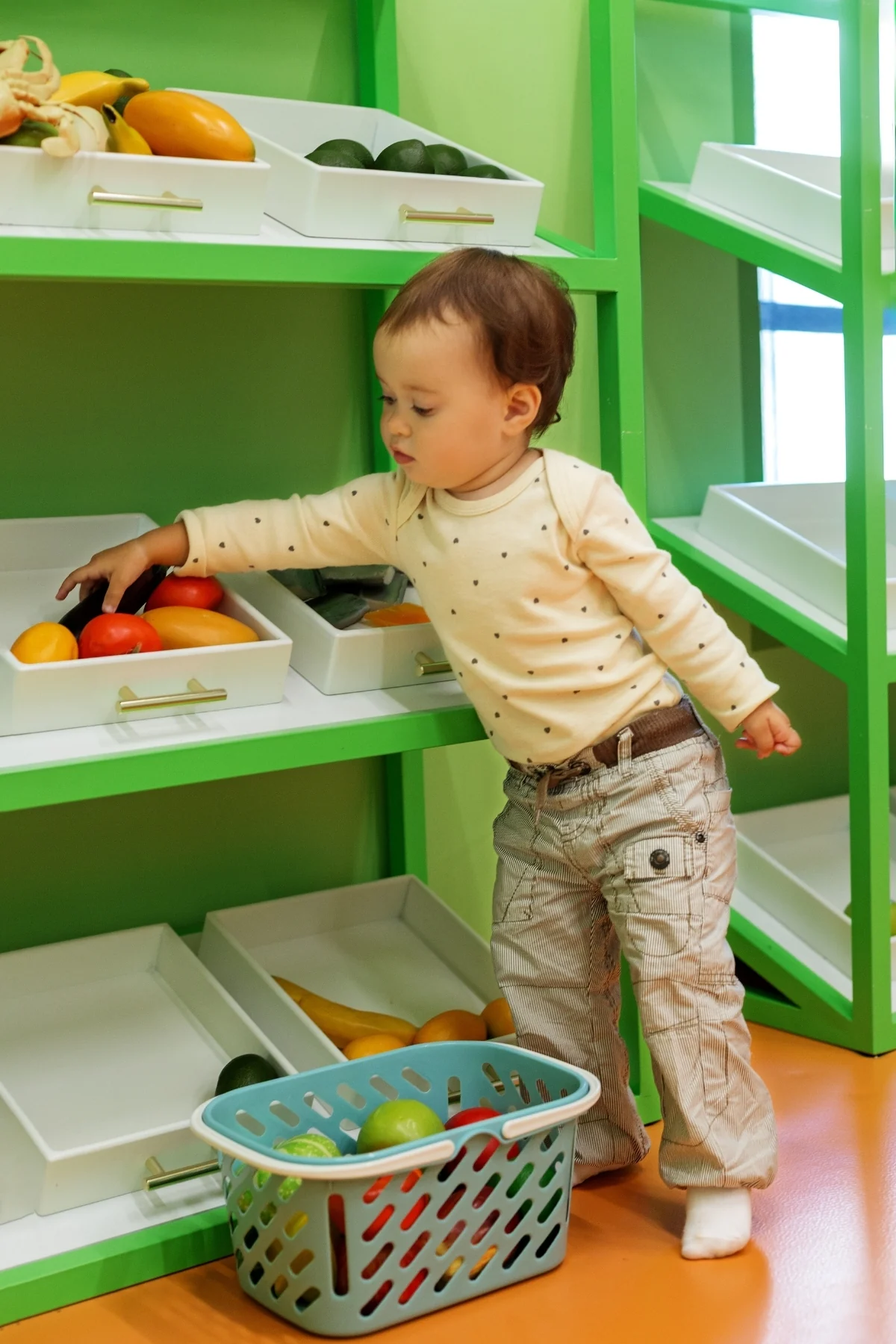
Think of a Montessori shelf as your child’s menu: a few things they’re into right now, set out low and in the open, so they can choose, play and put things back on their own.
The idea comes from the classroom. The Association Montessori Internationale (AMI) describes everything in a Montessori classroom’s prepared environment as child-sized, to support children’s independence. For families, the American Montessori Society (AMS) suggests open shelves at your child’s eye level, a limited choice of toys, smaller items sorted into trays or baskets, and the extras rotated out.
Simone Davies, who writes The Montessori Notebook, describes the same picture: activities laid out on open shelves so children can see what’s available, with only what they’re working to master or interested in right now.
 Save
Then there’s order, which Maria Montessori described in The Secret of Childhood as “things in their place.” On a shelf, your child can see it: the puzzle has its spot, the ball has its basket, and both go back there.
Put together, a Montessori toy shelf does four jobs, and any shelf that does them can work, whatever the listing calls it. At Moje Montessori, we rate each row on how much evidence stands behind it.
| Shelf feature | What your child can do | Evidence |
|---|---|---|
| Child-sized and low | Reach things and handle them without help | Montessori philosophy (not tested at home) |
| Open, at eye level | See what’s there and choose for themselves | Montessori philosophy (not tested at home) |
| Only a few things out | Play for longer stretches, and in more ways | Some research |
| One spot for each thing | Know where it goes and put it back | Montessori philosophy (not tested at home) |
“Backed by research” means studies with babies or toddlers support that piece. “Some research” means part of it is supported. “Montessori philosophy (not tested at home)” means there’s little or no research on it in family homes yet.
How low should a low toy shelf be?
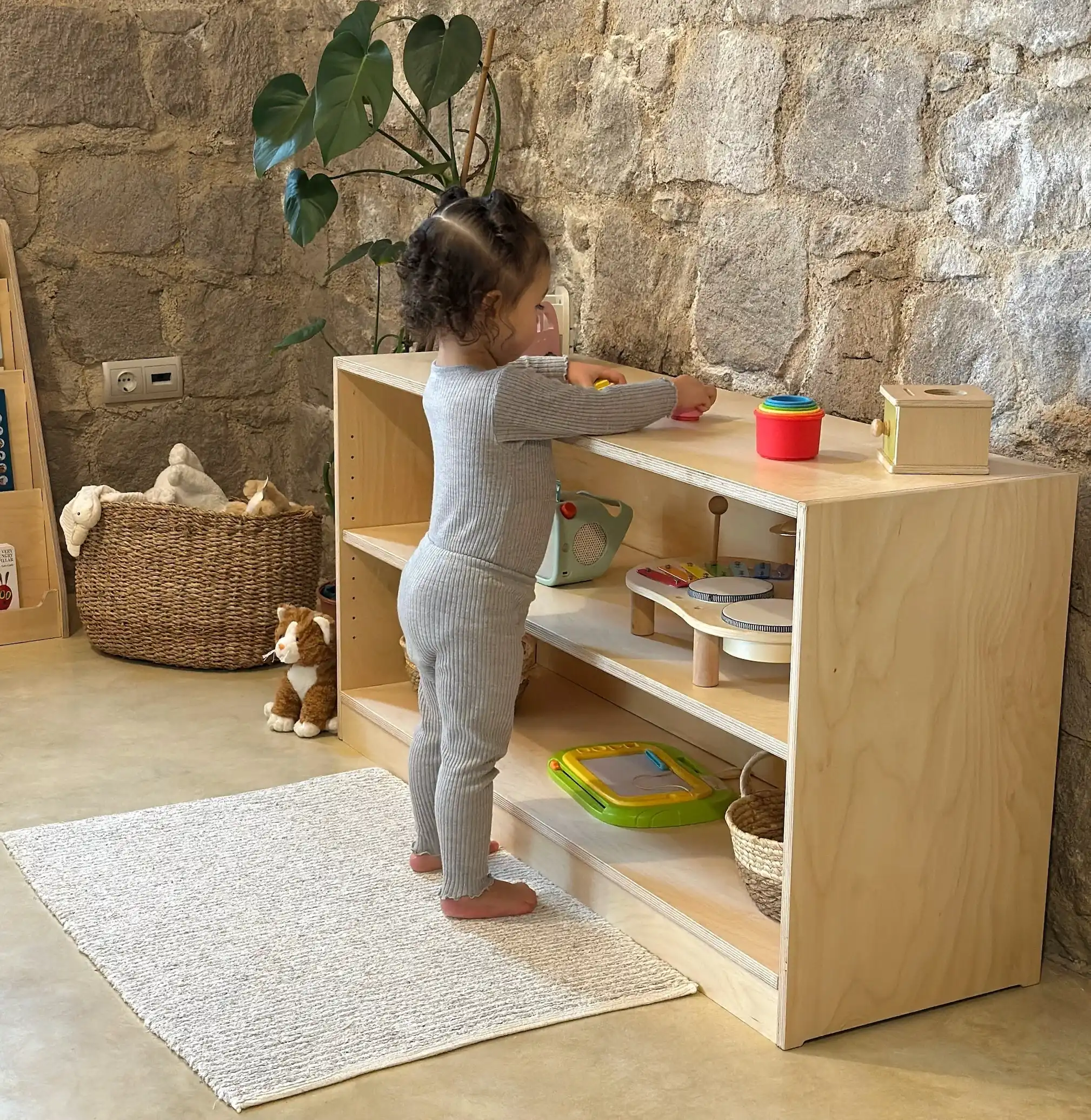
Your child’s hip is the measuring stick. When they stand beside a low toy shelf, the top should sit at about hip height, so both levels are within easy reach without tiptoes or a boost.
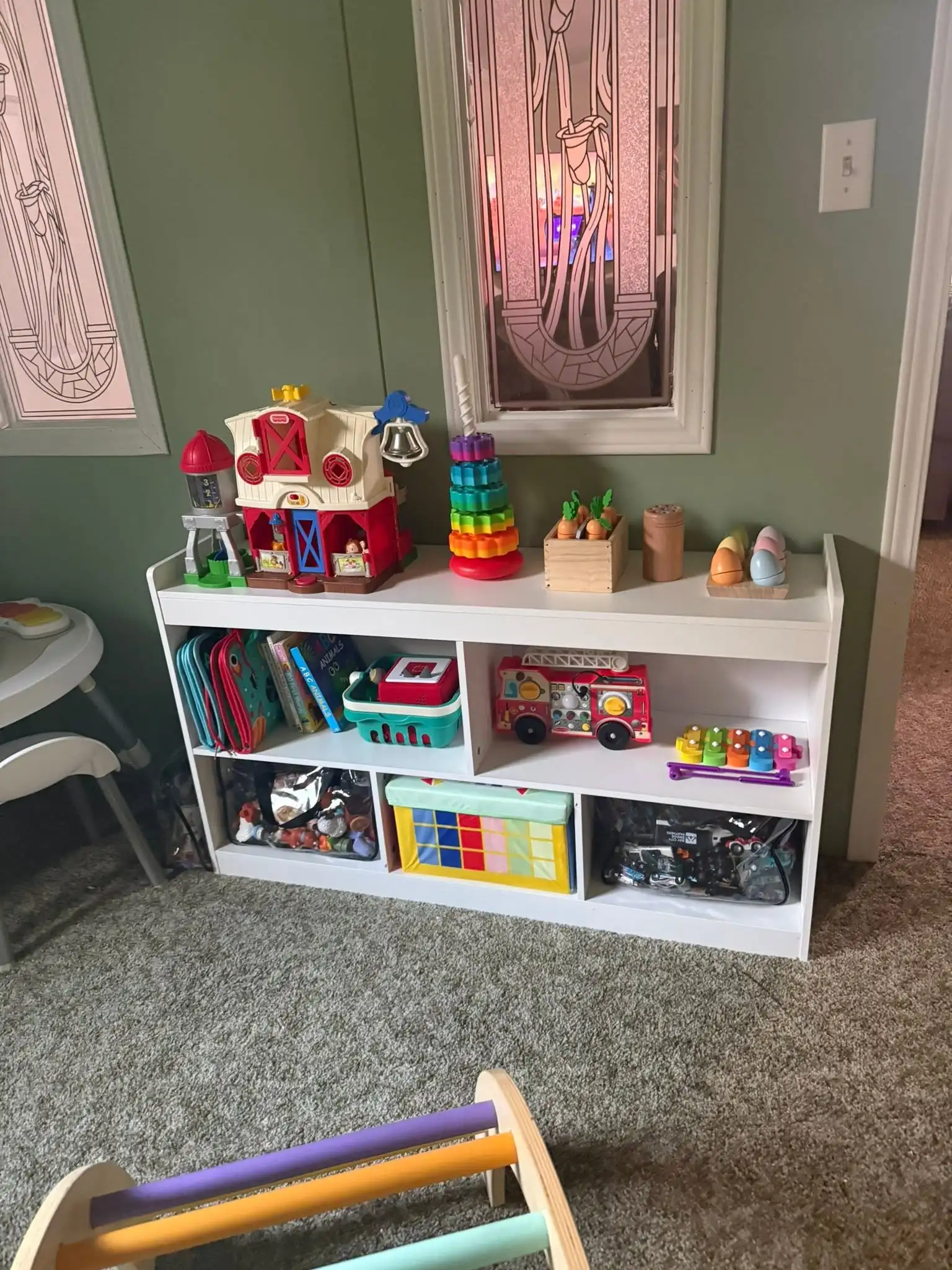
Ours is a two-tier Sprout Kids shelf in light birch plywood, with rounded corners and no doors or complicated dividers. It’s about 16 to 20 inches tall, and that’s a rough range. When Will stood beside it, the top came to about his hip, and he could get anything off either shelf without tiptoeing or calling me over. I picked a light wood on purpose, so the living room would stay calm once the colorful toys went on.
 Save
Your number may come out different, and that’s fine. I haven’t found a reliable chart of shelf heights by age, and children grow at their own pace anyway. A tape measure does the job better: stand your child against a wall, measure from the floor to their hip, and hold that number up against any listing.
The right shelf height is already marked on your child, about where their hip is.
For the three shelves in this guide, the heights are 16 inches for the Piccalio, 22 for TROFAST and 30 1/8 for KALLAX. The top level matters as much as the bottom one. The American Academy of Pediatrics (AAP) warns that keeping toys in high places can tempt kids to climb, and I’d count a play shelf whose top your child can’t reach as one of those high places.
Depth is the quieter number. On a very deep shelf, things slide to the back, where a short arm has to stretch and a toddler stops noticing them. Each depth is in the comparison table below.
Does a low shelf need to be anchored?
Yes. The AAP says to anchor all furniture to the wall, and “all” includes a low toy shelf that only comes up to your child’s hip.
Low feels safe. It’s short, it’s wide, and it looks like nothing could pull it over. But toddlers pull up on shelves and lean on them, and some try to climb them.
The numbers behind that advice are sobering. The U.S. Consumer Product Safety Commission (CPSC) counted 217 deaths from furniture, TV and appliance tip-overs from 2013 through July 2023, across all ages, and children were 71 percent of those deaths. It estimates an average of 17,800 tip-over injuries treated in emergency rooms each year from 2020 to 2022. That’s the most recent data I found, and it covers TVs and appliances along with furniture.
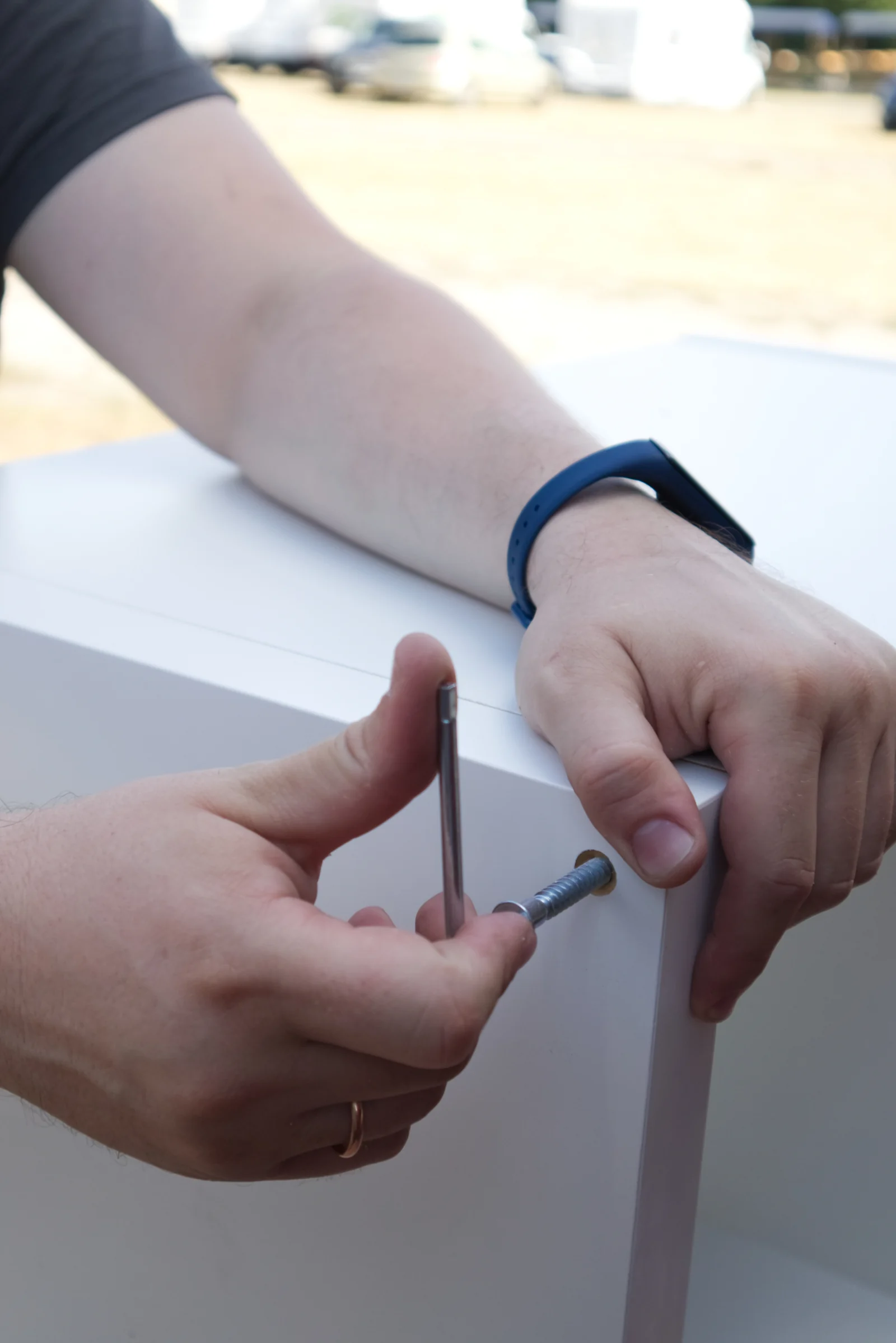
Anchor the shelf to the wall before the first toy goes on, however low it is. The AAP recommends anchoring all furniture to the wall, with the anchors placed in a stud, considering metal hardware such as “L” brackets, and using more anchors the heavier the piece is. The AAP puts anti-tip devices at about $5 to $25 and just minutes to install. Keep heavier things on the lower shelves, as the CPSC advises.
Even IKEA’s own KALLAX page warns that the unit is a tipping hazard and must be securely anchored. If you’ve never anchored furniture before, the CPSC’s Anchor It! steps walk you through it with an anti-tip kit.
 Save
How we chose these three shelves
Three things decided the list: a height a toddler can actually use, a maker that publishes measurements and materials, and a design you can anchor to a wall.
Specs and prices here come from each maker’s product page as of October 12, 2026 (Piccalio’s price was checked on October 19). Prices change, so look again before you order.
None of them is solid wood. The Piccalio is birch plywood, while TROFAST and KALLAX are particleboard and fiberboard. Those are all composite woods, and since June 1, 2018, formaldehyde emission limits for composite wood set by the U.S. Environmental Protection Agency (EPA) have applied to hardwood plywood, particleboard and MDF sold in the US, including when they’re part of a finished product like a shelf. That rule sets a ceiling for the material. It can’t tell you how one particular shelf tested, so if it matters to you, ask the maker which formaldehyde standard its panels meet.
Solid-wood play shelves are out there too. I left them off because I couldn’t check their specs the same way.
Books are a separate story. They do better on a front-facing bookshelf, where the covers show. IKEA’s FLISAT book display, for example, is low, made of solid pine with a fiberboard bottom, and designed so a child can reach the books and see every cover.
Why is the Piccalio stackable shelf my pick?
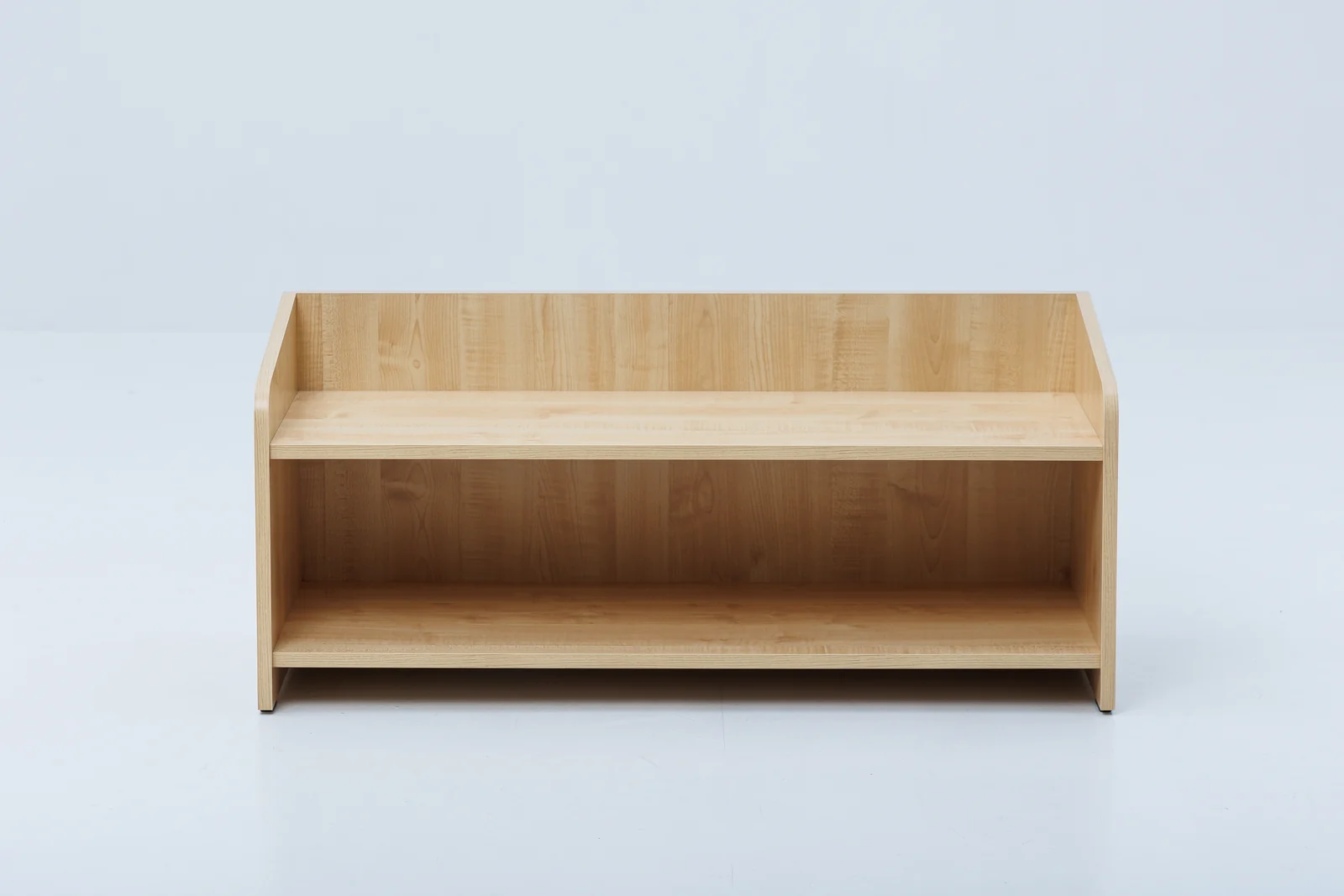
The Piccalio stackable shelf wins on height: at 16 inches, it’s the lowest of the three, and the maker names both the wood, FSC birch plywood, and the finish.
- Wood & finish named
- Safety testing not stated
- Short play window
At 16 inches, it sits right at the low end of our own shelf’s range, the height that let Will help himself. It’s 33 inches wide and 18 inches deep. If you want a Montessori wooden shelf that’s low from the start, this one comes closest.
The maker describes the finish as non-toxic and 0-VOC, and lists ASTM F2057 and F3096, California Prop 65, SGS and GREENGUARD Gold. Those are the maker’s claims, passed along as written. ASTM F2057 and F3096 cover clothing storage units such as dressers and the restraints used with them, so don’t read them as proof that this open shelf can’t tip.
Each tier weighs 15 pounds. That’s the shelf’s own weight; the page doesn’t say how much it holds. Piccalio recommends stacking up to two tiers high, and a second tier makes it taller, so redo the hip test before you stack. On October 19, 2026, the single tier was $169 and the two-tier was $319. That makes the single tier the priciest of the three, so check the current price before you order.
Quick safety check: The product page lists the shelf as recommended from birth, which is the maker’s wording rather than a safety rating, and it doesn’t mention wall anchoring. Anchor it anyway, with a bracket into a stud, the way the AAP describes.
Choose it if your child is small enough that a 22-inch top is still a stretch. If they already reach that easily, TROFAST gives you a wider shelf for the same stretch of wall.
 Save
What is IKEA TROFAST good for?
IKEA TROFAST is good for toys that come in many pieces and live best in a bin, like blocks or train track, and at 22 inches it’s the middle height of the three.
- Wood & finish named
- Safety testing not stated
- Short play window
The version with boxes is 39 inches wide and 17 3/8 inches deep, and it costs $97.99 as of October 12, 2026. The frame is particleboard with paper foil, and the six boxes are polypropylene: three 9 inches tall and three 4 inches tall.
Quick safety check: Treat it like any other shelf and anchor it, as both the CPSC and the AAP advise. Put the heavier boxes in the lower rows.
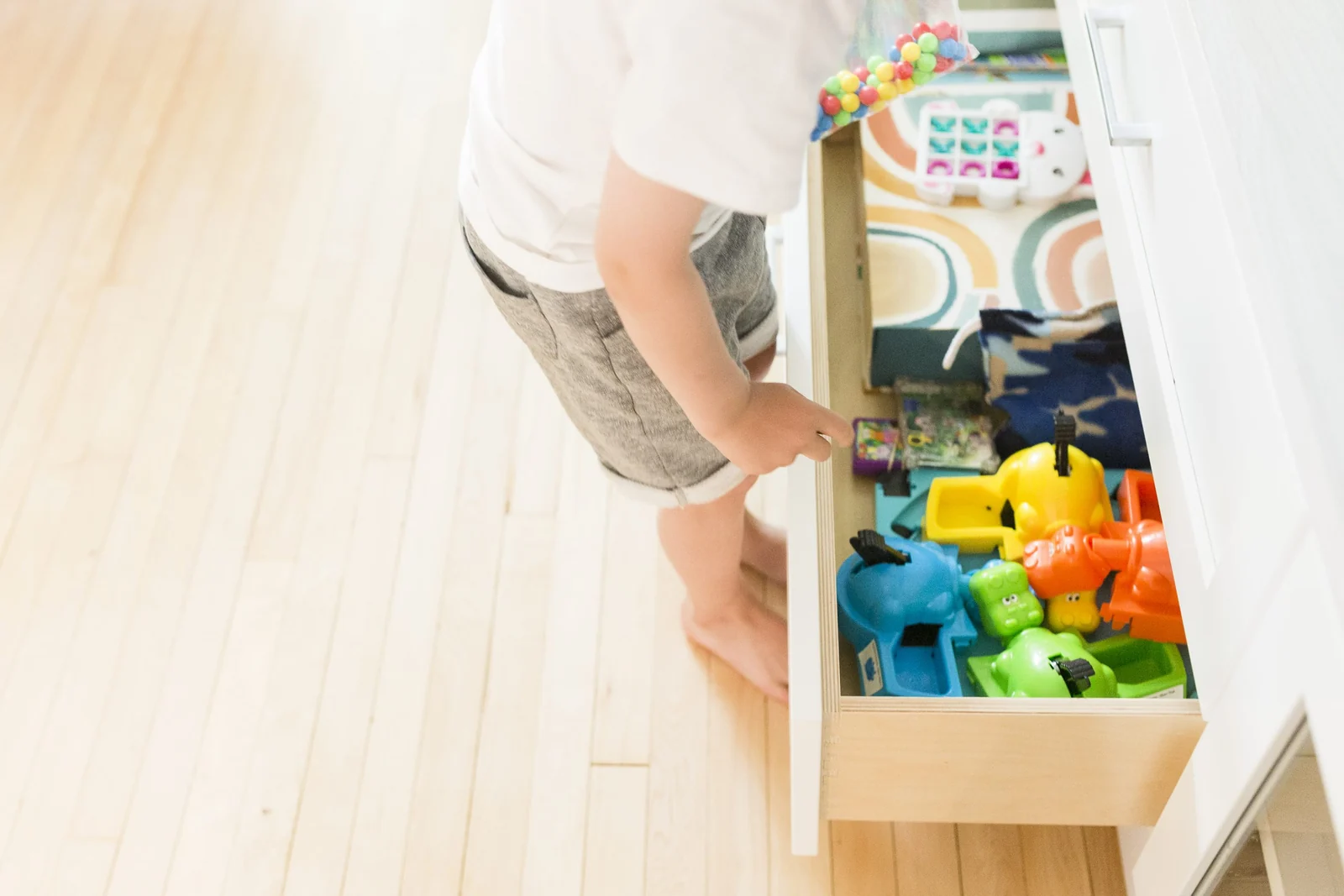
Bins make cleanup fast. Everything goes in, the box slides back, done. The trade-off is that a toy inside a box stays out of sight until your child pulls it out, and seeing what’s there is half of what an open shelf is for. If most of your toys come in sets and your child reaches 22 inches with ease, TROFAST earns its spot. I’d use the boxes for the sets and keep the top surface for a few things out in plain view. If you want every toy visible at a glance, pick an open shelf instead.
 Save
Is IKEA KALLAX a good Montessori shelf?
As a play shelf for a small toddler, IKEA KALLAX runs tall at 30 1/8 inches, so the top may be out of reach. It earns its place as storage for the toys you’ve put away.
- Wood & finish named
- Safety testing not stated
- Short play window
At $49.99 (October 12, 2026), it costs about half what TROFAST does. It’s 30 1/8 inches wide, 15 3/8 inches deep and 30 1/8 inches tall. IKEA lists a max load of 29 pounds per shelf and 55 pounds on top, and the main parts are particleboard and fiberboard with acrylic paint and a recycled-paper honeycomb filling.
The height is my hesitation. If your child can’t reach the top, it becomes a place for things they can’t have, which is close to the high-places setup the AAP warns about. A taller child may reach it fine, so do the hip test first.
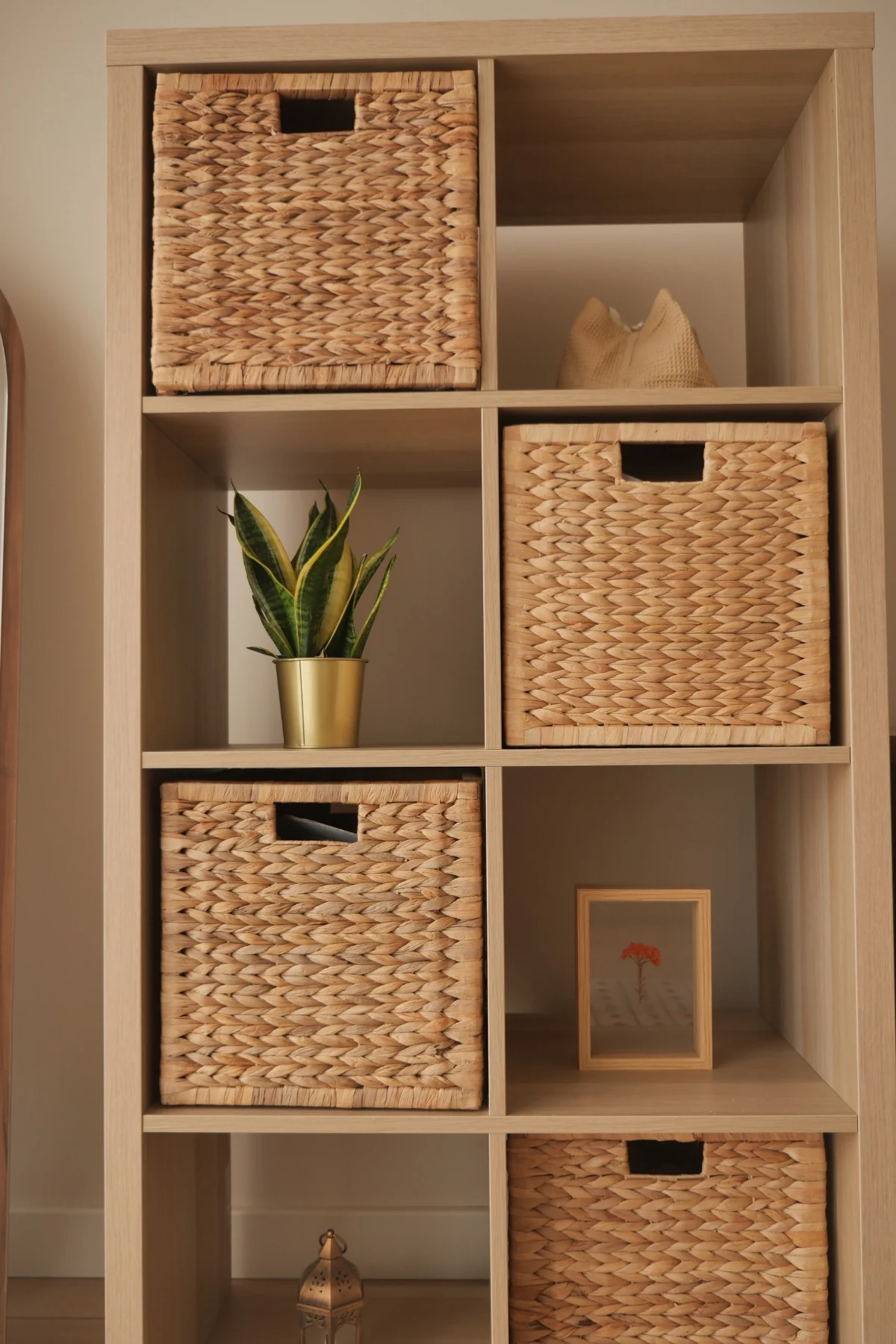
Where KALLAX makes sense is storage. Labeled boxes or baskets in its compartments make a tidy home for toys that are resting until the next swap. So buy it for storage, or for a child who reaches the top easily, and skip it as the main play shelf for a small toddler.
Quick safety check: IKEA’s page is direct about it: “Tipping hazard – this product must be securely anchored. Use suitable screws and plugs for your home. If you are uncertain, seek professional advice.”
 Save
Comparison at a glance
Side by side, the Piccalio is lowest at 16 inches, TROFAST sits at 22 and KALLAX at 30 1/8. Whichever you buy, add about $5 to $25, the AAP’s range, for an anti-tip kit.
| Shelf | Height | Width | Depth | Made of | Max load | Price (October 2026) |
|---|---|---|---|---|---|---|
| Piccalio stackable shelf (1 tier) | 16 in. | 33 in. | 18 in. | FSC birch plywood; finish the maker calls non-toxic, 0-VOC | Not stated | $169 |
| IKEA TROFAST with boxes | 22 in. | 39 in. | 17 3/8 in. | Particleboard frame with paper foil; polypropylene boxes | Not stated | $97.99 |
| IKEA KALLAX | 30 1/8 in. | 30 1/8 in. | 15 3/8 in. | Particleboard, fiberboard, acrylic paint | 29 lb per shelf, 55 lb on top | $49.99 |
With the anchor kit in, the math looks like this. Using the AAP’s $5 to $25 range (from a page last updated in 2021), KALLAX comes to about $55 to $75 and TROFAST about $103 to $123, before tax and shipping. For the Piccalio, the same math gives about $174 to $194.
Our own two-tier shelf cost more than either IKEA option and more than the one-tier Piccalio. I ordered the Sprout Kids shelf straight from the maker’s website in late 2024, when Will was just starting to walk. It was about $200, or about $230 once tax and shipping to Colorado were added. I did look at a cheaper IKEA shelf first, then went with wood. That’s what I paid back then, so it isn’t a current price and it isn’t in the table.
The accountant in me ran the numbers anyway. About $230 over almost two years comes to roughly $10 a month so far, and the meter’s still running, because I plan to hand it down to Jimmy. A cheaper shelf your child can reach is a good buy too. Any shelf only earns its cost per month if it stays useful, and that comes back to height and anchoring.
Once the shelf is home and anchored, the next question is what goes on it.
How to set up a Montessori shelf
Clear the shelf completely, bring back only what your child is into right now, give each thing a tray or basket of its own, and keep the heavy pieces on the bottom.
- Clear the whole shelf. Choosing what goes back is easier than deciding what comes off.
- Bring back what your child is working on. Davies’ test is simple: only what they’re working to master or interested in right now. A toy they ignored all week can rest.
- Give each thing a tray or basket. AMS suggests trays or baskets for smaller items. We use small wooden trays and little rattan baskets.
- Put heavy things low. The CPSC advises keeping heavier items on the lower shelves.
- Put the rest away. An AMS article suggests that tucking away 30% to 50% of a child’s toys may make them more interested in what’s left on the shelf. In one small study of 36 toddlers, when the children had 4 toys instead of 16, they played with toys for longer stretches and in more ways. Swapping things in and out over time is toy rotation, and it’s simpler than it sounds.
- Give everything one spot. Simone Davies puts it as “a place for everything and everything is in its place.” The overflow needs a spot too, in labeled bins somewhere out of the way, and that’s where small playroom ideas come in handy.
How many toys your child needs overall is a bigger question, and how many toys a baby actually needs takes it on.
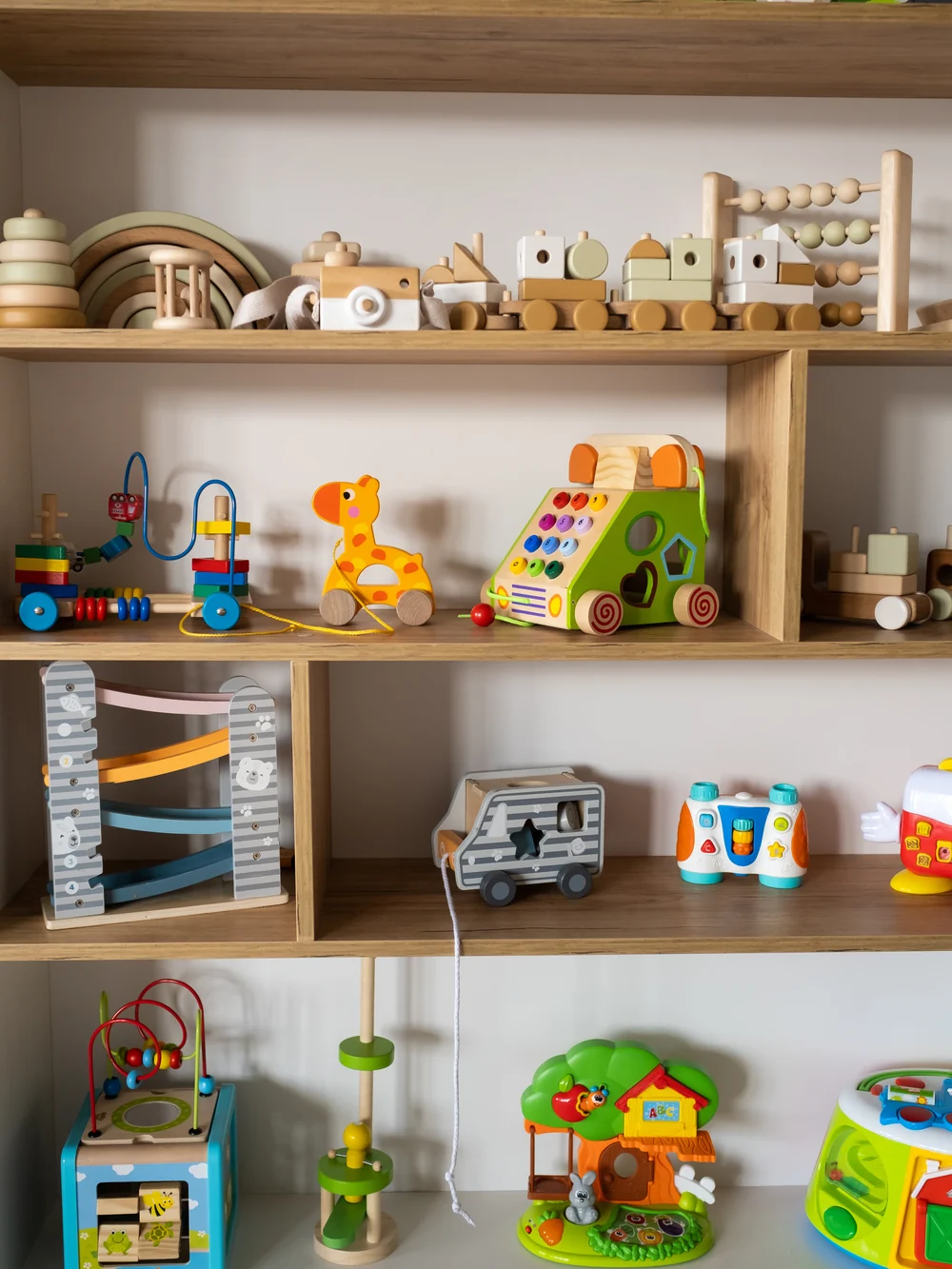
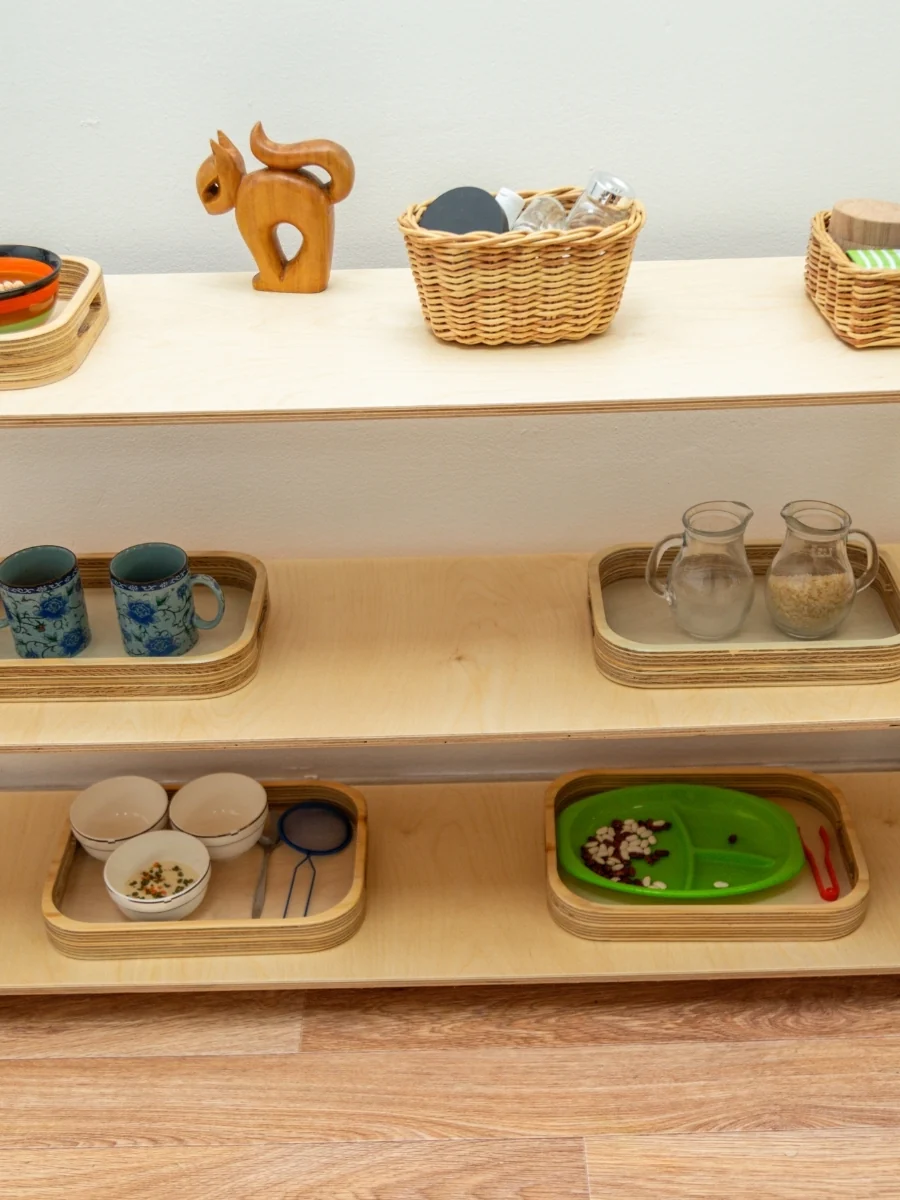
When everything is out at once, it’s hard to choose anything. A few things with space around them are easier to choose and easier to put back.
When I first cut our shelf down, it stung a little. I worried Will would be sad with so little to choose from. What happened instead was that he settled in. With less out, he went deeper into each thing and stopped grabbing one toy, then tossing the next across the floor.
 Save
As for the shelf itself, it’s staying put. What sits on it will keep changing, first with Will and later with Jimmy.
I keep 6 to 8 things out at a time, each on a small wooden tray or in a little rattan basket, split evenly between the two shelves. The less I put out, the deeper Will plays.
Miri’s Tip
What I’d skip (and why)
I’d skip the lidded toy chest, toys stored up high, a play shelf taller than your child can reach, and any shelf you can’t anchor.
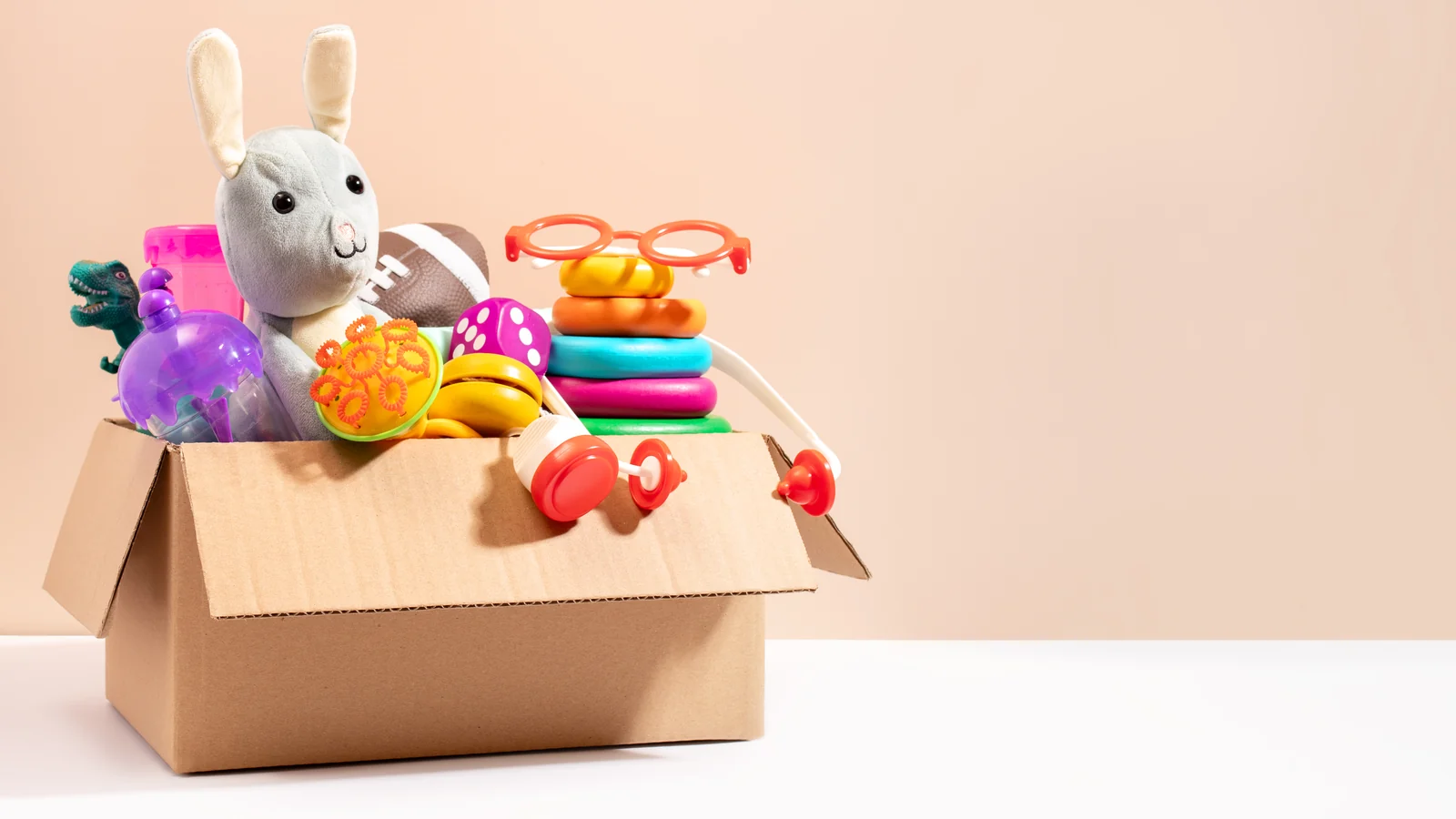
- A big lidded toy chest. Simone Davies warns that a toy box can turn into a “black hole” and suggests easily accessible, labeled storage instead. A closed chest is that black hole with a lid on it. Toys at the bottom stay out of sight, and putting them away means dropping them in.
- Toys on top of tall furniture. The AAP warns that toys kept in high places can tempt kids to climb. If it’s meant for your child, it goes where they can reach it from the floor.
- IKEA KALLAX as the main play shelf for a small toddler. At 30 1/8 inches, the top is a stretch. Use it for storage and let a lower shelf do the daily work.
- Any shelf you can’t anchor. If there’s no way to anchor it securely to the wall, it doesn’t belong in a toddler’s play space.
Save your money on the extras until the basics are in place: a shelf your child can reach, a few trays or baskets, and an anti-tip kit.
 Save
Frequently Asked Questions
How do you build a Montessori shelf?
You can build a Montessori shelf yourself as long as it follows the same three rules as a store-bought one: low enough that your child reaches the top, open so they can see what’s on it, and anchored securely to the wall. If you’re working with plywood or MDF, ask the supplier which formaldehyde standard the panels meet.
Are Montessori shelf plans based on age?
Montessori shelf plans work better when they’re based on your child’s reach. I haven’t found a sourced height chart by age, and kids grow at different speeds. Stand your child beside the shelf: the top should land at about hip height. Ours is about 16 to 20 inches, which fit Will, so treat it as one example. What goes on the shelf will change as your child does.
Conclusion
Any of those three tabs can work if the shelf passes three checks: your child can reach the top, there are only a few things on it, and a bracket holds it to the wall. Tonight, grab a tape measure. Stand your child against the wall and note where their hip lands, then measure that empty stretch between the couch and the window. Those two numbers will narrow the choice faster than any listing photo.
Start with the shelf you can afford and anchor this week. Your child will make it theirs long before it looks like the pictures.
Miri
Fewer toys, deeper play.
Further Reading & Resources
See all 14 sources
- Montessori background: Prepared Environment and Order (Association Montessori Internationale glossary) · Montessori at Home and The Importance of a Simple Environment (American Montessori Society)
- Educators & research: Montessori storage and toy rotation (Simone Davies, The Montessori Notebook) · Dauch et al., 2018 (Infant Behavior & Development)
- Safety: Ahead of Sunday’s Game, CPSC Reminds Families to Tackle the Deadly Hazard of TV and Furniture Tip-Overs (U.S. Consumer Product Safety Commission, 2024) · Preventing Furniture and TV Tip-Overs (American Academy of Pediatrics, HealthyChildren.org) · Clothing Storage Units (CPSC business guidance)
- Materials: 40 CFR 770.10, Formaldehyde emission standards (eCFR, U.S. Environmental Protection Agency rule)
- Prices & specs, checked October 2026: KALLAX shelf unit, TROFAST storage combination with boxes and FLISAT book display (IKEA US) · Montessori Toy Shelf (Piccalio)