
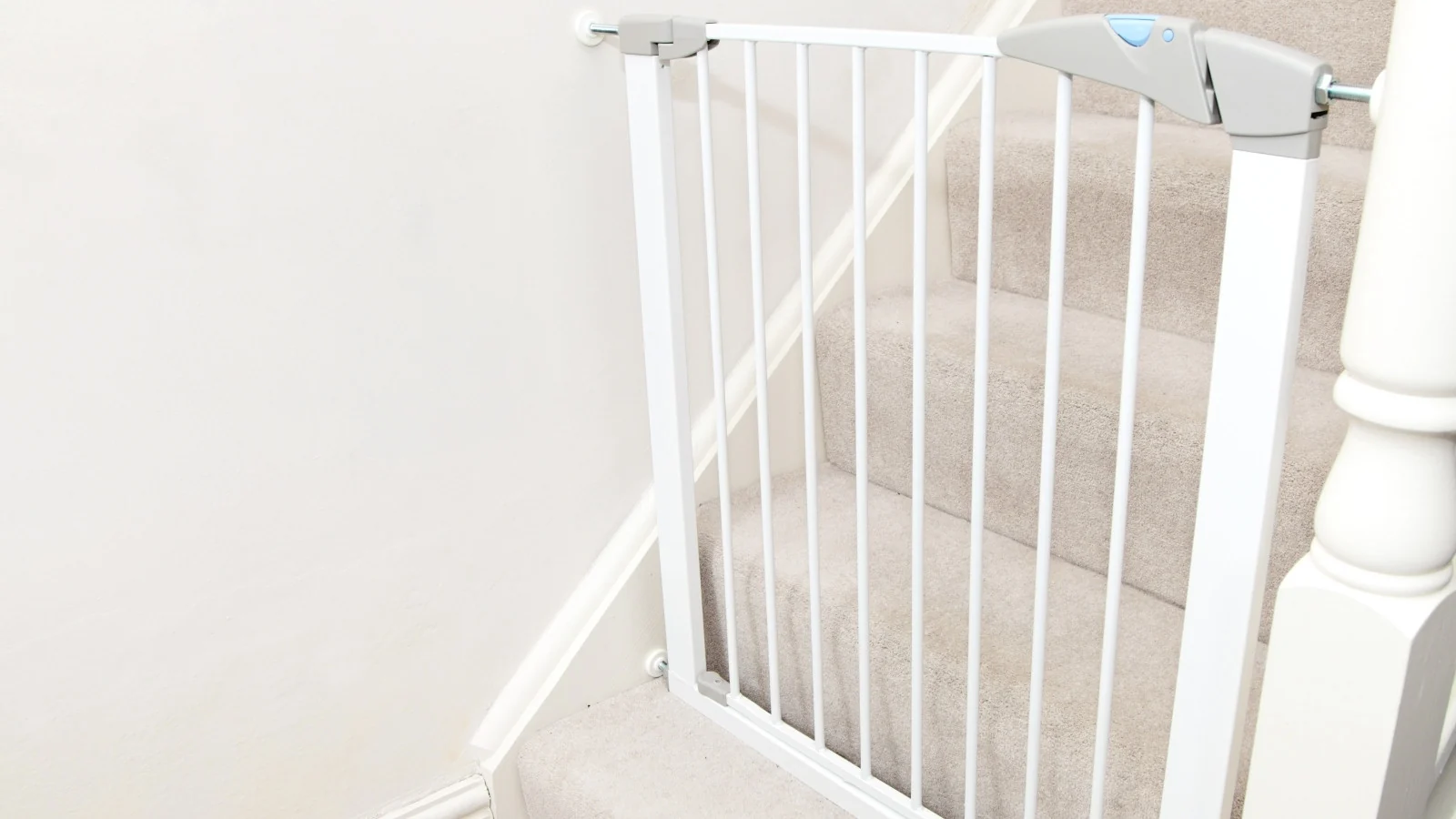
The gate at the top of our basement stairs takes two moves to open. You squeeze the latch hard, then you lift. It’s metal and it’s screwed into the wall, and in our house that was the whole point, because all it took was one second of me looking the other way and Will was climbing those stairs.
A basement plus a climber meant gates at the top and the bottom. For us, that part was never optional.
Maybe you’re standing at your own staircase right now with a crawler who gets faster every week, or a brand-new walker who has just noticed the steps. Then the questions pile up. Pressure-mounted or hardware-mounted? What do you do with a banister on one side? And if you rent, can you even drill? That’s a lot to sort out when you’re running on empty.
Stair gates are the part of babyproofing a Montessori home you’ll walk through all day, so they’re worth getting right.
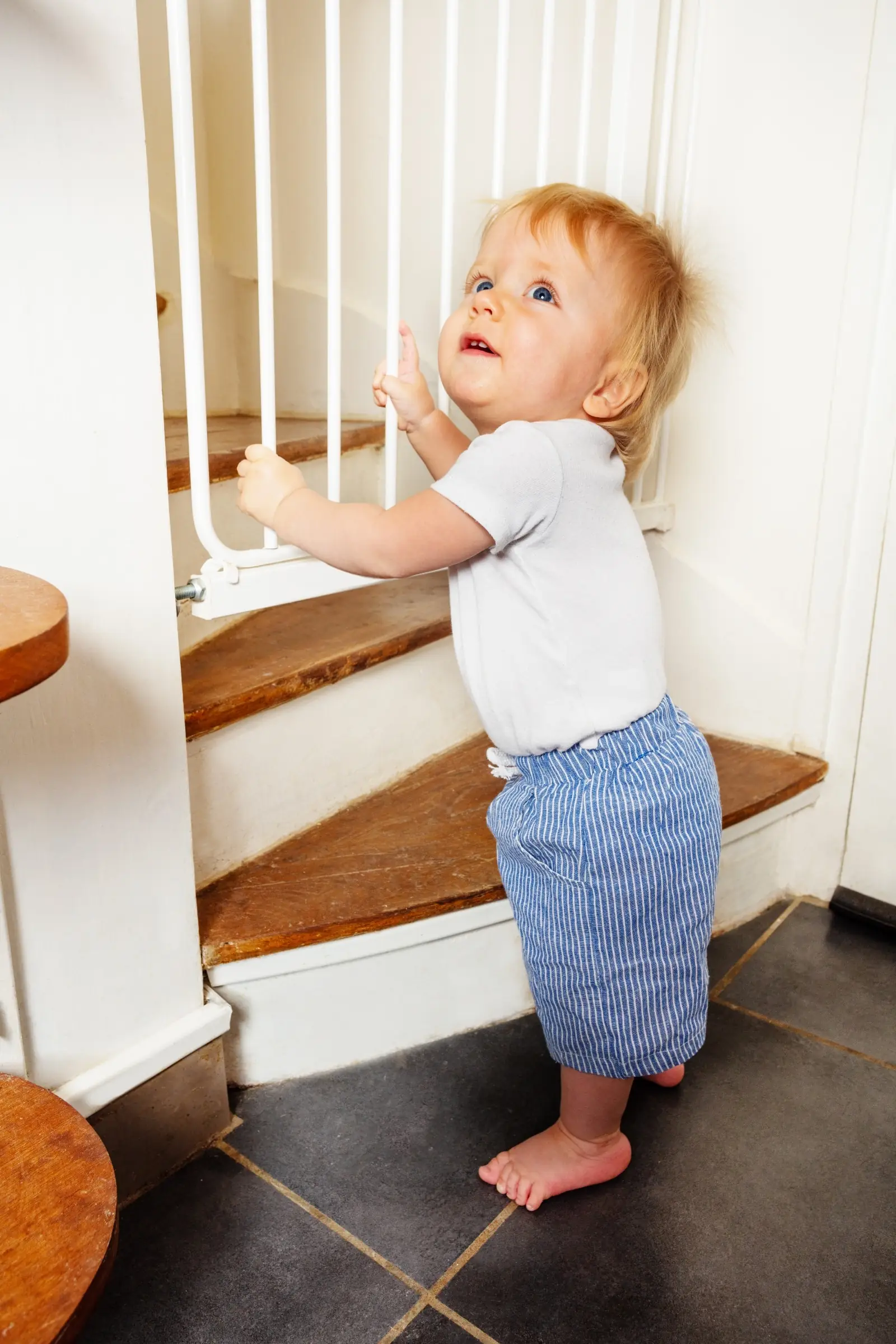
Gates at both ends of the stairs, firmly mounted to the studs — that’s the AAP’s stair advice as of 2022.
You’re looking at an accordion-style gate. The AAP says to avoid those because they can trap an arm or a neck.
Why do you need a baby gate for stairs?
A baby gate for stairs is a barrier at the top or bottom of a staircase that’s meant to keep young children from getting through while grown-ups can still open it. The AAP ties it to the crawling and walking months.
The pediatric advice fits in three sentences. This is how the AAP puts it on its home safety page, last updated in 2022:
“Install safety gates at both top and bottom of stairs when your child is learning to crawl and walk. Avoid accordion style gates, which can trap an arm or a neck. Instead, use gates firmly mounted to the home’s studs.”
American Academy of Pediatricshome safety tips on HealthyChildren.org (2022)
Studs are the framing behind your drywall. The gate itself is fall prevention for the months when your child has plenty of enthusiasm and very little sense of where the top step is.
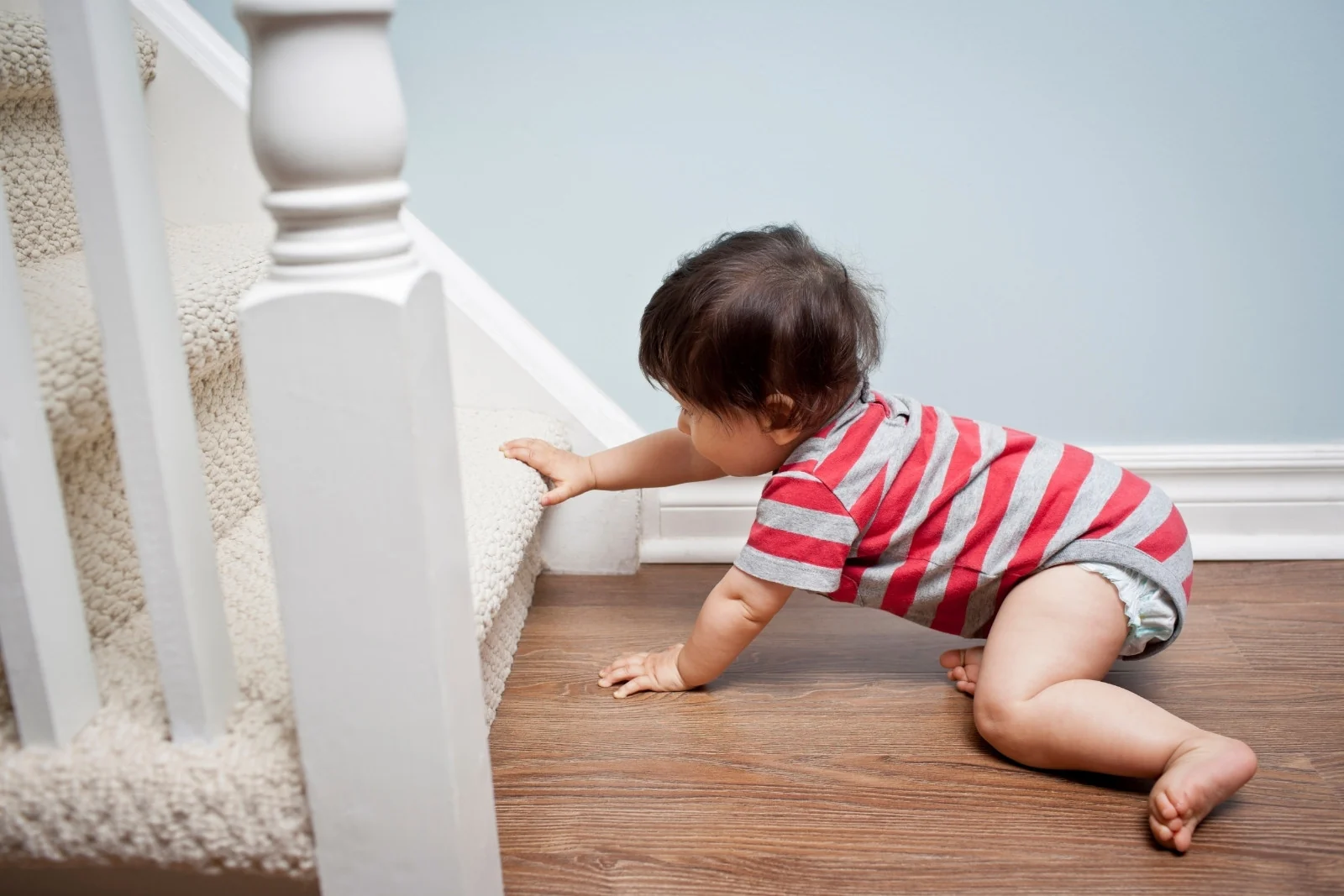
Why the stairs, specifically? A 2014 study in Academic Pediatrics looked at U.S. emergency room visits tied to baby gates from 1990 through 2010. It estimated 37,673 children were treated, and 60.4% of them were under 2. The under-2s were most often hurt falling down stairs after the gate gave way, while kids from 2 to 6 were more often hurt by contact with the gate itself.
The rate climbed from 3.9 to 12.5 injuries per 100,000 children over those two decades. The accountant in me did the division: a little more than three times the rate. The data stops at 2010, and the study’s summary doesn’t say which kinds of gates were involved. Still, if your child is crawling or cruising right now, that age pattern is hard to ignore.
For me, the gates were also about head space. With both ends of the stairs gated, I can run to the bathroom or tidy up without keeping one ear on the basement steps.
 Save
Hardware-mounted vs pressure-mounted baby gates
The AAP’s stair advice comes first: gates firmly mounted to the studs. Pressure-mounted baby gates hold by pressing outward instead, and a required warning says any wall cups that came with yours must go in.
The first fork in the road is how the gate stays up. A hardware-mounted gate screws into the wall. A pressure-mounted gate works like a tension curtain rod: it presses outward against both sides of the opening and stays put that way.
Pressure gates come with a warning that’s easy to skim past. Under the federal gate standard, a pressure gate that comes with wall cups has to carry this on the product: “You MUST install [wall cups] to keep gate in place. Without [wall cups], child can push out and escape.” The U.S. Consumer Product Safety Commission (CPSC) says incidents tied to how pressure gates were installed have included deaths and serious injuries. So if there are wall cups in the box, treat them as part of the gate.
Two more designs deserve a row of their own: accordion-style gates and gates with a built-in pet door.
| Gate type | How it stays up | What the AAP or CPSC says | Where it fits |
|---|---|---|---|
| Hardware-mounted | Screws into the wall | AAP: use gates “firmly mounted to the home’s studs” (as of 2022) | Top of the stairs, and the bottom too |
| Pressure-mounted | Presses outward against both sides of the opening, like a tension curtain rod | Required warning: if it came with wall cups, you must install them. CPSC: installation-related incidents have included deaths and serious injuries | Check your gate’s manual for where it may be used |
| Accordion-style | Zigzag panels that fold out across the opening | AAP: avoid, because it can trap an arm or a neck | Skip it |
| Built-in pet door | Any mount, with an opening that lets a pet pass through on its own | Not allowed on gates made after July 19, 2026: a child can get through or trap their head, and the opening gives feet a place to climb | Skip it when you shop |
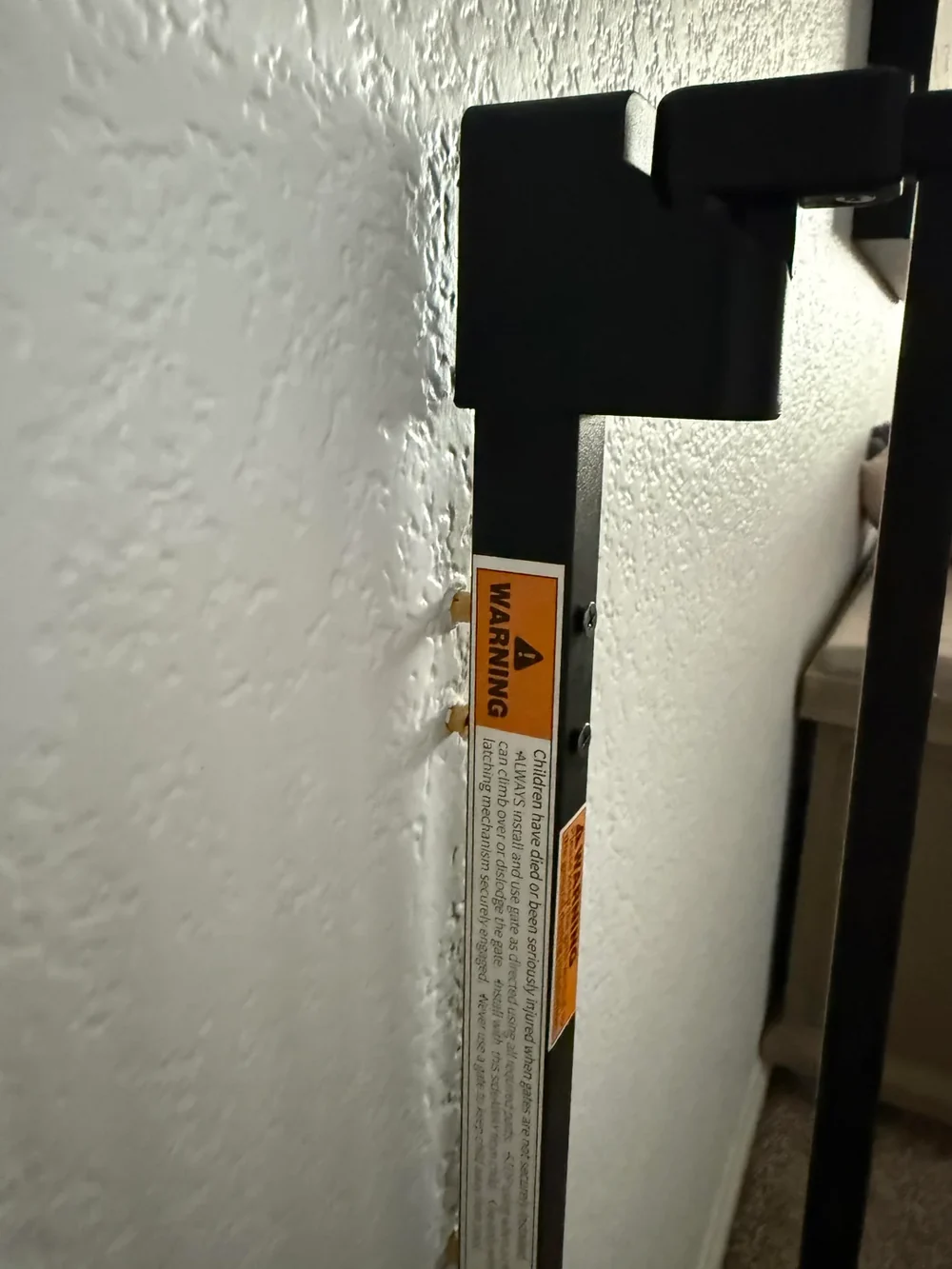
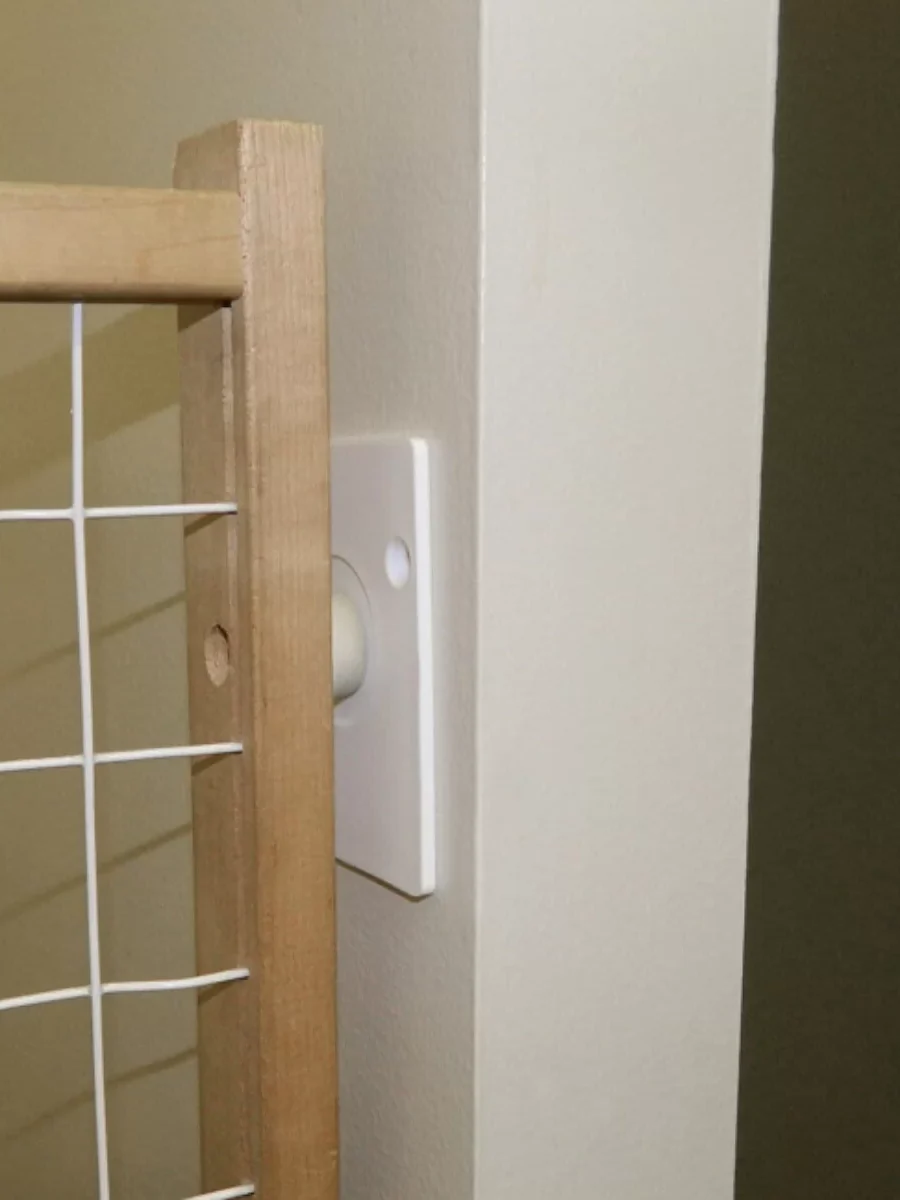
A hardware-mounted gate screws into the wall. The AAP wants stair gates mounted to the studs. Pressure gates hold by pushing outward. If yours came with wall cups, put them in.
Top vs bottom of stairs
The AAP’s advice covers both ends of the staircase, and it points to gates firmly mounted to the home’s studs. The top is the one I’d never cut corners on, because that gate is all that stands between your child and the whole flight.
At the bottom, the gate’s job is to keep a new climber off the first step, and we have one there too. If the gate you use at the bottom is pressure-mounted, install every wall cup it came with, and check that its manual lists the bottom of the stairs as a place it may be used.
When we chose the gate for the top of our basement stairs, I wanted one that screws into the wall. For us, a pressure gate up there would have meant a bar across the floor right at the top step, and I didn’t want one more thing to trip over at the edge of a staircase. That’s my own reasoning, so weigh it against your stairs and your gate’s manual.
Miri’s Tip
How do you choose a baby gate for stairs?
Read the label, match the manufacture date to the standard, mount the gates to the studs, install any wall cups, skip accordion folds and pet doors, then mail the registration card.
If you came here looking for the best baby gates for stairs, these six checks work on any brand you’re considering. At Moje Montessori, they’re what we look at on any stair gate, in this order. If I were buying one for Jimmy’s crawling months tomorrow, I’d go down this list exactly as it’s written.
- Find the permanent label. By federal rule, it lists the maker and contact information, the model name and number, and the date of manufacture (which can be in code).
- Match the date to the standard. It tells you which version of the gate standard applies.
- Mount stair gates to the studs, top and bottom. Banister or uneven walls? Follow the gate maker’s instructions for banisters.
- Install every wall cup a pressure gate came with. Without them, a child can push the gate out.
- Skip accordion folds and pet doors. The AAP says accordion-style gates can trap an arm or a neck.
- Mail the registration card. It’s how a recall notice can reach you.
The standard sounds technical, but your part is short. Gates sold in the U.S. have to meet a mandatory CPSC standard (16 CFR part 1239, which makes ASTM F1004 the required standard), and makers and importers have to certify that with a Children’s Product Certificate. CPSC’s gates and enclosures guidance ties each gate to the version in force when it was made: ASTM F1004-19, with CPSC changes, after July 6, 2021, and F1004-22 after January 21, 2023.
A rule published in April 2026 makes F1004-25 the standard for gates made after July 19, 2026. That version rules out openings that let a pet come and go on its own, because a child can get through one or trap their head in it, and the opening gives small feet a place to climb. You don’t have to memorize any of this. Check the date on the label, and ask the seller for the certificate if you’d like to see it.
 Save
That registration card matters more than it looks. It comes from a federal rule, 16 CFR part 1130, which covers gates and enclosures along with play yards. When CPSC staff looked back at recalls of children’s gates and enclosures from January 2008 to December 2018, more than 1 million units (1,318,180) had been recalled for fall, entrapment, tripping and laceration hazards, tied to 215 incidents and 13 injuries. Checking for toy recalls is a routine of its own, and worth learning once.
One more detail from the standard itself: CPSC notes that it’s written for products intended for children 6 to 24 months. Questions about height, or about an older toddler who’s started eyeing the top rail, belong with your gate’s manual.
Put gates at both the top and the bottom of the stairs once your child is learning to crawl and walk, and use gates firmly mounted to the home’s studs, as the AAP advises. Skip accordion-style gates, which can trap an arm or a neck.
If a pressure-mounted gate came with wall cups, install them before the gate goes into use. Without them, a child can push the gate out, and CPSC says installation-related incidents with pressure gates have included deaths and serious injuries.
 Save
Six checks sounds like a lot, but most of it is reading. Once the label, the mount and the card are sorted, the stairs stop being the thing you watch out of the corner of your eye all day.
Baby gates for stairs without drilling: what renters can do
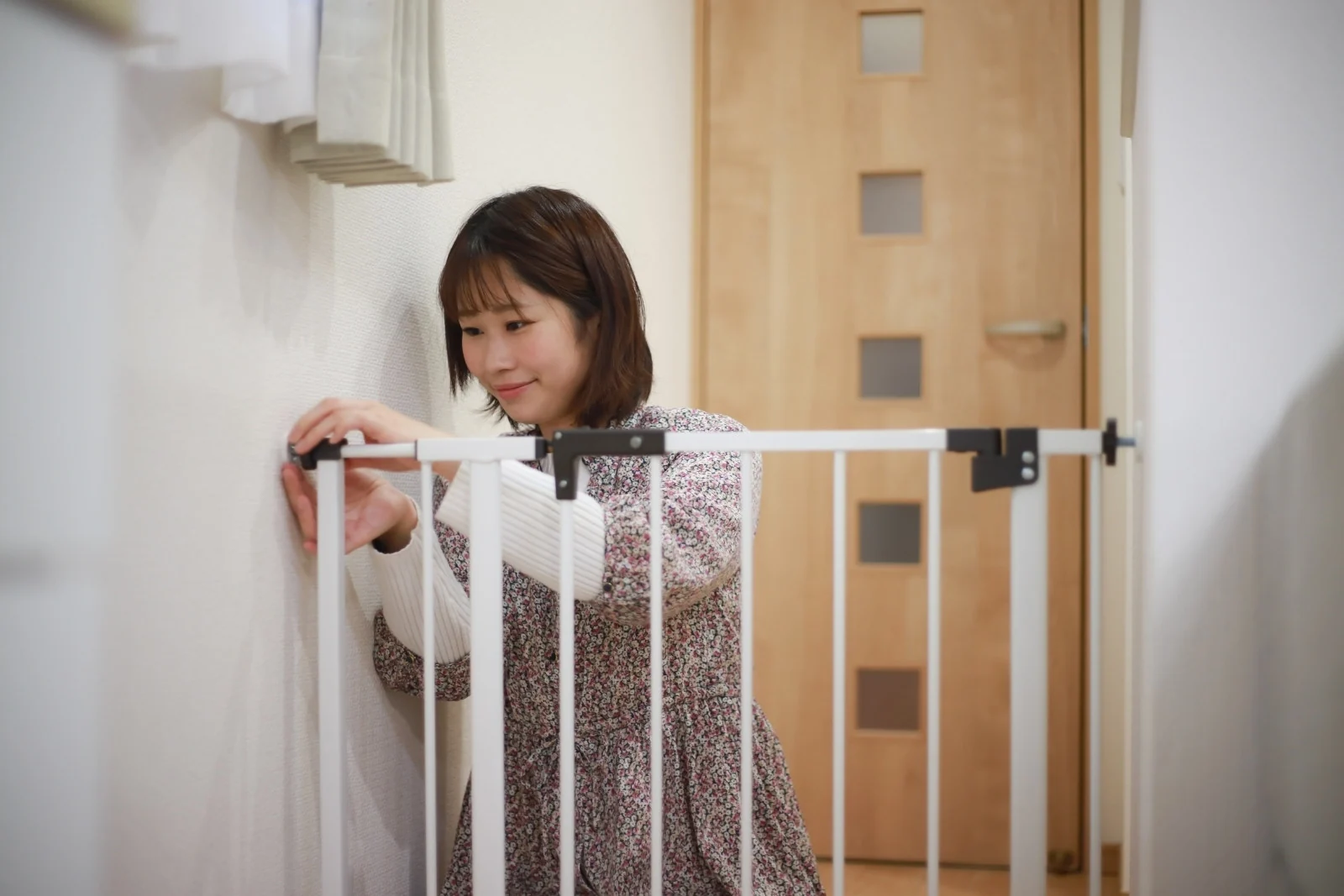
Renting doesn’t change the AAP’s stair advice: gates at both ends, firmly mounted to the studs. The drill-free option is a pressure-mounted gate, and its manual tells you where it may go and how its wall cups attach.
If you rent, searching for baby gates for stairs without drilling makes complete sense. Holes in the wall can feel like money coming straight out of your deposit.
The honest answer is that I couldn’t find a pediatric or federal source that offers a drill-free setup for the top of the stairs. The AAP’s stair advice reads the same for renters and owners: gates firmly mounted to the home’s studs.
Pressure-mounted gates are the no-drill kind. Before you buy one, read where its manual says it may be used, and check how its wall cups attach, since the required warning says they have to be installed.
Then ask your landlord before you rule out screws. It’s a short conversation, and the AAP’s advice gives you a clear reason to bring it up.
 Save
Extra wide baby gate, play yard, or a whole safe room?
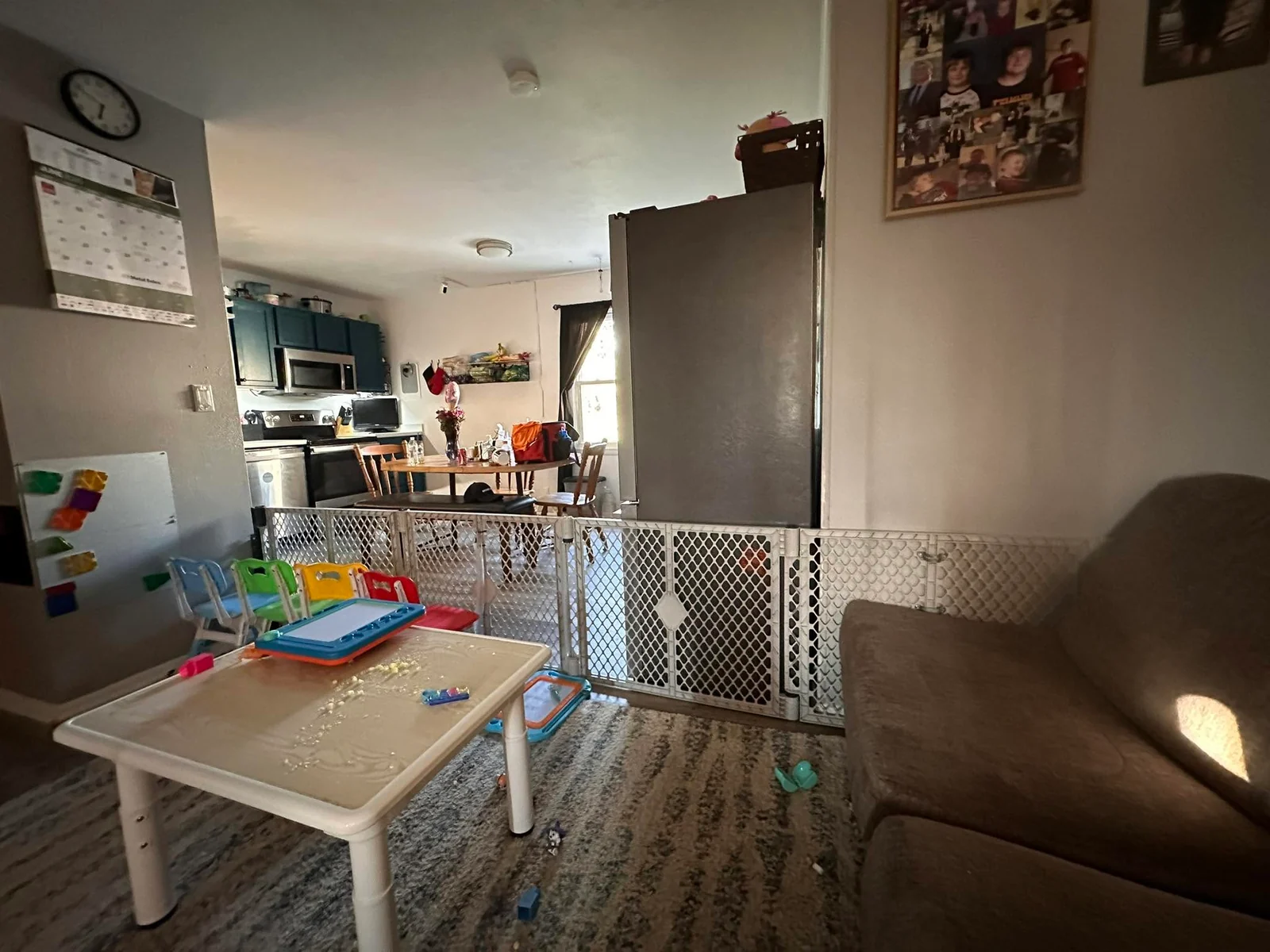
An extra wide baby gate closes off an opening too wide for a regular gate, a play yard is a framed enclosure with a floor and mesh or fabric sides, and a safe room is a whole room made ready for your child.
For a toddler who’s on the move from breakfast to bedtime, my pick is gated stairs plus one room that’s safe from corner to corner. Each option does a different job.
The federal gate standard covers two kinds of barriers. Expansion gates go across an opening, like a doorway, and can be removed by anyone old enough to operate the lock. Expandable enclosures are self-supporting and completely surround a play space. If the gap you need to close is wider than a doorway, say an open living room, an extra wide baby gate or an enclosure is the tool. Measure the opening before you shop and compare it with the width range on the box.
 Save
A play yard is its own product with its own CPSC standard, 16 CFR part 1221. CPSC’s play yards guidance defines one as “a framed enclosure that includes a floor and has mesh or fabric sides,” and inflatable play yards aren’t covered. Play yards made or imported on or after April 5, 2025 have to meet the 2024 version of the ASTM play yard standard, with a CPSC change. That rule is for products sold as play yards, so a fence you put together yourself doesn’t fall under it.
CPSC also describes play yards as made for a child who can’t climb out and is under 35 inches tall. If your toddler is already a climber, that line is worth reading twice.
 Save
In our house, the rest of Will’s freedom comes from rooms we made safe: his bedroom with the floor bed, and the corner of the living room with his toy shelf. That’s a yes space, a spot where your child can touch, climb and roll around without hearing “no” every few minutes. If you’re not sure which room to start with, the room-by-room babyproofing checklist walks through each one.
Gate the stairs at both ends, and the rest of the house can be mostly yes.
 Save
If you only get one thing done this week, make it the stairs. The safe room can come together one outlet cover and one cleared shelf at a time.
Frequently Asked Questions
Are pressure mounted baby gates safe for top of stairs?
For a pressure-mounted baby gate at the top of the stairs, start with the AAP’s stair advice: gates firmly mounted to the home’s studs. A pressure gate holds by pressing on both sides of the opening, and if it came with wall cups, its required warning says they must be installed. The gate’s manual says where it may be used.
Are retractable baby gates safe for top of stairs?
Retractable baby gates at the top of the stairs aren’t addressed directly in the AAP and CPSC sources I rely on, so I won’t guess. What holds for any gate up there: the AAP says to use gates firmly mounted to the studs and to skip accordion-style ones. That model’s manual tells you where it may be used.
Are mesh baby gates safe for top of stairs?
A mesh baby gate at the top of the stairs gets the same questions as any other gate. Does its manual say it may be used there, and can it be firmly mounted to the studs, as the AAP advises? Then check the label for the maker, model and date of manufacture, and mail in the registration card.
Are retractable baby gates safe for stairs?
For a retractable baby gate anywhere on the stairs, I’d run the same three checks as for any gate: the label, how it mounts, and what its manual says about stairs. The AAP’s advice still applies at both ends: gates firmly mounted to the home’s studs, and never accordion-style.
Conclusion
You don’t have to get the whole house ready this weekend. Go stand at the top of your stairs and look at what the gate is screwed into, or where it will be. Find the label and the date of manufacture. If the registration card is still sitting in the box, fill it out and mail it. That’s the stairs, handled for this stage.
Busy little legs are a good sign, even on the days they wear you out. Sort out the stairs this week and let that count as a win.
Miri
Fewer toys, deeper play.
Further Reading & Resources
See all 7 sources
- Gate rules: Gates and Enclosures Business Guidance and Gates and Enclosures FAQ (U.S. Consumer Product Safety Commission, CPSC) · Safety Standard for Gates and Enclosures (Federal Register, April 2026)
- Play yards: Play Yards Business Guidance (CPSC)
- Labels and registration cards: 16 CFR Part 1130, Requirements for Consumer Registration of Durable Infant or Toddler Products (eCFR)
- Pediatric advice: Home Safety: Tips for Families With Young Children (American Academy of Pediatrics, AAP, HealthyChildren.org, updated 2022)
- Injury research: Baby gate-related injuries among children in the United States, 1990-2010 (Academic Pediatrics, 2014)