

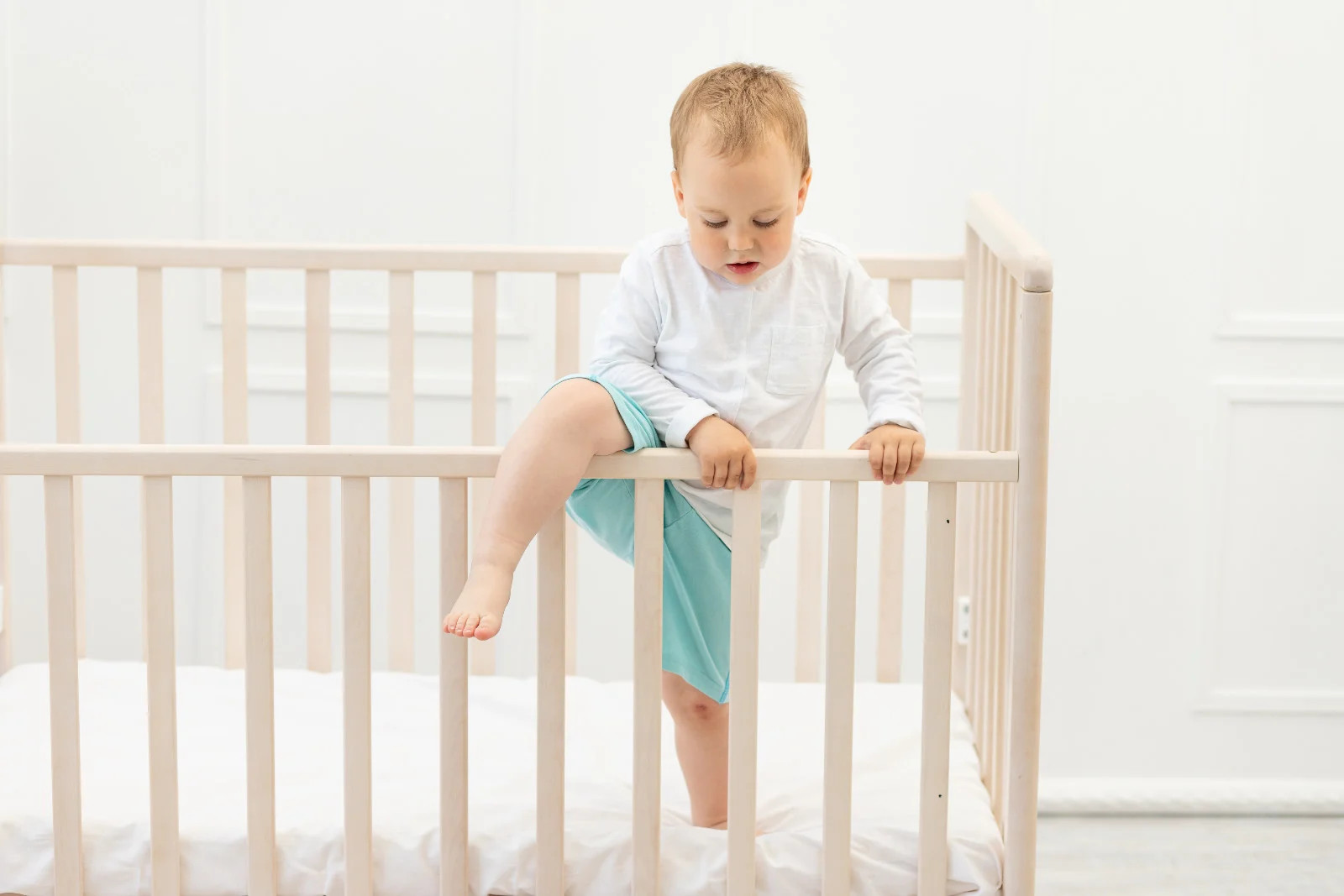
The first time a leg swings over the crib rail, it can happen fast. One minute your toddler is standing there holding on, and the next they’re straddling the top, looking very pleased with themselves. Ask about it online and you’ll hear it put bluntly: as soon as they try to climb out, the crib is no longer safe. It’s easy to come away thinking you need a new bed by tonight.
The American Academy of Pediatrics (AAP) is calmer about it. Its page on moving to a big-kid bed (as of 2022) says that once your toddler can climb out of the crib, it “may be time” to switch. If the new bed isn’t ready yet, the same page suggests putting the crib mattress on the floor while you wait.
So that leg over the rail is your cue to start planning. Back in the eat, play, sleep months, sleep mostly stayed where you put it. A toddler in a big bed can get up, open a door and come looking for you at 2 a.m., which is why the room around the bed matters as much as the bed.
What’s the best age to switch to a toddler bed?
Your child’s signs matter more than their birthday. The AAP’s advice on when to move to toddler bed is built around climbing out and height, with no set age attached.
That can feel frustrating when you’d like a date to circle on the calendar. The AAP gives you two physical markers instead. One is climbing out, from the big-kid bed page above. The other comes from its guide to choosing a crib (as of 2021): once children are about 3 feet tall, they should start sleeping in a bed.
 Save
One number you may come across is 15 months. It comes from the U.S. Consumer Product Safety Commission (CPSC), which defines a toddler bed as one sized for a full-size crib mattress and meant for a child at least 15 months old who weighs no more than 50 pounds. That definition is written for the companies that make toddler beds. It sets who the bed is built for, and it says nothing about when your child should move.
So plan around the signs, and let the ages you hear from other parents stay theirs.
What are the signs your child is ready for a toddler bed?
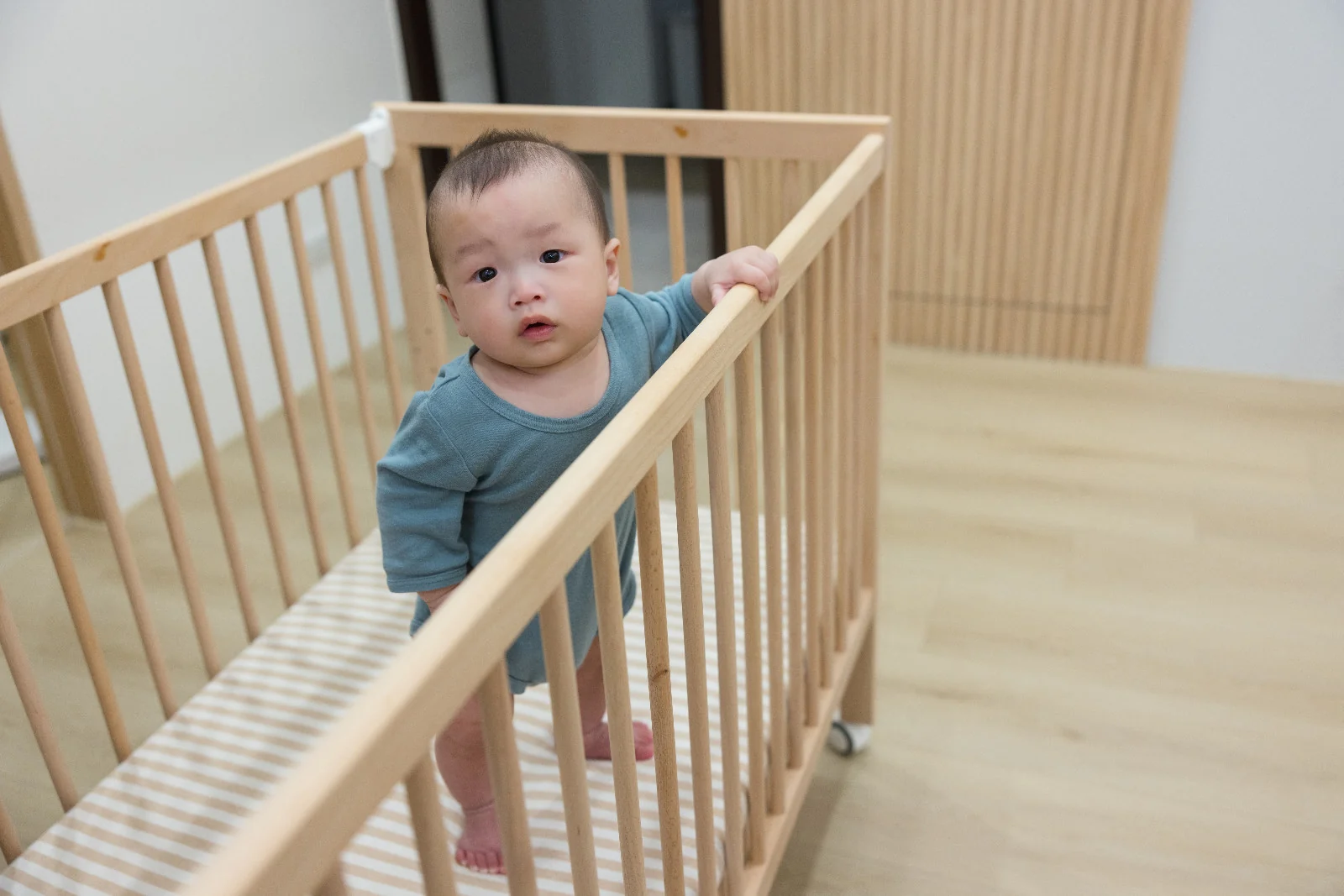
Watch for three signs: your toddler can climb out of the crib, they’re about 3 feet tall, or the crib mattress is already at its lowest setting while they keep growing.
- They can climb out. It’s the sign the AAP names for moving to a big-kid bed. A knee hooked over the rail is your heads-up.
- They’re about 3 feet tall. That’s the AAP’s marker for starting to sleep in a bed. Stand them against a doorframe, heels to the wall, and check.
- The mattress has nowhere lower to go. The AAP says raised crib sides should be at least 26 inches above the mattress support at its lowest setting (as of 2021), and to lower the mattress as your child grows. Once you’ve used the last setting, there’s less and less crib above a growing child.
You’ll find longer lists online. I stuck to these three: two come straight from the AAP, and the third is my own reading of its crib rule. Those are the ones worth rearranging a bedroom for.
 Save
Signs your toddler is not ready
Flip those three signs around and you have the other answer. In my book, a toddler who isn’t climbing out, is still well short of 3 feet and has a mattress setting or two left can stay right where they are. The AAP’s “may be time” starts with a child who can climb out.
If you’re feeling the pull of the calendar, or of a friend whose kid switched early, I’d leave a crib that’s working alone. The AAP adds that most kids are happy to “graduate” and stay in their beds more willingly than they did in their cribs, though for a few, the move has to be managed closely. Waiting for a real sign gives you time to get the room ready, whichever kind of kid you have.
Toddler bed vs twin bed vs floor bed
Going from crib to toddler bed gives you three everyday choices: a toddler bed that reuses the crib mattress, a twin bed, or a mattress on the floor. Bunk beds can wait, since the CPSC warns against kids under 6 on the upper bunk.
Each one asks something a little different of you and your room.
| Bed | A good fit when | Worth knowing |
|---|---|---|
| Toddler bed | You want to keep the crib mattress your child already sleeps on | The CPSC defines it as sized for a full-size crib mattress, for kids at least 15 months old and up to 50 pounds. Its federal rule (16 CFR Part 1217) aims to minimize entrapment at the bed ends, between the guardrail and side rail, and in the mattress support, because a trapped head or neck can lead to asphyxiation |
| Twin bed | You’d rather buy one bed and skip a step | It isn’t sized for a crib mattress, so it isn’t a toddler bed under the CPSC’s definition. Check the frame height before you buy |
| Floor bed (mattress on the floor) | Your child is past 1 and you want them to get in and out on their own | For babies under 1, the AAP’s safe-sleep list is a crib, bassinet, portable crib or play yard that meets federal safety standards. Floor beds aren’t on it, so talk to your pediatrician first |
| Crib mattress on the floor | The new bed isn’t ready yet | The AAP suggests it as a stopgap for a toddler who’s climbing out (as of 2022) |
| Bunk bed | Later, for older kids | The CPSC requires a warning not to let children under 6 use the upper bunk |
We made the crib to floor bed move ourselves. Will left his crib at about 14 months because he hated being shut in, and our Montessori floor bed post has the whole story, along with how we got his room ready. That bit of independence is the idea behind a floor bed: your child can get in and out without you. It also means the room has to be ready for them to do exactly that.
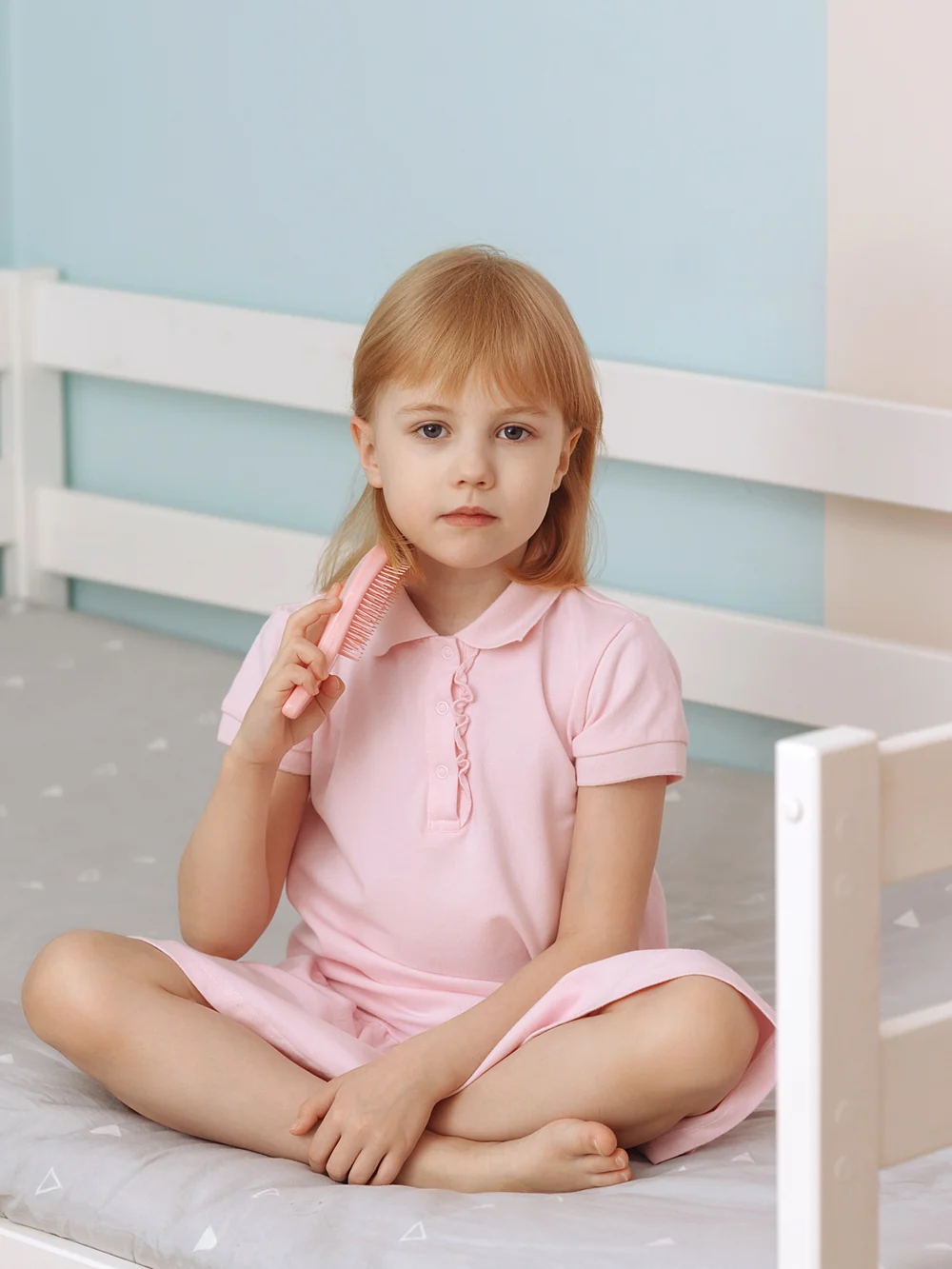
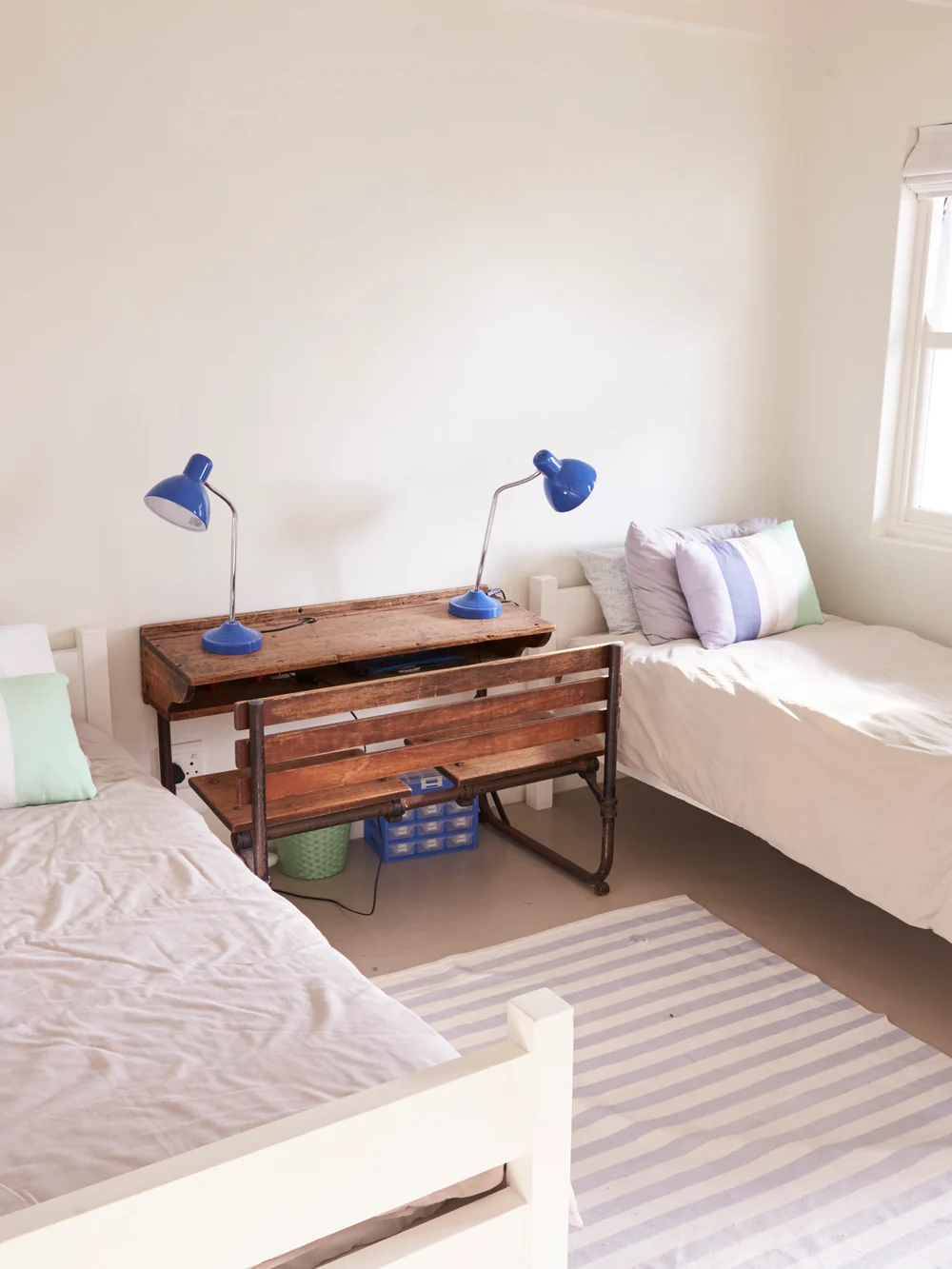
A toddler bed reuses the crib mattress your child already knows. A twin bed is a big jump in size, so give the room check below extra attention.
How do you make the room safe once your toddler can get out of bed?
Start inside the bedroom: clear it, anchor it, and check for a smoke alarm and an escape window. Then work outward to the bedroom door, the hallway and the stairs, the places a wandering toddler reaches next.
What’s new with a big-kid bed is the timing. Your toddler can now get up while you’re asleep. Our babyproofing checklist walks the whole house room by room, and the bigger plan lives in our babyproofing guide, so this section sticks to what changes at night.
In the bedroom. Between the AAP’s big-kid bed page and its home safety guide (both as of 2022), the list looks like this:
- Clear away furniture and large toys, like a rocking horse, that could hurt your child if they fell against them.
- Keep dressers and other furniture from tipping over. Latch drawers or tape them shut so they can’t be pulled out and used as steps.
- Put safety plugs in unused outlets (pick ones that aren’t a choking hazard), and keep cords out of reach and out of sight.
- Skip window coverings with cords. If yours aren’t cordless, attach the cords to floor mounts that hold them taut, or wrap them around wall brackets out of reach.
Windows deserve a second look once your toddler is up on their own. Open them from the top if you can, and use window guards that only an adult or older child can open from inside. Keep chairs, low tables and anything climbable away from them, because a screen isn’t strong enough to stop a fall. Guards come with one condition from the CPSC’s childproofing guide: at least one window in each room should be easy to use for escape in a fire. The same guide says to put smoke alarms on every level of your home, inside each bedroom and outside sleeping areas.
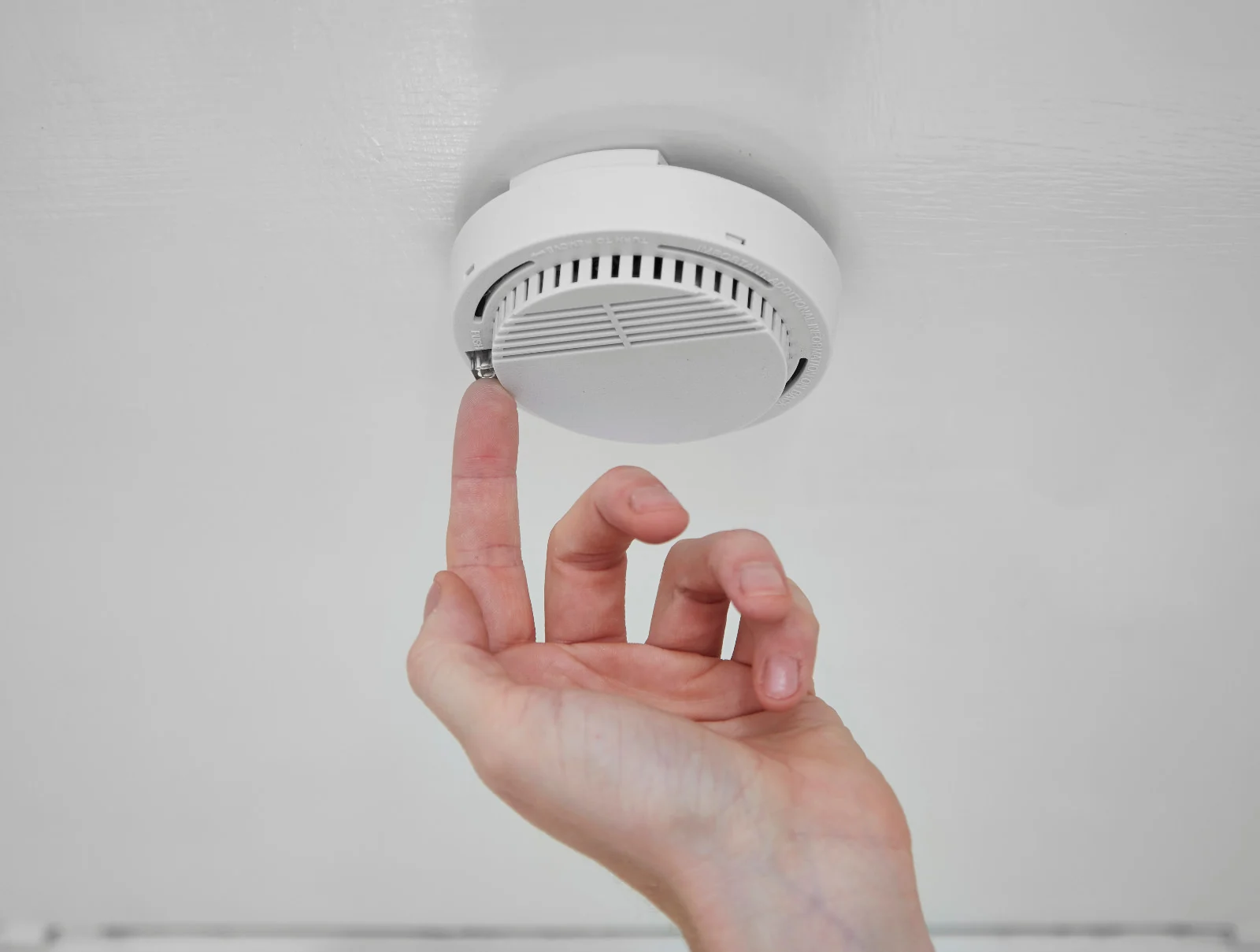 Save
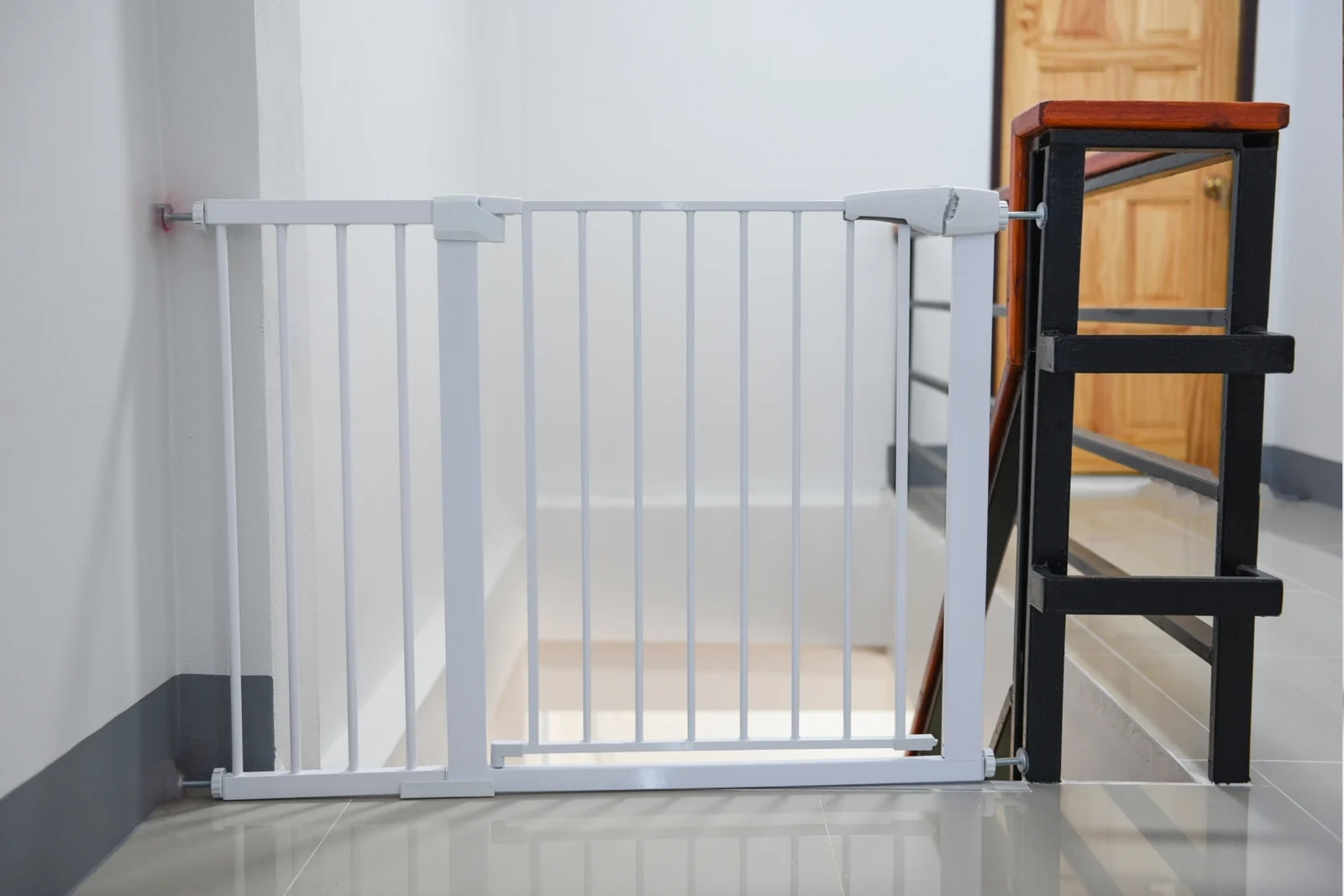
At the door and in the hallway. The AAP says you may need a safety gate across your toddler’s bedroom door to keep them from wandering when you’re not awake, and a gate at the top of the stairs for when they get out of bed. Its home safety guide puts gates at both the top and the bottom of the stairs and warns against accordion-style gates, which can trap an arm or a neck. If you use a door knob cover, the CPSC says it should be sturdy and let an adult open the door quickly in an emergency.
The first night they open the door by themselves, your hallway becomes part of their bedroom.
 Save
For us, the door came later. For a long time after the floor bed, Will couldn’t reach the handle. Once he was past 2 and taller, there were a few nights he opened it himself and walked over to our room.
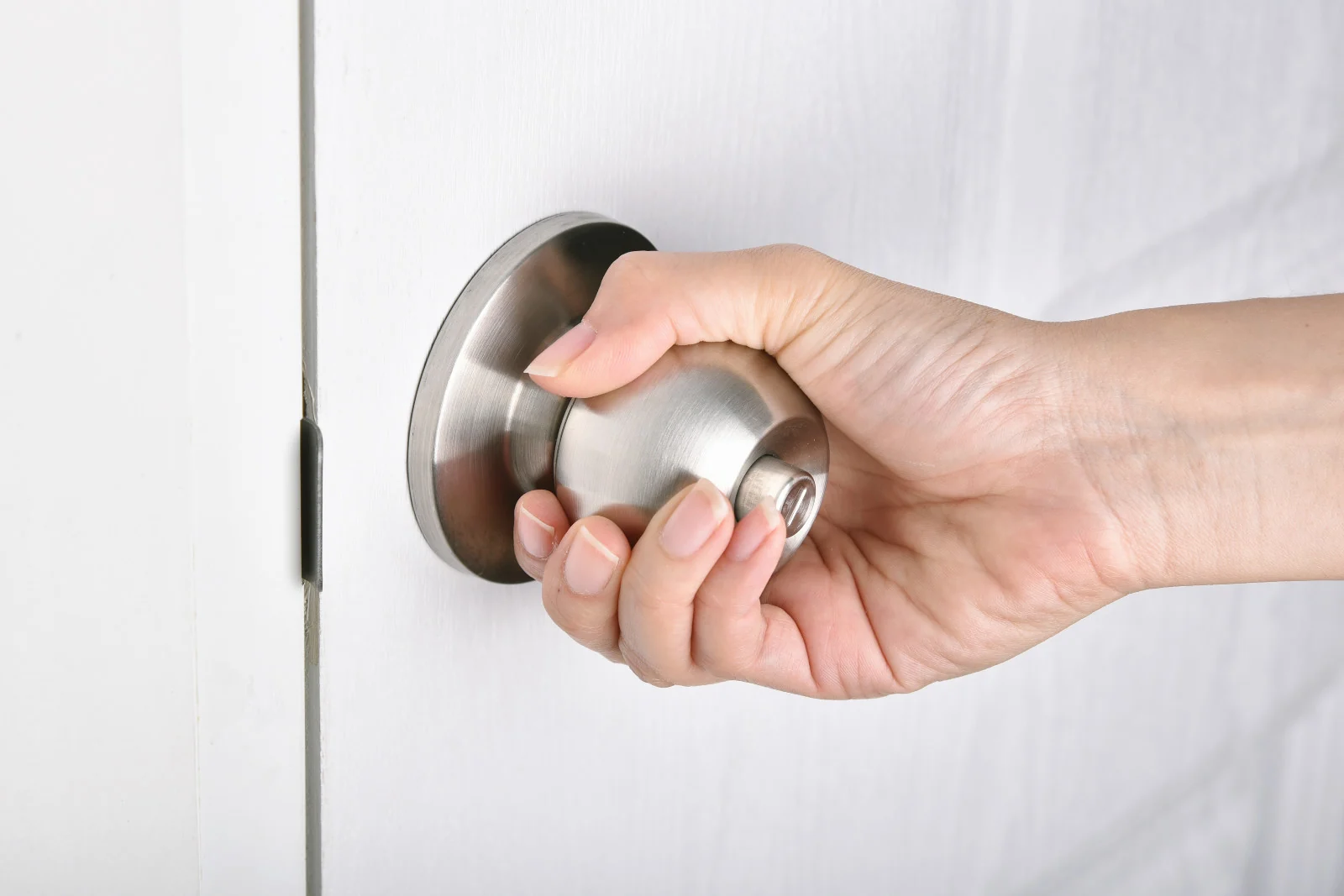
We keep Will’s door closed at night, since it keeps his room darker and quieter, and we added a childproof knob cover on the inside handle plus a baby monitor turned up loud by our bed, so I go in as soon as he calls or stirs. We skipped a gate at his doorway and count the hardware-mounted gate at the top of our basement stairs as the second layer. That’s our setup, and the gate across the bedroom door that the AAP mentions is the other way to do it.
Miri’s Tip
 Save
A toddler who can open their own door may soon work out the others in the house.
Check every way out of your house before you go to bed: the front door, any sliding door and the door to the garage.
At our house, Dom walks around each night and checks the locks on the front door, the sliding glass door to the backyard and the door to the garage. Our outside doors also have an extra latch mounted up high, out of Will’s reach.
What about blankets and pillows?
For a baby under 1, the AAP is specific. Keep soft objects and loose bedding out of the sleep area, because they can raise the risk of entrapment, suffocation or strangulation. That includes pillows and pillow-like toys, quilts, comforters, mattress toppers, non-fitted sheets, blankets, toys and bumper pads. The AAP notes that its safe-sleep recommendations apply to babies up to 1 year unless it says otherwise.
Past the first birthday, the AAP pages I used for this post don’t name an age for a pillow, a blanket or a stuffed animal in a big-kid bed, so I’m not going to guess at one. Bring it to your pediatrician, ideally with a few notes on how your child sleeps and moves around at night.
Doing this room check once, before the first night in the new bed, is a lot easier than doing it at 2 a.m. with a toddler standing in the hallway.
How to ease the transition: the first two weeks out of the crib
Keep bedtime exactly as it was, say the new rule at lights-out, walk your toddler back calmly every time they get up, and save the praise for morning. For the first couple of weeks, boring works best.
The bed is new. Try to keep everything around it the same, from the books to the time the light goes off.
 Save
- Keep the routine you already have. The AAP says to keep the same bedtime routine, and a quiet one at the same time every night. Our bedtime routine for 3-year-olds lays ours out.
- Say the rule at lights-out. Something like “Stay in bed until I come get you in the morning.” The AAP makes one exception: the bathroom.
- If they get out, lead them back. Calmly and quietly, every time, with a reminder to stay in bed. Keep it brief and boring, the AAP says, for several nights.
- Praise in the morning. The AAP suggests it for staying in bed all night, so a “You stayed in your bed!” over breakfast counts.
None of this needs a reward chart or a new speech every night. When every trip back looks like the last one, there’s less for a toddler to get excited about.
For the first couple of weeks, the most boring parent in the house wins.
If a new baby is on the way, you may be wondering when to make the switch. I couldn’t find timing guidance I’d trust, so I won’t hand you a month. The four steps above stay the same either way. We’re expecting Jimmy in the spring, and Will has been on his floor bed for a long time, so this is one question our family got to skip.
 Save
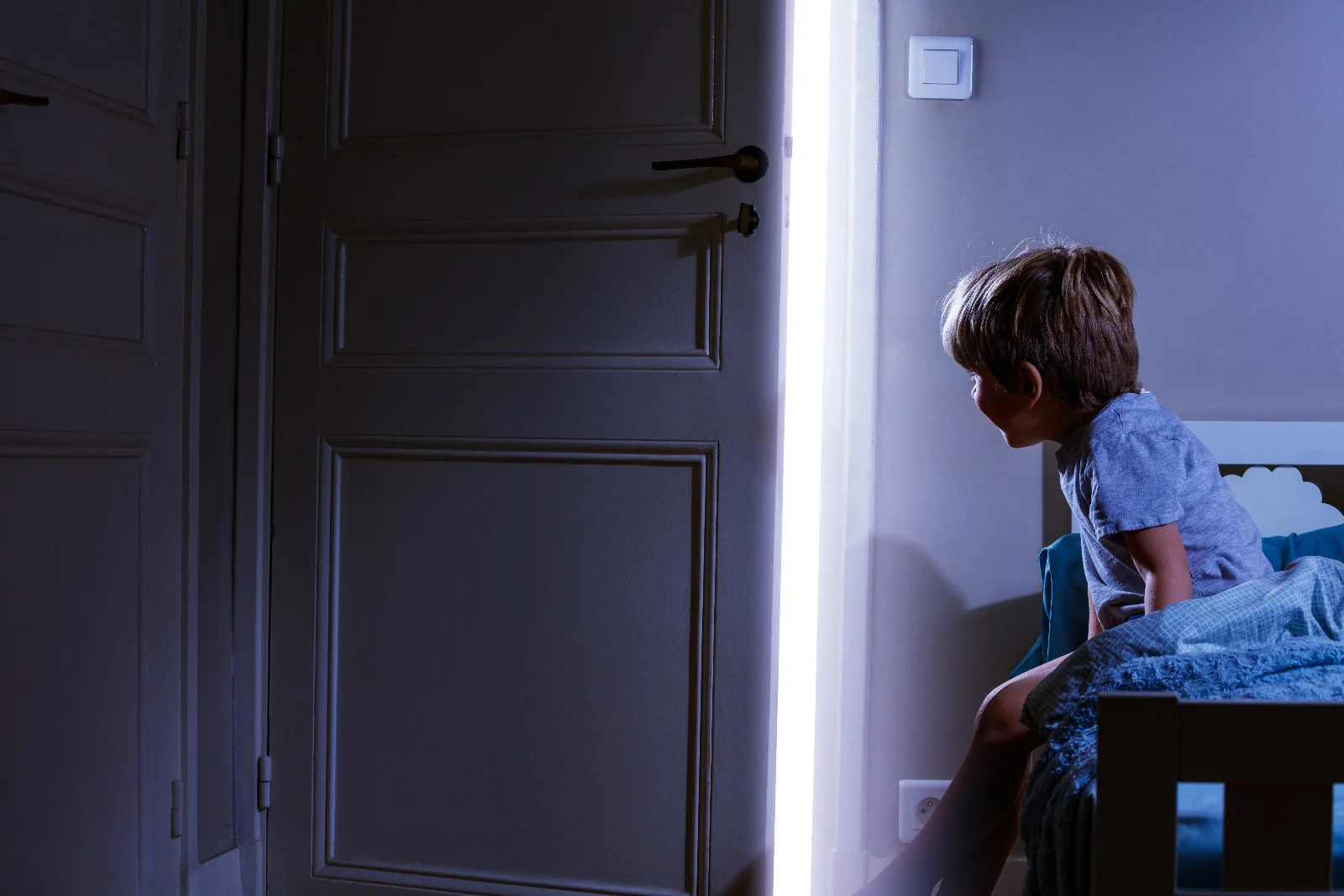
What if your toddler keeps getting out of bed?
Then you’re in good company. The AAP says twenty “farewell appearances” in one evening is “by no means an unusual number.” Each one is a chance to show your toddler the answer hasn’t changed.
Pick one short sentence before the first night and use it every time. A parent on What to Expect says what worked was walking their child back every time and saying the same phrase “in a boring tone” (“It’s time for you to sleep. I love you, good night”), then walking out. On r/toddlers, a parent of a 3½-year-old on a floor bed is doing the same walk at least two or three times a night.
Miri’s Tip
The other half is what you skip. The AAP says to avoid rewarding bedroom “breakouts,” like letting your child climb into your bed or join whoever’s still up.
By night four you might be running on empty, and “just this once” starts to sound reasonable. Keep the trip the same anyway. The sameness is the whole method.
 Save
You may also come across the Bedtime Pass, which was tested in a small randomized trial of 19 children aged 3 to 6 who resisted bedtime. Its authors describe it as an extinction-based procedure. Our bedtime routine post has a little more on it, and it’s worth talking over with your pediatrician before you try it.
If the night trips don’t settle down, or bedtime turns into a fight every night, bring it up with your pediatrician. The AAP lists stalling and resisting going to bed among the most common sleep problems in children, and says most sleep problems are easily treated.
Frequently Asked Questions
When should a toddler transition into a bed?
A toddler should transition into a bed when the signs show up, since the AAP’s advice is built on signs. Climbing out of the crib means it “may be time,” and once children are about 3 feet tall, the AAP says they should start sleeping in a bed. Until one of those happens, there’s no rush.
Does a 2 year old still need to sleep in a crib?
A 2-year-old can keep sleeping in a crib until one of the signs shows up: climbing out, standing about 3 feet tall, or a crib mattress already at its lowest setting. If none of that is happening and your toddler sleeps well there, keeping the crib a while longer is a perfectly reasonable choice.
Is 4 too old for a toddler bed?
Four isn’t too old for a toddler bed on its own. What counts is whether your child still fits the bed: the CPSC defines a toddler bed as one meant for a child who weighs no more than 50 pounds, so check that and the label on yours. If your 4-year-old is still in a crib, measure them. Once children are about 3 feet tall, the AAP says they should start sleeping in a bed.
Conclusion
You don’t have to solve all of this the night that first leg goes over the rail. If the new bed isn’t ready, the crib mattress can go on the floor while you wait, and the room check can happen over an evening. After that, the first couple of weeks mostly ask you to be calm, consistent and a little dull, which is easier said than done at 10 p.m. on night three. Tonight, after your toddler is asleep, look at which setting the crib mattress is on.
While you’re in there, crouch to your toddler’s eye level and walk the room once. You’ve kept up with a climber this long, and you’ll keep up with this too.
Miri
Fewer toys, deeper play.
Further Reading & Resources
See all 13 sources
- Big-kid beds and cribs: Big Kid Beds: When to Switch From a Crib · Choosing a Crib (American Academy of Pediatrics, HealthyChildren.org) · Toddler Beds (U.S. Consumer Product Safety Commission) · 16 CFR Part 1513: Requirements for Bunk Beds (eCFR)
- Sleep: How to Keep Your Sleeping Baby Safe: AAP Policy Explained · Healthy Sleep Habits: How Many Hours Does Your Child Need? · Toddler Won’t Go to Sleep? 7 Tips to Help End Bedtime Battles (American Academy of Pediatrics, HealthyChildren.org) · Evaluating the Bedtime Pass Program for child resistance to bedtime: a randomized, controlled trial (Moore, Friman et al., Journal of Pediatric Psychology, 2007)
- Home safety: Home Safety: Here’s How (American Academy of Pediatrics, HealthyChildren.org) · Childproofing Your Home (U.S. Consumer Product Safety Commission)
- Real parents: 3.5 year old bedtime is worse than the newborn stage (r/toddlers) · Big Bed Transition Sleep Struggles 4YO (What to Expect)