It’s 10 a.m. when your phone lights up with the daycare’s number. Your toddler has a fever, and could you come get them? Your laptop is still open on the kitchen table, halfway through an email, and there’s a call on your calendar at eleven.
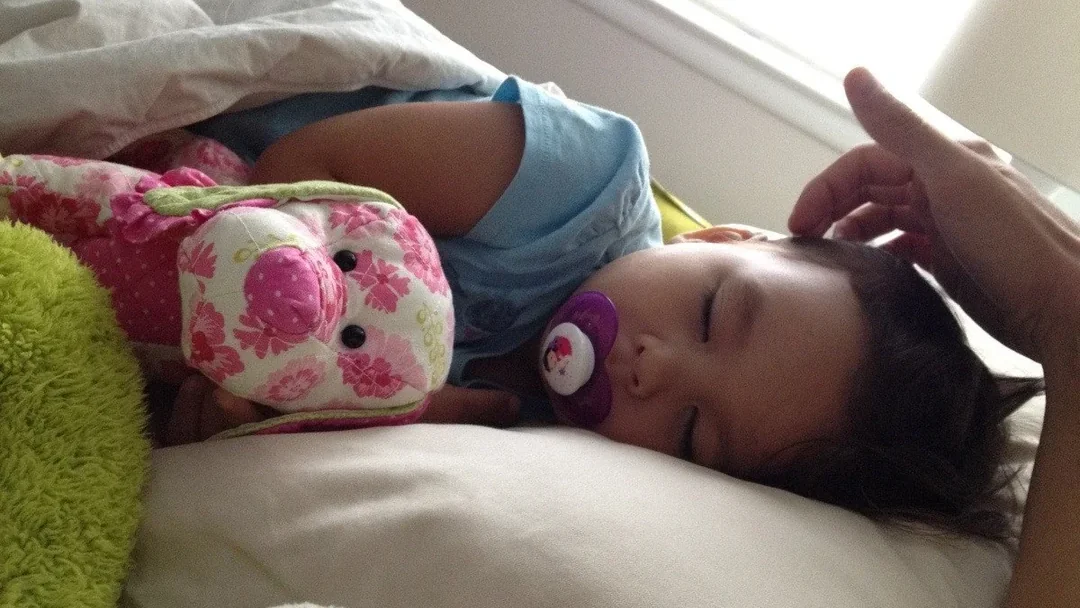
By the time you’re home, the day you planned has quietly packed up and left. Your toddler is tired and out of sorts. They push the blocks away. The puzzle they loved yesterday gets one look. They want your lap, then the floor, then your lap again. And when you finally turn on a show so you can answer one message, the guilt shows up right on cue.
It takes a village, people say. On a Tuesday morning with a sick kid, the village is usually you.
The part of a sick day you can plan ahead is the play. This post walks you through a basket of quiet things, packed once from what’s already in your house and sorted by how much energy your toddler has. Making it takes about ten minutes. It’s the slow, sofa-sized end of everyday Montessori activities at home, and none of it asks you to play cruise director while you work.
 Save
What does a sick toddler actually need from play?
If you’re wondering what to do with a sick toddler, start smaller than you think: rest comes first, and play is just there to keep them comfortable and calm. Familiar, low-effort things work better than anything new.
On an ordinary day, play is how toddlers practice nearly everything. A sick day runs on different terms. Nobody has to learn a color or finish a puzzle. The goal is a quiet stretch where your child feels okay, and you can see them from wherever you’re sitting.
That’s why the most familiar things tend to win. In Montessori, practical life is the name for the real, everyday jobs a child can do with their own hands, like wiping a table or pouring water. On a sick day, the gentlest versions still fit: handing you socks while you fold, or watering one plant by the window.
Some toddlers want to be held for most of the day, and that counts too. A lap, a blanket and the same book read twice in a row make a perfectly good sick day plan.
And if anything about how your toddler seems today worries you, call your pediatrician. This post sticks to the play.
 Save
The sick day basket: set it up before you need it
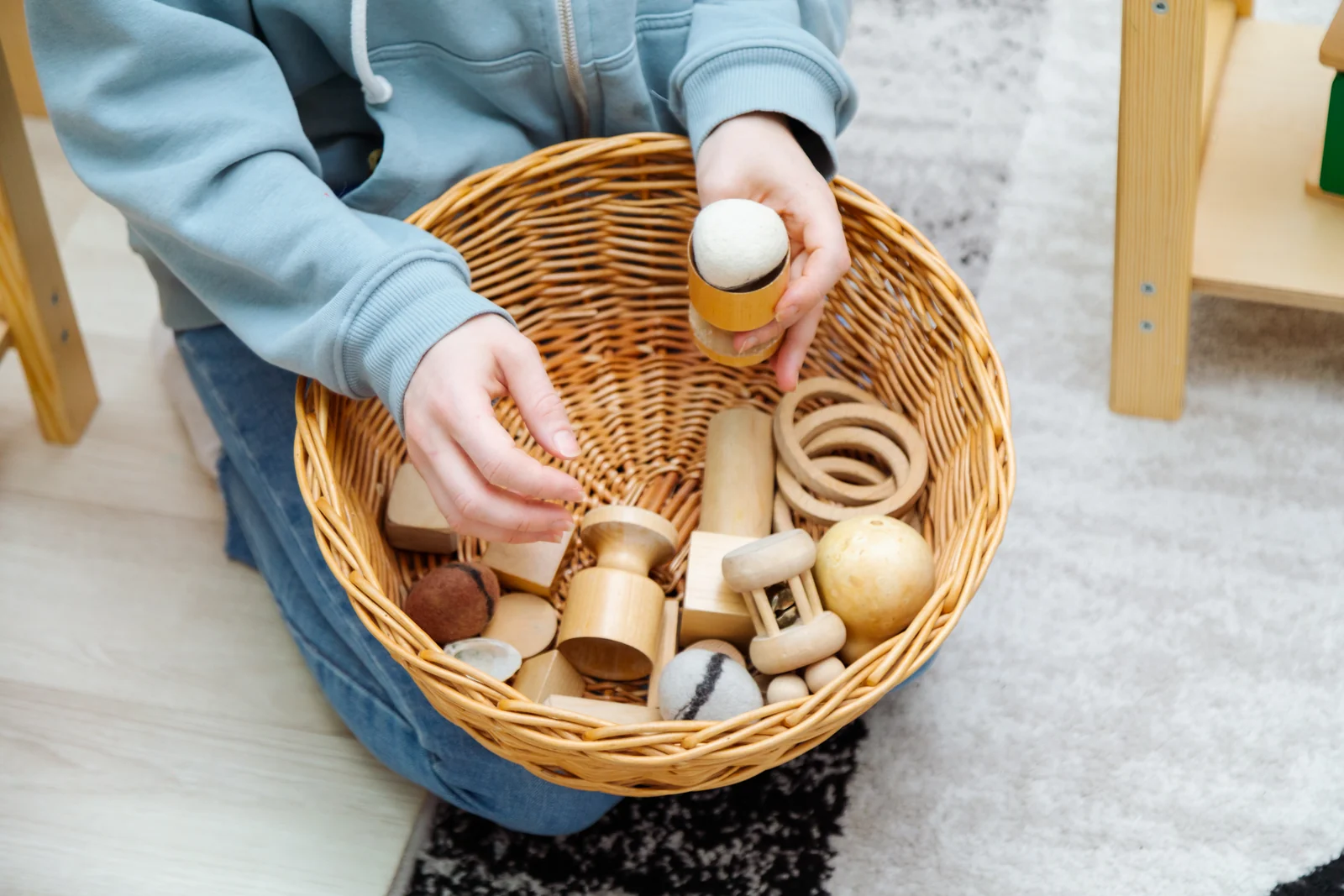
Pick a handful of quiet things you already own, put them in one basket and store it up high, away from everyday play. On a sick day, bring it down and let your toddler choose from two or three things at a time.
The trick is packing it on an ordinary evening, when everyone’s well and you have ten spare minutes. On the morning the daycare calls, nobody has the bandwidth to hunt for the crayons.
- Grab one basket or tray. Anything with low sides that your toddler can see into.
- Walk through the house once. Pick one or two things for each energy level in the table below: something to look at while lying down, something for busy hands once they’re sitting up, something for the bouncing-back day.
- Check each item against its age label. The small-parts check further down takes a minute.
- Put it up high. A closet shelf works. The basket only comes down on sick days.
- On the day, offer two or three things. Hold them out and let your toddler point.
When Will is home sick, I set out a separate tray for him. It holds only things that need very little movement, like a simple puzzle and a lift-the-flap book. Anything that takes a lot of concentration, or gets him moving hard, gets put away for the day. What I’m going for is a quiet spot where he can rest and get his energy back. A tray or a basket does the same job.
If your toddler already loves a sensory bin, think of this as its quieter cousin: fewer pieces, and nothing to pour across the couch.
 Save
Letting your toddler choose is the part I’d hold on to. A sick day takes a lot of choices away from a small child. They can’t go to daycare, they can’t run around, and they don’t feel like themselves. Picking the book, or turning down the puzzle, hands a little control back. That’s my own read, with no study behind it, but toddlers want a say in nearly everything, and being sick doesn’t change that.
My hunch is that keeping the basket for sick days only helps too, because things that show up a few times a year still feel a bit special. That’s really all a Montessori sick day comes down to: a prepared spot, a few real choices, and you within sight.
Bring your work to your toddler. When Will is home sick, I move my work and the light chores, like a pile of laundry to fold, down to the floor right next to his mat. I can keep the essentials going and still see him the whole time.
Miri’s Tip
Quiet activities for a sick toddler, by energy level
Check your toddler’s energy before you reach into the basket. Quiet activities for a sick toddler work when they match where your child is today: resting, sitting up on the sofa, or recovering and ready for a little more.
Energy on a sick day ebbs and flows. A toddler who spent breakfast flat on the couch might want playdough by lunch and be back under the blanket an hour later. So treat the three levels as a menu you can move up and down all day.
| Energy level | What it looks like | Try | Safety note |
|---|---|---|---|
| Resting | Lying down, heavy-eyed, wants you close | Board books read aloud while you cuddle · an audiobook or quiet songs · a lift-the-flap book on their chest | Snacks wait until they sit up |
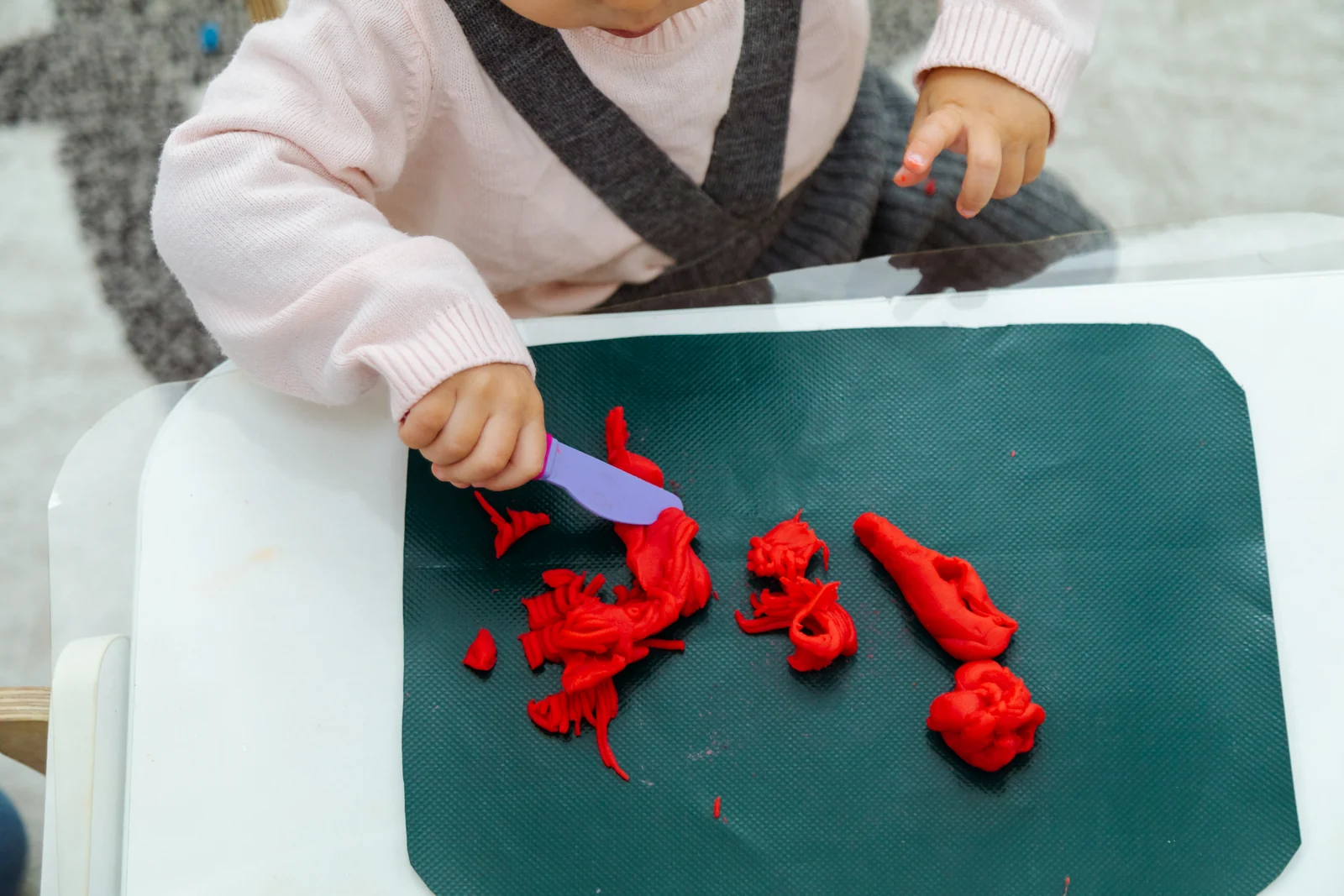
| Sofa | Propped up on pillows, curious for a few minutes at a time | Playdough on a tray · crayons and paper on a clipboard · a sheet of stickers · a simple puzzle | Stay close: crayons, stickers and playdough can end up in mouths |
| Recovering | Up and wandering, a bit bored, still not their usual self | Pouring cups in the bath · peeling a clementine at the table · block building · a blanket fort | Arm’s reach in the bath · cut fruit small |
Resting. This is the lap-and-blanket level. Board books are the steady choice here, read slowly, with your toddler picking which one comes next. An audiobook or a playlist of quiet songs on a speaker can fill the room when your voice needs a break, or when you need both hands to reply to an email.
Sofa. Once they’re sitting up, hands want something to do. Playdough on a rimmed tray keeps the bits off the cushions. Crayons on a clipboard behave better in bed than loose paper does, and a sheet of stickers can keep small fingers busy for a good while.
 Save
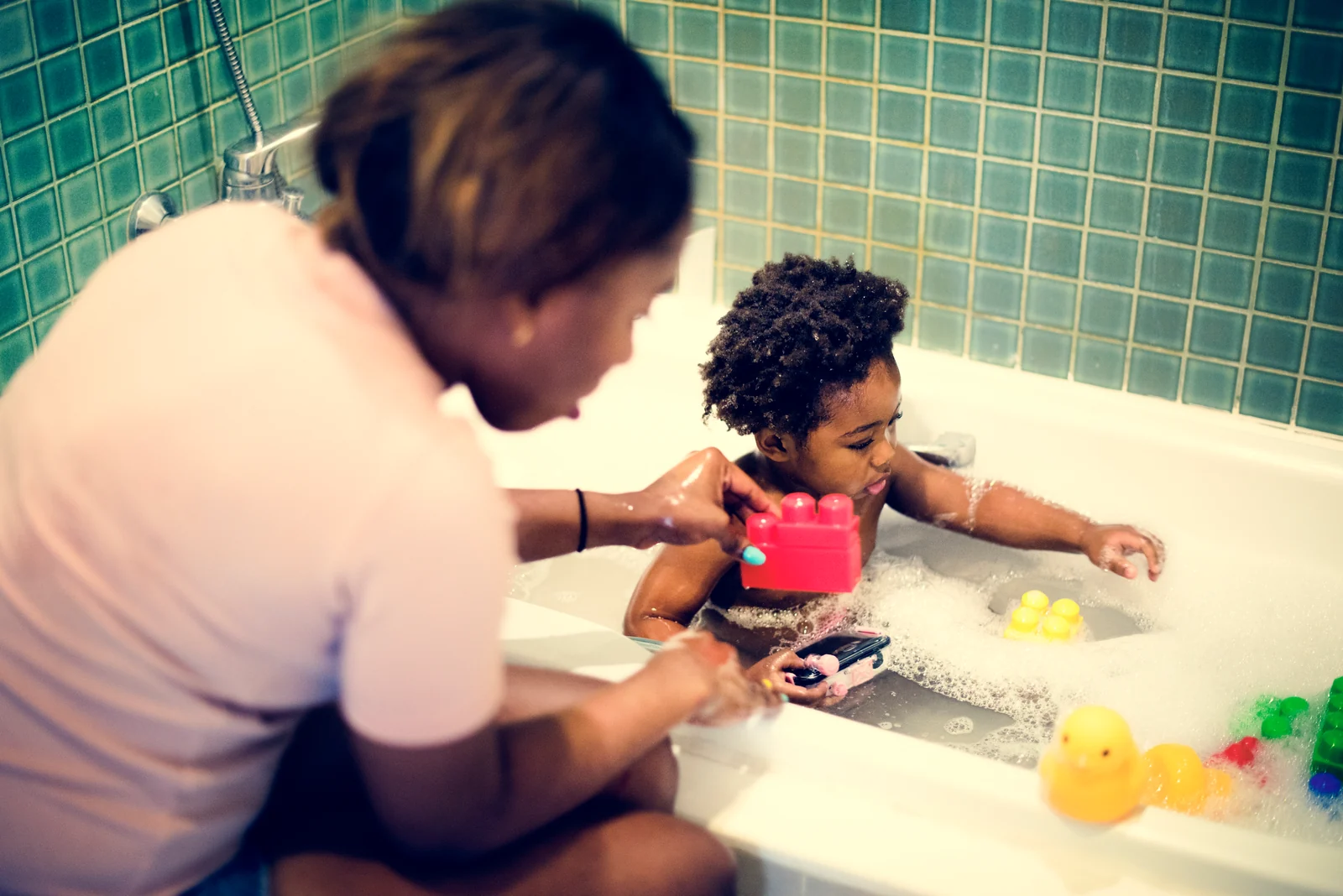
Recovering. This is the restless, bored-on-the-couch day before they’re fully back to themselves. Pouring water from cup to cup in a warm bath keeps hands busy without much effort, and it’s one of the easier sensory activities for toddlers to pull off on a low day. Peeling a clementine at the table gives fingers a real job, with a snack at the end of it. A blanket draped over two chairs turns the living room into a fort, which might be all the excitement the day needs. Once the sick part is over but you’re still stuck inside, the longer list of indoor activities for toddlers picks up where this one ends.
 Save
Snacks are for sitting up. The American Academy of Pediatrics (AAP) says children should sit down when they eat and should never run, walk, play or lie down with food in their mouths, so the clementine waits until your toddler is upright, with you watching. Peel it, then cut the segments into pieces no larger than half an inch, the size the AAP gives for young children’s food.
Bath play needs you within arm’s reach. Young children can drown in as little as an inch or two of water, quickly and silently, so the AAP recommends staying within arm’s length the whole time. Drain the tub as soon as you’re done.
Put together, the three levels give you something you can actually work around. Your toddler has one gentle thing to do, picked by them, and you get a stretch long enough for a phone call, or for finishing the email you left half-written at ten o’clock.
How one Montessori family handled a sick week
Nicole Kavanaugh, a Montessori mom who blogs at The Kavanaugh Report, wrote about her young toddler’s sick week in January 2018. Her list ran long, but three things on it suit a low-energy day: books, lots of cuddled-up reading, and different kinds of cups.
What I like about her post is how ordinary it is. It reads like a week of getting through, with a few ideas that held up.
Case: Nicole Kavanaugh’s sick week with a young toddler
Her son Gus was a young toddler when he got sick that January. In “Entertaining a Sick Toddler”, she walks through how they spent those days at home, with more ideas than fit here. These are the three that suit a low-energy day:
- Step 1: Books, books, and more books, as she puts it. Books are the easiest thing to reach for when a sick toddler can’t do much else.
- Step 2: Reading cuddled up together. A lot of the week was spent close.
- Step 3: Different kinds of cups. She offered drinks in different types of cups, anything that might spark Gus’s interest in drinking.
“We spend tons of time cuddled together reading.”
Nicole KavanaughMontessori mom and blogger, The Kavanaugh Report (2018)
Books and cuddling are the resting row of the table above, and some sick days never get past that row. That’s fine.
 Save
Screens on sick days, without the guilt
On a sick day, a show that buys you one phone call is a tool, and you can use it without guilt. When you can, watch together, and keep your own songs and stories for soothing and sleep.
If the TV went on this morning so you could take that eleven o’clock call, you don’t owe anyone an apology. Sick days bend a lot of the usual house rules, from naps to snacks to how long everyone stays in pajamas. The guilt tends to come from a fuzzy sense of what pediatricians actually say about screen time, so it helps to see it in plain words.
The AAP’s family guide to its updated media policy says babies under 18 months learn best from real-world interactions, and its advice for whenever a screen is on is to watch and play alongside your kids. Its 2026 policy statement in Pediatrics suggests that for toddlers and preschoolers, time limits might be under an hour a day.
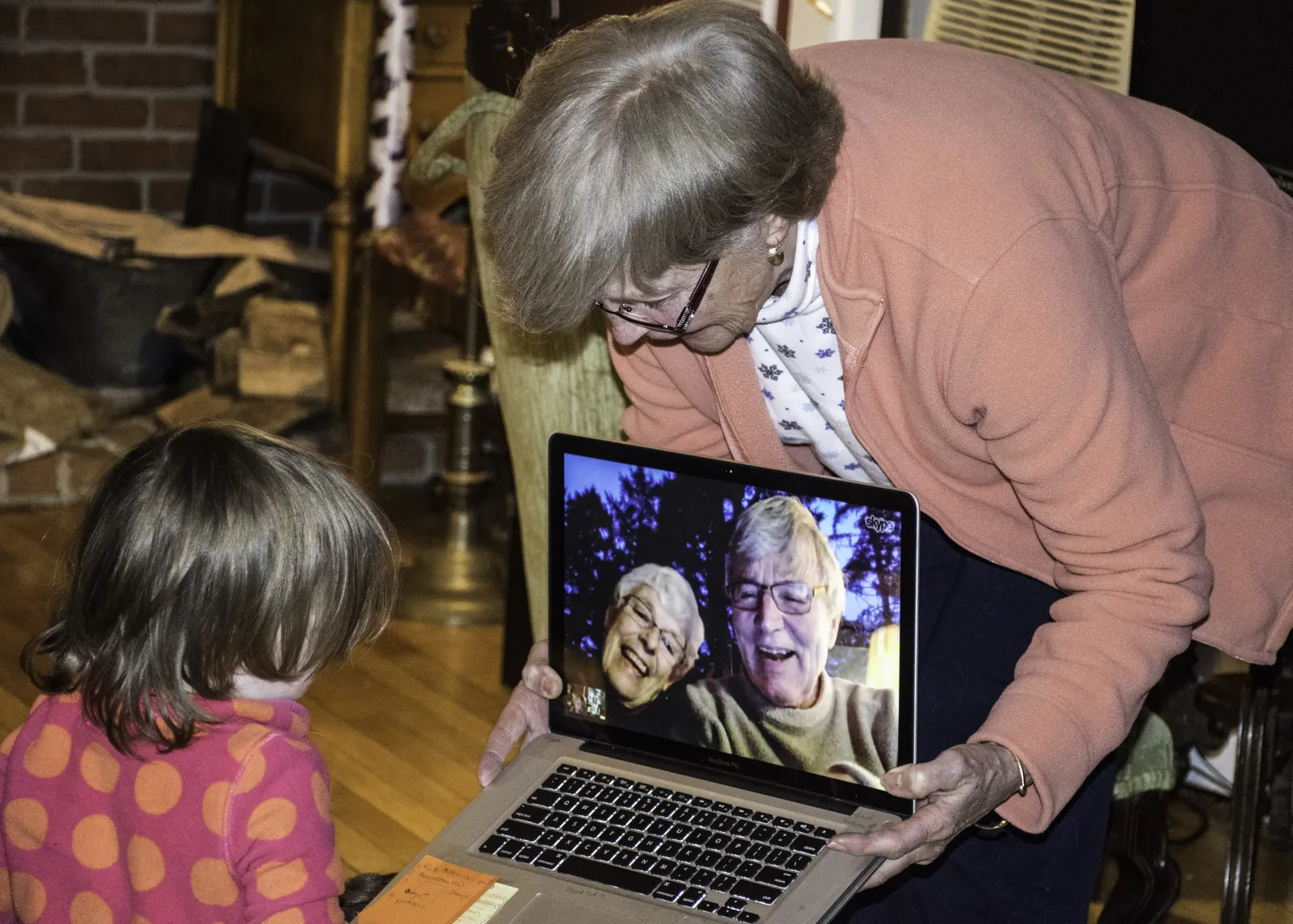
An AAP page about screen time for infants makes two more points that carry over well to a sick day. Video chats can help build relationships between your child and the people they love, so a call with Grandma is time well spent. And it’s worth trying not to get into the habit of using screens to stop crying or to get a child to sleep, because songs and stories in your own voice, the page says, make more of a positive impact than any video.
My own take, from one parent to another: if a show buys you the call, let it. When the call ends, turn it off and come sit down. Keep the singing and the made-up stories for the moments when they’re crying, or drifting off on your shoulder.
A sick day has room for a cartoon and a cuddle. You’re allowed to have both.
How screens fit into an ordinary week for a child under 3 is a bigger conversation, and it deserves its own space.
 Save
A quick small-parts check before play in bed
Before the basket goes up on the bed or the couch, take each item out, check it against the age label on its package, and set aside anything with small, loose pieces.
Play in bed has its own catch. A toddler lying down is at eye level with every crumb and crayon, and the folds of a blanket are very good at hiding things.
Babies and toddlers are at the highest risk of choking, the AAP says, because they explore by putting things in their mouths. Follow the age recommendations on toy packages, and watch older siblings: many choking incidents happen when one gives a younger child food, a toy or a small object.
Crayons are minimally toxic, says the Illinois Poison Center, but they can be a choking hazard too: if your child is choking on one, call 911 immediately. The Tennessee Poison Center estimated that one tablespoon from two of three homemade salt dough recipes it tested could put a 22-pound child in the toxic range for salt. If your toddler eats some of that dough, call Poison Help at 1-800-222-1222.
When play winds down, everything goes back in the basket. Run a hand along the couch cushions and shake out the blanket, because whatever slipped out of sight during the afternoon is still in there somewhere.
 Save
The basket is a one-time job. Pack it once and it’s there for the next call from daycare, and the one after that, all year. Swap a book or two when your toddler outgrows them, and check the age labels again when you do.
Conclusion
Tonight, or any ordinary evening this week, grab a basket and drop in a few board books, a simple puzzle and a lump of playdough in a lidded tub. Put it somewhere high, and that’s the whole prep. The next sick day will still be long, and you’ll still be juggling a laptop and a tired kid, but you’ll have one thing ready before the phone rings. A sick day can be slow and a little messy and still be a good day to be close.
Working through a sick day with a toddler on your lap is hard, and you’re doing it. Pack the basket once, then let yourself off the hook.
Miri
Fewer toys, deeper play.
Further Reading & Resources
See all 8 sources
- Screens and babies: Kids & Screen Time: The 5 C’s Questions to Ask for Infants (American Academy of Pediatrics, HealthyChildren.org)
- Screen time policy: Helping Kids Thrive in a Digital World: AAP Policy Explained (American Academy of Pediatrics, HealthyChildren.org) · Digital Ecosystems, Children, and Adolescents: Policy Statement (Pediatrics, 2026)
- Choking and mealtimes: Choking Prevention for Babies & Children: What Every Parent Needs to Know (American Academy of Pediatrics, HealthyChildren.org)
- Water: Drowning Prevention for Curious Toddlers: What Parents Need to Know (American Academy of Pediatrics, HealthyChildren.org)
- Poison help: Back to School: What Are the Dangers of Borax Slime and Homemade Salt Dough? (Tennessee Poison Center, Vanderbilt University Medical Center, 2016) · My Child Ate Crayons (Illinois Poison Center)
- Real parents: Entertaining a Sick Toddler: Montessori Young Toddler Week 7 (Nicole Kavanaugh, The Kavanaugh Report, 2018)