It’s 9:40 at night. The baby is finally down, and you’re on the couch scrolling a Montessori shop with one thumb. A low wooden shelf. A rainbow stacker. A “starter bundle” where every piece matches. You add it up in your head, wince, and close the tab. Your feed is full of Instagram-worthy playrooms, and not one of them fits this month’s budget. Maybe this is a thing for other families.
 Save
SaveI never bought the classic Montessori materials, like the pink tower and the brown stair, those sets of wooden blocks in graduated sizes you see in Montessori classrooms. They’re expensive. They’re bulky. And my hunch was that a kid would play with them for a short while and then be done. So I went to the kitchen instead: baskets and colanders, clothespins, dried beans, cardboard boxes. My son, Will, still got plenty of practice with his hands, and our budget didn’t take the hit. (Beans come with a big safety note, and you’ll find it further down.)
You’re not the only one wondering whether Montessori is even possible on a tight budget. One parent asked it plainly on Reddit’s Montessori forum:
“Is there a way to educate my kid in Montessori even if I can’t afford a school?”
A parent on Redditr/Montessori thread (2026)
The short answer is yes. If you’re brand new to all of this, the bigger picture of Montessori at home lives in our main guide. This one is about doing it for $0, starting tonight.
Can you do Montessori without buying toys?
Yes, you can do Montessori without buying toys. Montessori educator Simone Davies says you don’t need to buy anything to practice the principles at home, and your kitchen already holds plenty to start with.
In her words:
“You do not need to buy anything to practice Montessori principles at home.”
Simone DaviesAMI Montessori educator, The Montessori Notebook (2024)
The principles are the part that counts. Maria Montessori was writing about her classrooms for children around 3 to 6, but one line from The Montessori Method (1912) carries straight into a home with a baby. Habitually serving children, she wrote, “tends to suffocate their useful, spontaneous activity.” So the Montessori move is often to do a little less for your child, not to buy more for them.
That’s the idea behind what people call Montessori minimalism. Fewer things, chosen on purpose, and a lot of ordinary life. The room, the routine and the chance to help matter more than whatever sits on the shelf. Montessori without buying toys isn’t a lesser version of the real thing. It’s the real thing with a smaller receipt.
Parents on Reddit keep giving the same advice when money is tight, across threads on r/Montessori, r/MontessoriForHome and another MontessoriForHome thread: start with household objects, real chores and the principles themselves. No toy kit required.
Miri’s Tip
What is “practical life,” and why does your kitchen count?
Practical life is the Montessori name for everyday jobs like dusting, sweeping, setting a table and taking care of yourself. Your kitchen counts because it’s full of those jobs, and the tools are already in the drawers.
The Association Montessori Internationale keeps a glossary of Montessori terms, and it describes practical life exercises as “exercises of daily life for the preservation of the environment such as dusting, sweeping, laying a table, and care of self.” According to the same entry, these jobs build coordination, ask for patience and focused attention, and help a child become “a contributing person in the community.”
For the youngest kids, the American Montessori Society’s guide to infant and toddler programs lists the same kind of real tasks. Toddlers learn to use the toilet and wash their hands, and setting the table for lunch is on its list of practical activities. Nothing on that list comes in a box.
Picture the grocery haul. You’re unloading bags onto the counter, and a toddler is right under your feet, grabbing for whatever you’re holding. Instead of moving everything higher, hand over a job. The napkins go to the table. The unbreakable cups go in the low drawer. Suddenly there’s a very serious helper in your kitchen, and that’s independence in its most ordinary form.
 Save
SaveYour toddler doesn’t want a toy version of your day. They want a turn at the real one.
Free Montessori activities by age (printable)
Free Montessori activities for babies center on a basket of safe kitchen things to hold and explore. For toddlers, they’re real household jobs in small versions. Both tables below are made to print.
If you came here hoping for a Montessori activities PDF, these two tables are the printable. Print the page or screenshot them, then tape them inside a kitchen cabinet. One rule runs through every row: nothing goes within reach of a child under 3 until it has passed the small-parts test further down.
Babies: a basket of ordinary things
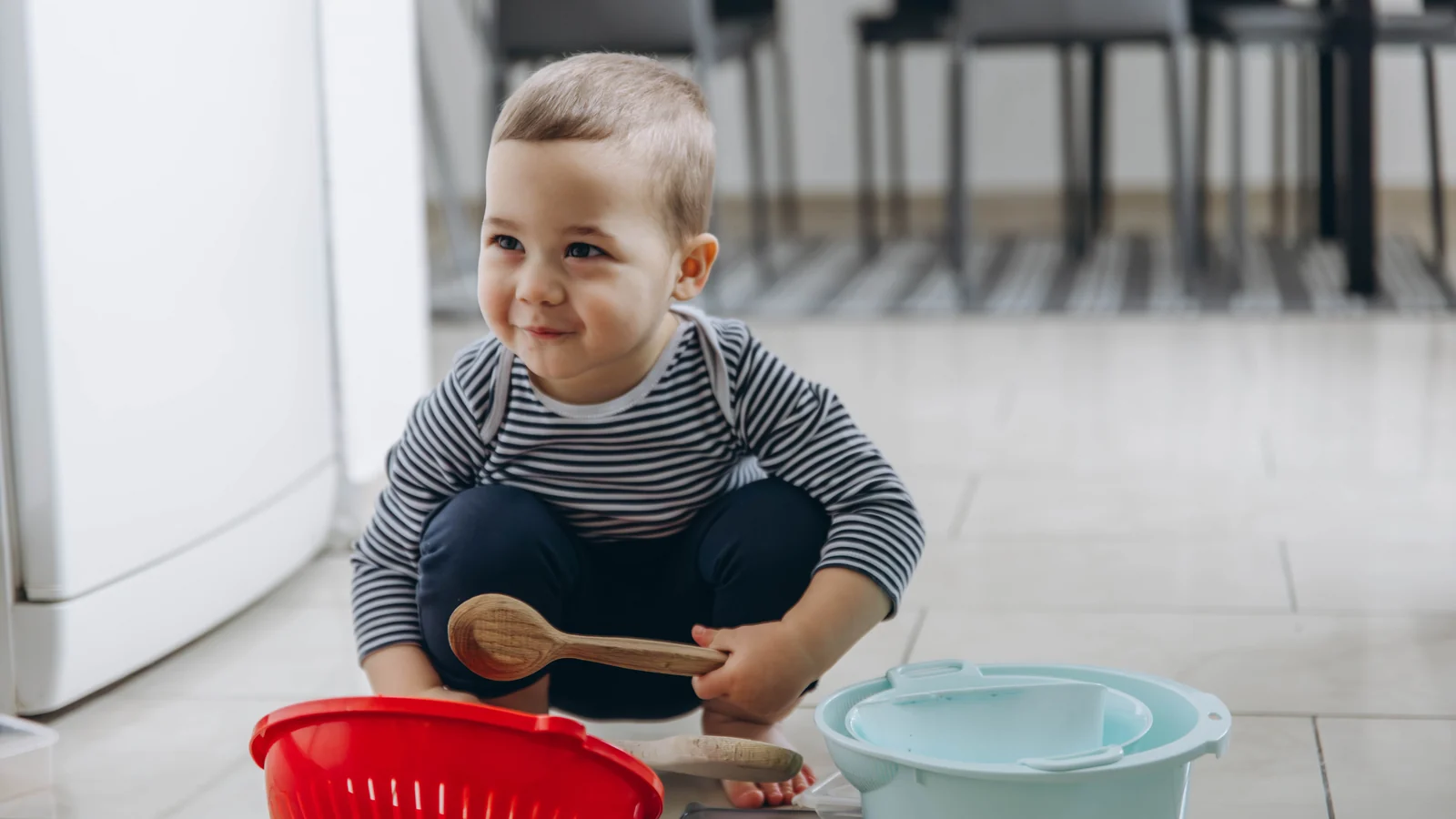
Once your baby can sit and reach, a low basket of everyday things gives them plenty to do. They’ll hold it, mouth it, bang it on the floor, drop it and pick it up again. That’s sensory exploration, and a wooden spoon is a fine place to start. Some families call this a treasure basket, and putting together a full one is a project of its own.
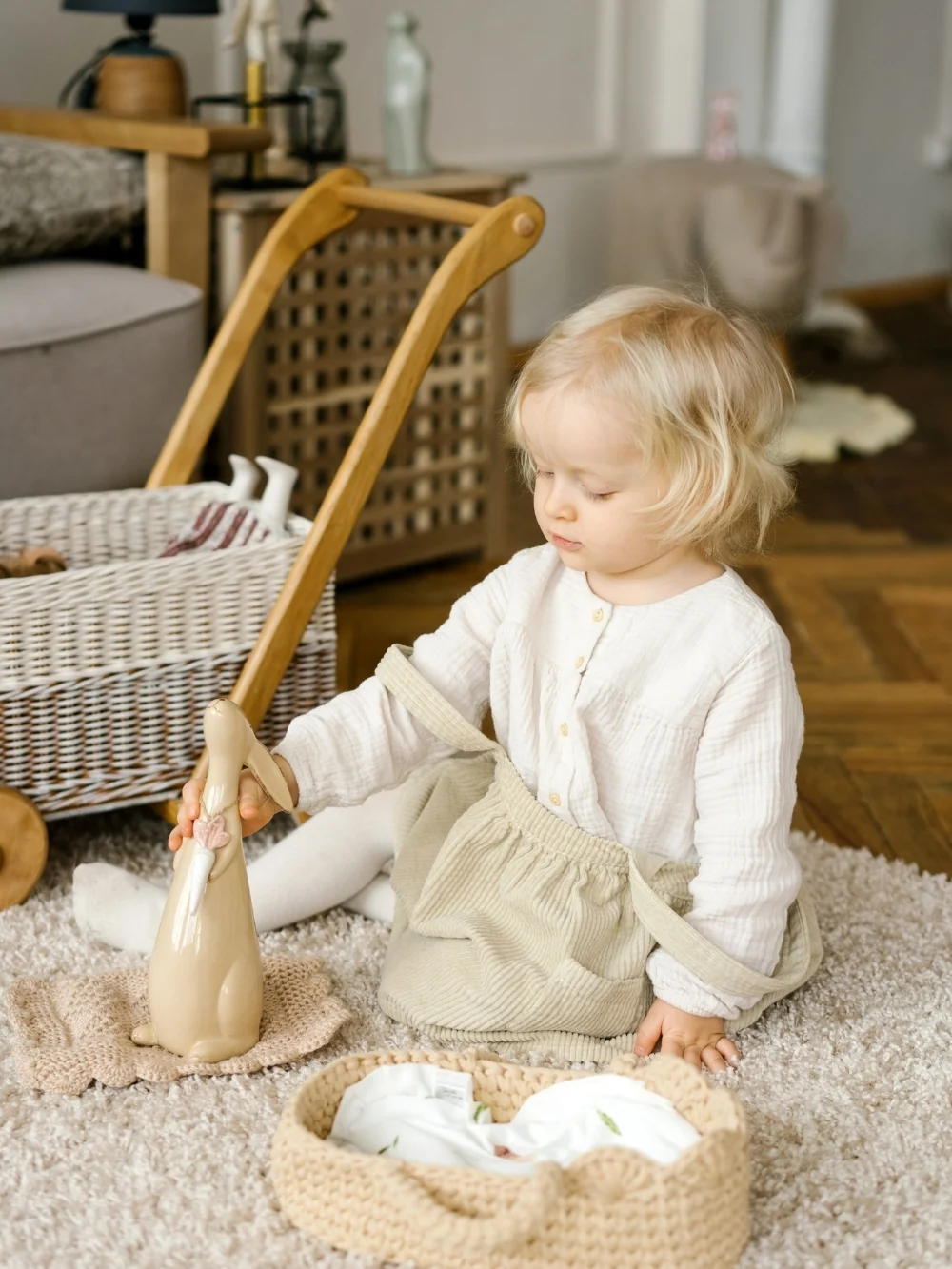
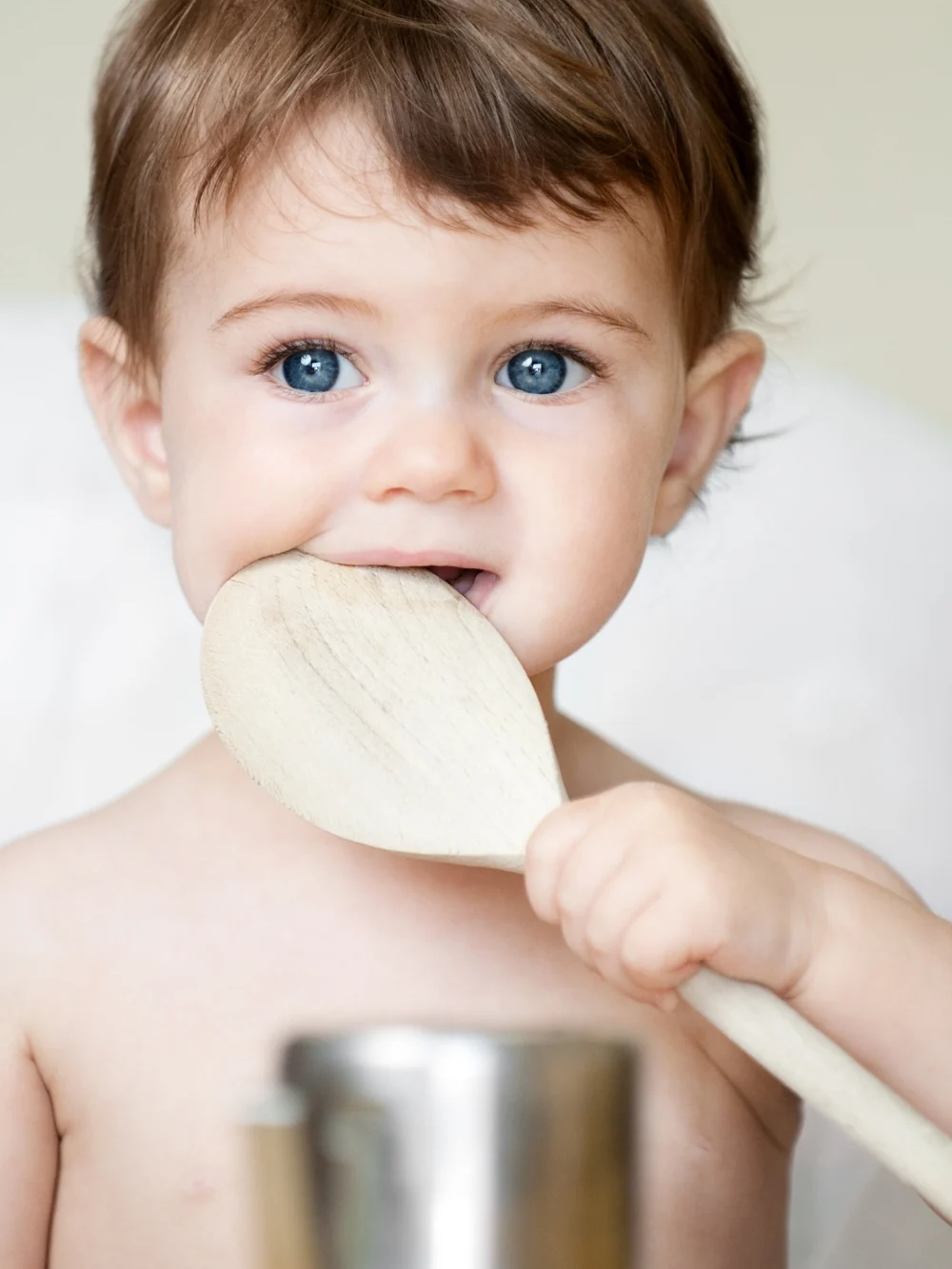
Baskets and colanders were part of my kitchen kit, and either one can be the basket itself. Start with three or four things. Watch which one your baby keeps coming back to, and swap out the ones they ignore.
| What you already have | What your baby does with it | Safety check first |
|---|---|---|
| A low basket or colander | Reaches in, pulls things out, tips it over | No loose strands, splinters or broken edges |
| Wooden spoon | Grips it, mouths it, bangs it on the floor | Smooth all over, no cracks or splinters |
| Dish towel or washcloth | Scrunches it, tugs it, hides under it and pops back out | Plain cloth, no strings, loops or tassels |
| Metal measuring cup or small bowl | Taps it, turns it over, puts things in and takes them out | No dents or sharp edges |
| A clean, empty cardboard box | Drops things in, tips them out, pats the sides | No staples or tape that peels off |
Every item in that basket also has to pass the small-parts check below, and you stay close while your baby explores.
Toddlers: real jobs, small versions
Toddlers want to do what you’re doing. So give them the real thing in a smaller size: their own cloth, a hand brush, the napkins for dinner. These are the same jobs the Montessori glossary names, scaled down for short arms.
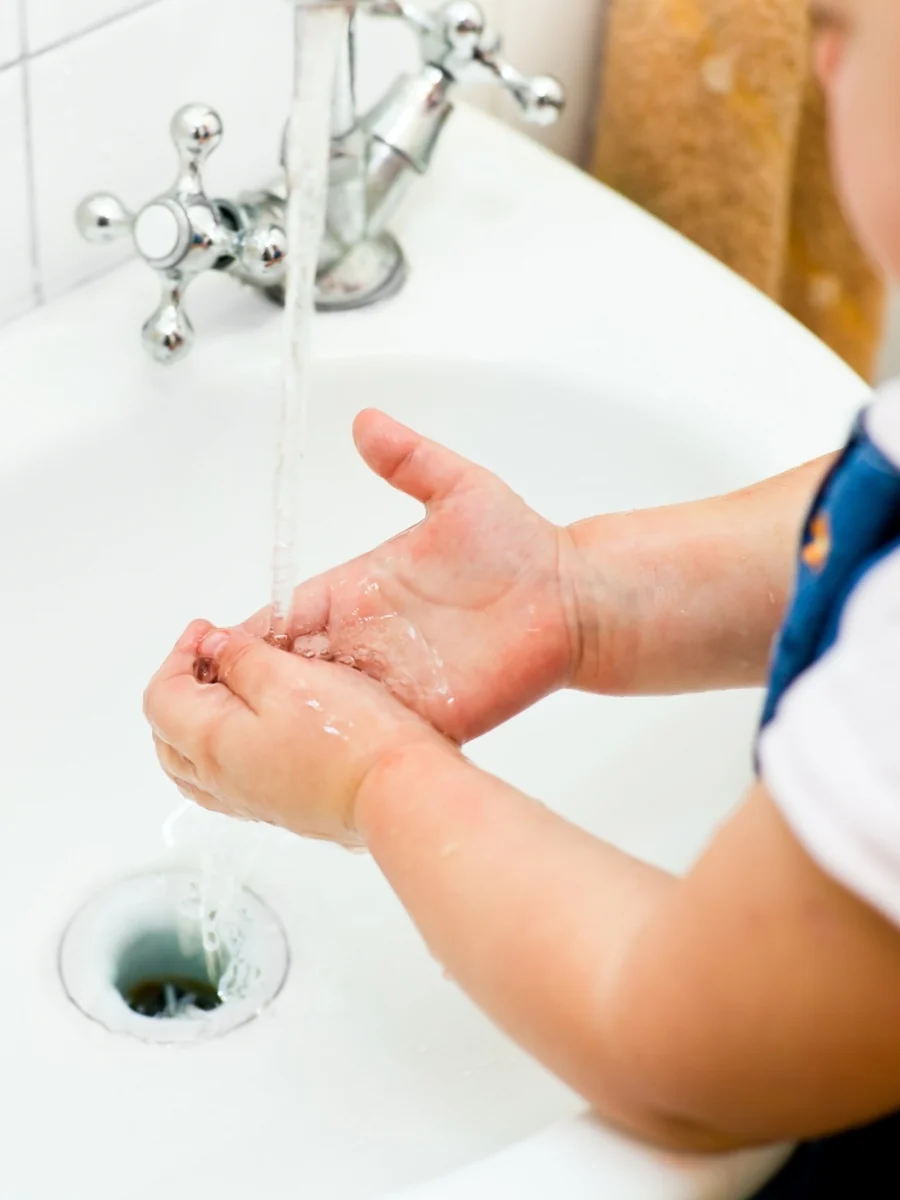
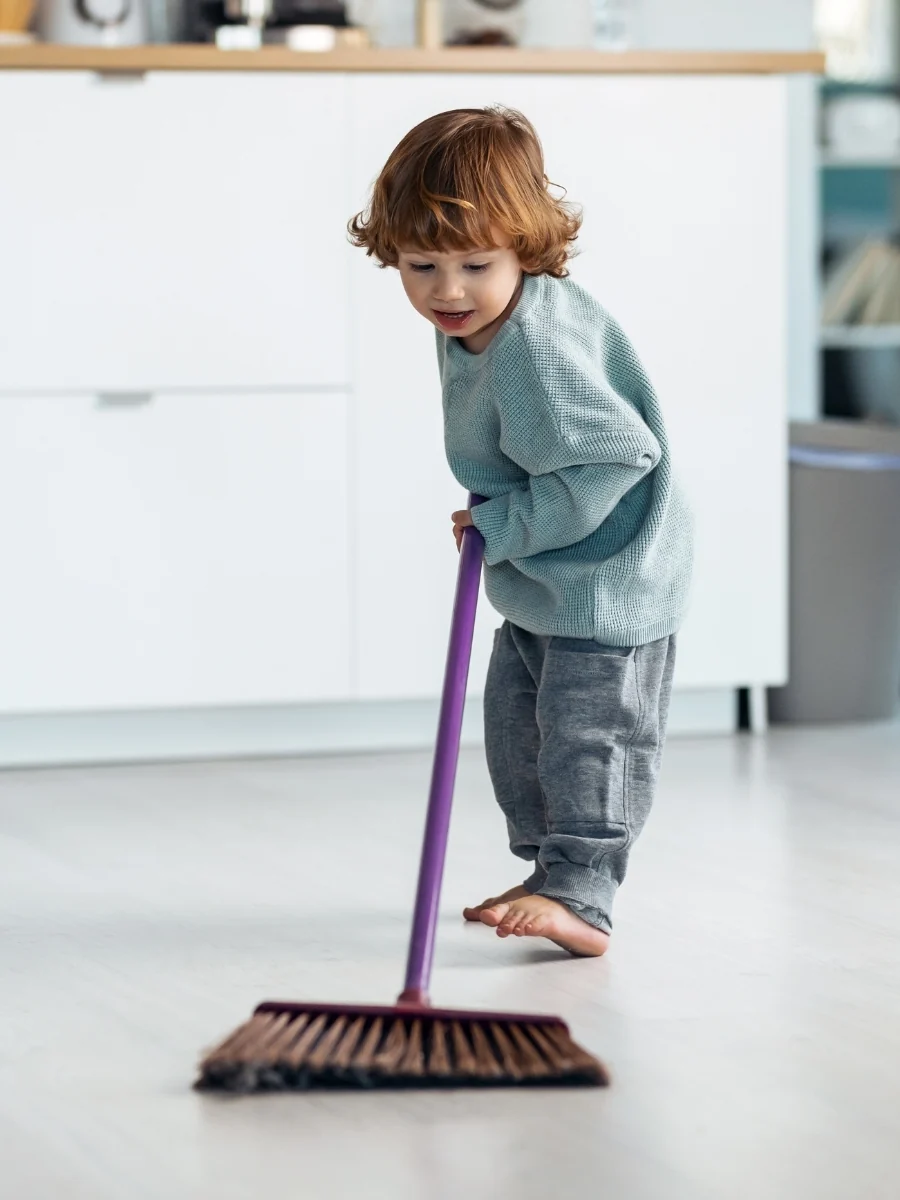
At Moje Montessori, we mark how strong the evidence is for each row, so you can tell research from philosophy at a glance.
| Real job | What it looks like | What it practices | Safety check | Evidence |
|---|---|---|---|---|
| Washing hands | Rubbing soap, rinsing, drying on their own towel | Taking care of themselves | You set the water and check it isn’t hot; stay within arm’s reach | Montessori philosophy (not tested at home) |
| Setting the table | Carrying napkins, a spoon and an unbreakable cup to each seat | Coordination, focus, helping the family | Unbreakable dishes only; knives stay with you | Montessori philosophy (not tested at home) |
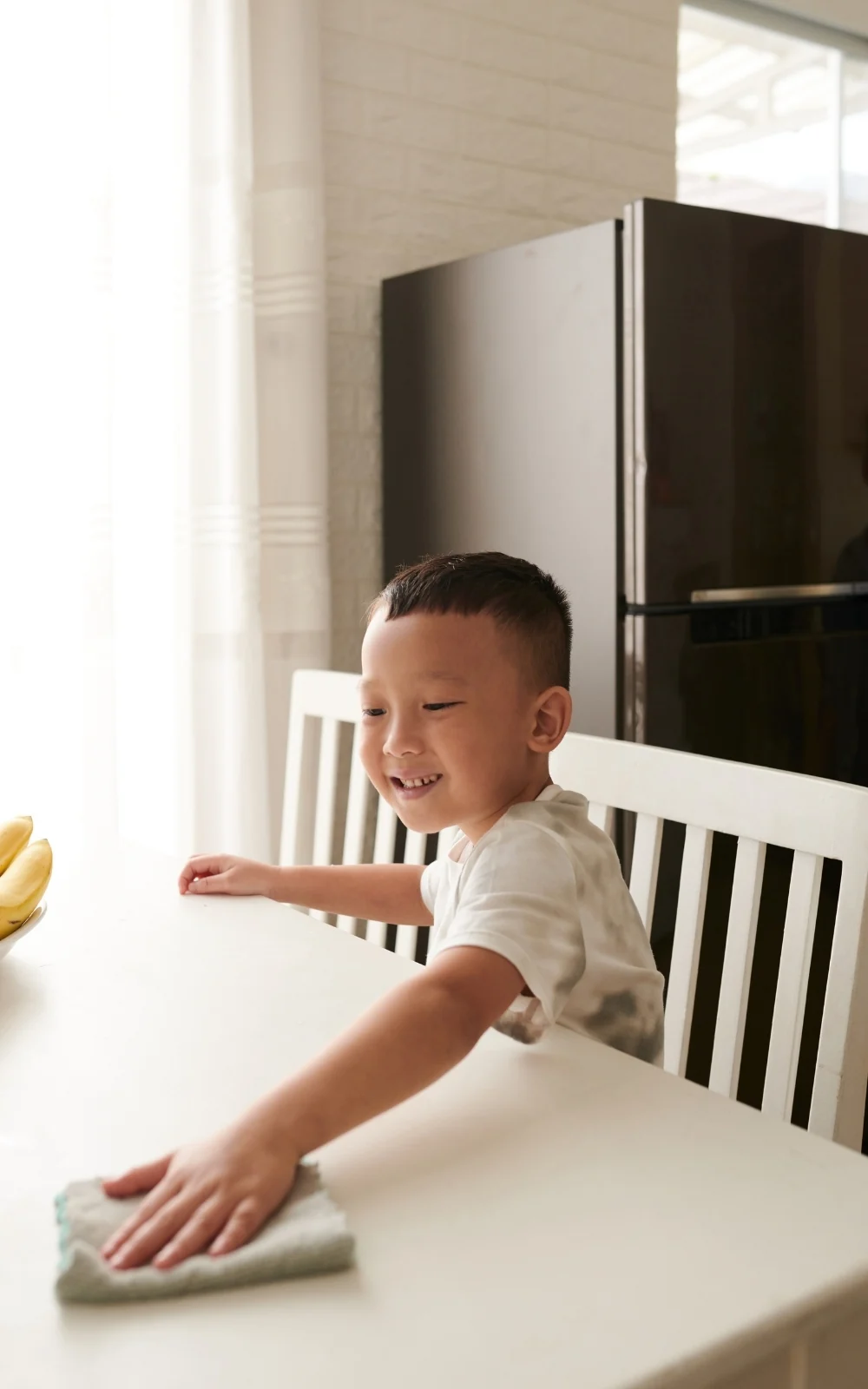
| Dusting or wiping | Wiping a low shelf or the table with a damp cloth | Coordination and patience | Plain water on the cloth | Montessori philosophy (not tested at home) |
| Sweeping | Pushing a hand brush or small broom, crumbs into a dustpan | Coordination, sticking with a job | You empty the dustpan; floors collect small things | Montessori philosophy (not tested at home) |
“Backed by research” means studies with babies or toddlers support that piece. “Some research” means part of it is supported. “Montessori philosophy (not tested at home)” means there’s little or no research on it in family homes yet.
The kitchen also kept Will’s hands busy without costing us anything. Clothespins and cardboard boxes were my standbys. You can clip a few clothespins around the rim of a basket and let your toddler pull them off, or cut a slot in a box lid for dropping things through. Squeezing a clothespin open takes real effort in small fingers, which is exactly the point.
 Save
SaveWhen I ran out of ideas, I leaned on a book of 100-ish Montessori activities built around kitchen things, and it sits with the other Montessori books for parents I’ve read.
How do you check a household object before it goes within reach?
Before a household object goes within reach of a child under 3, set it into a small-parts test cylinder without squeezing it. If it fits all the way inside, in any direction, it stays out of reach.
Toys sold for kids under 3 pass through a filter that your kitchen drawer never did. Federal law bans toys and other articles meant for children under 3 that present a choking, aspiration or ingestion hazard because of small parts. A wooden spoon, a clothespin, a bag of beans: none of those were made as toys, so no toy rule ever checked them. That check is yours.
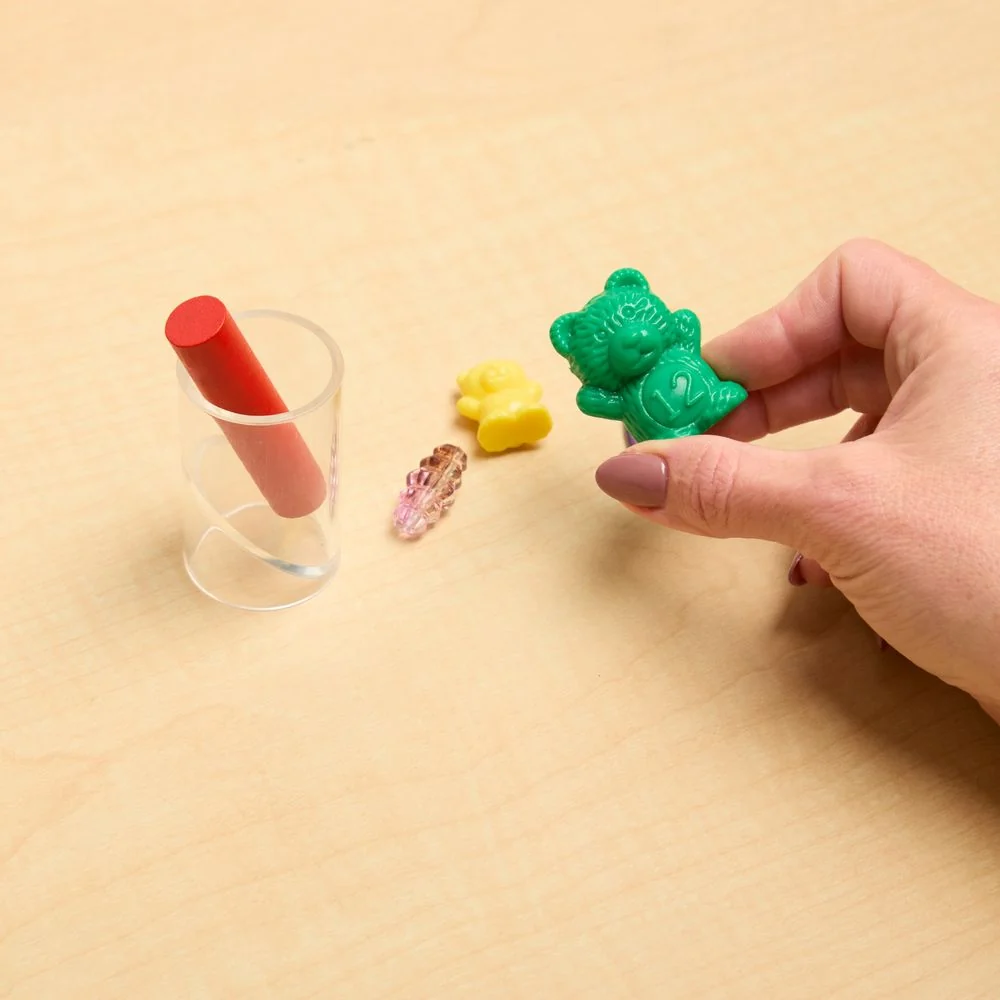
The U.S. Consumer Product Safety Commission, the federal agency in charge of consumer product safety, defines a small part as any object that fits completely into its small parts cylinder. That cylinder approximates the fully expanded throat of a child under 3.
The test itself is simple. Place the object into the cylinder without pushing or squeezing it. If it fits entirely inside, in any position, it fails. That rule was written for toys, not spoons. Using it on kitchen things is our own step at Moje Montessori, and it’s the simplest way I know to check a whole basket in a couple of minutes.
 Save
SaveRun the clothespin check twice: once on the whole clothespin, then on the spring and any piece that could come apart. No cylinder at home? Use the idea behind it. If something looks small enough that it might fit, treat it as if it does.
Dried beans are a choking hazard for babies and toddlers. They’re small and hard, and a bean that slips into the cylinder fails the test. The Centers for Disease Control and Prevention, the US public-health agency, lists whole beans among choking hazards for young children. The American Academy of Pediatrics, the main US pediatricians’ group, says to keep high-risk foods away from children until age 4 or older, depending on the child. If you use the beans for scooping or pouring, sit right beside your child the entire time, and put the beans back up out of reach the moment you’re done.
Button batteries, magnets and long cords don’t belong in any activity basket. Keep them out of reach altogether.
The rest of a safe home, from anchoring furniture to safe sleep, is covered in our guide to setting up a Montessori home for ages 0 to 3.
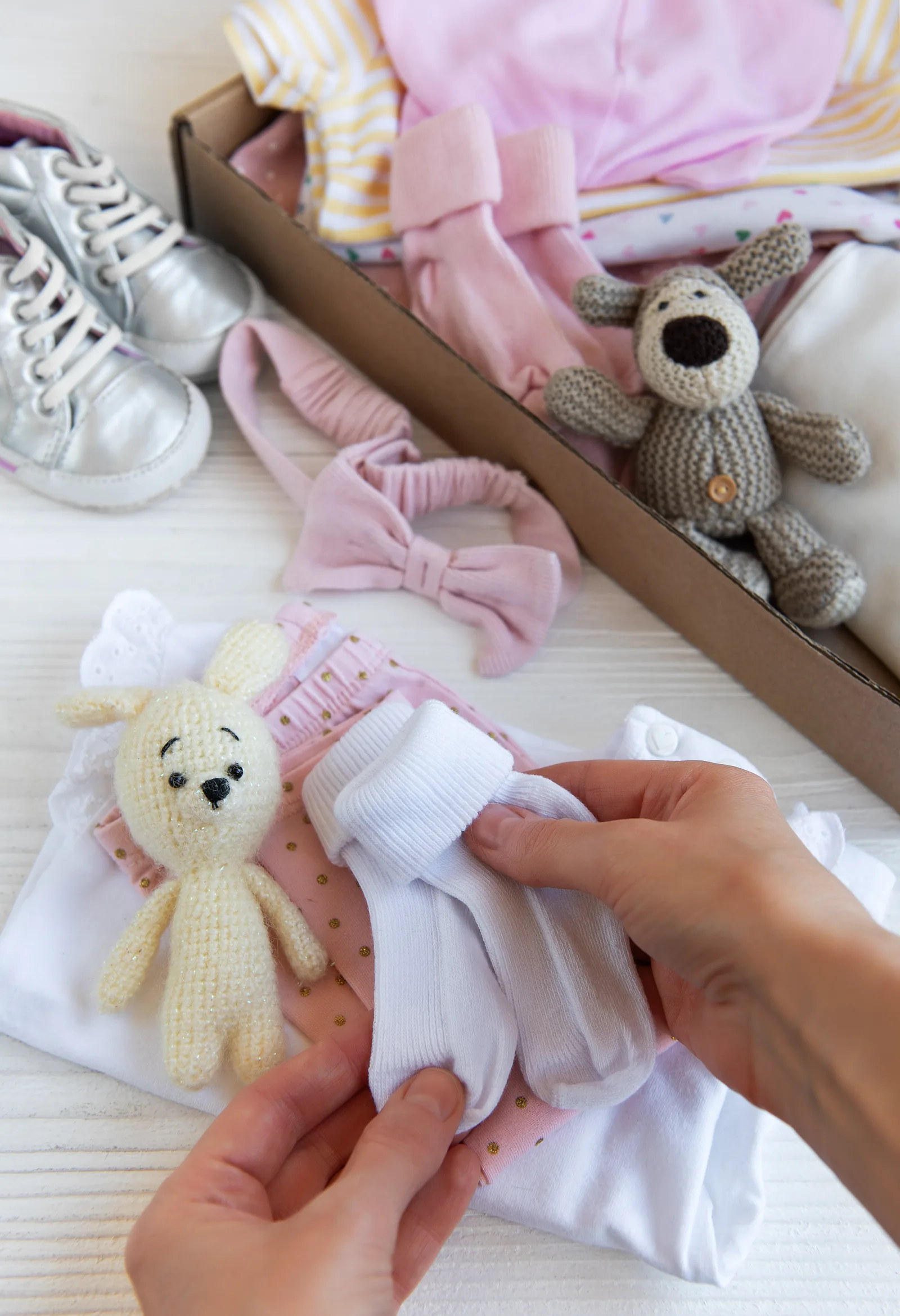
What about hand-me-downs and thrift finds?
Hand-me-downs and thrift finds can be free too, but they deserve a harder look than your kitchen drawer. Used products have been recalled many times, and anything broken, wobbly or missing parts is better thrown out.
The Consumer Product Safety Commission’s guidance for resellers says used products “have caused injuries and deaths and have been the subject of numerous recalls.” It tells sellers not to pass on broken or wobbly nursery furniture, or baby gear that’s missing parts, even if it was never recalled. Its rule of thumb: “When in doubt, throw it out!”
 Save
SaveThat page is written for sellers, but I’d hold the same line as the person receiving the bag. How to check secondhand gear, and what’s worth buying used, is part of Montessori on a budget.
What this costs: $0
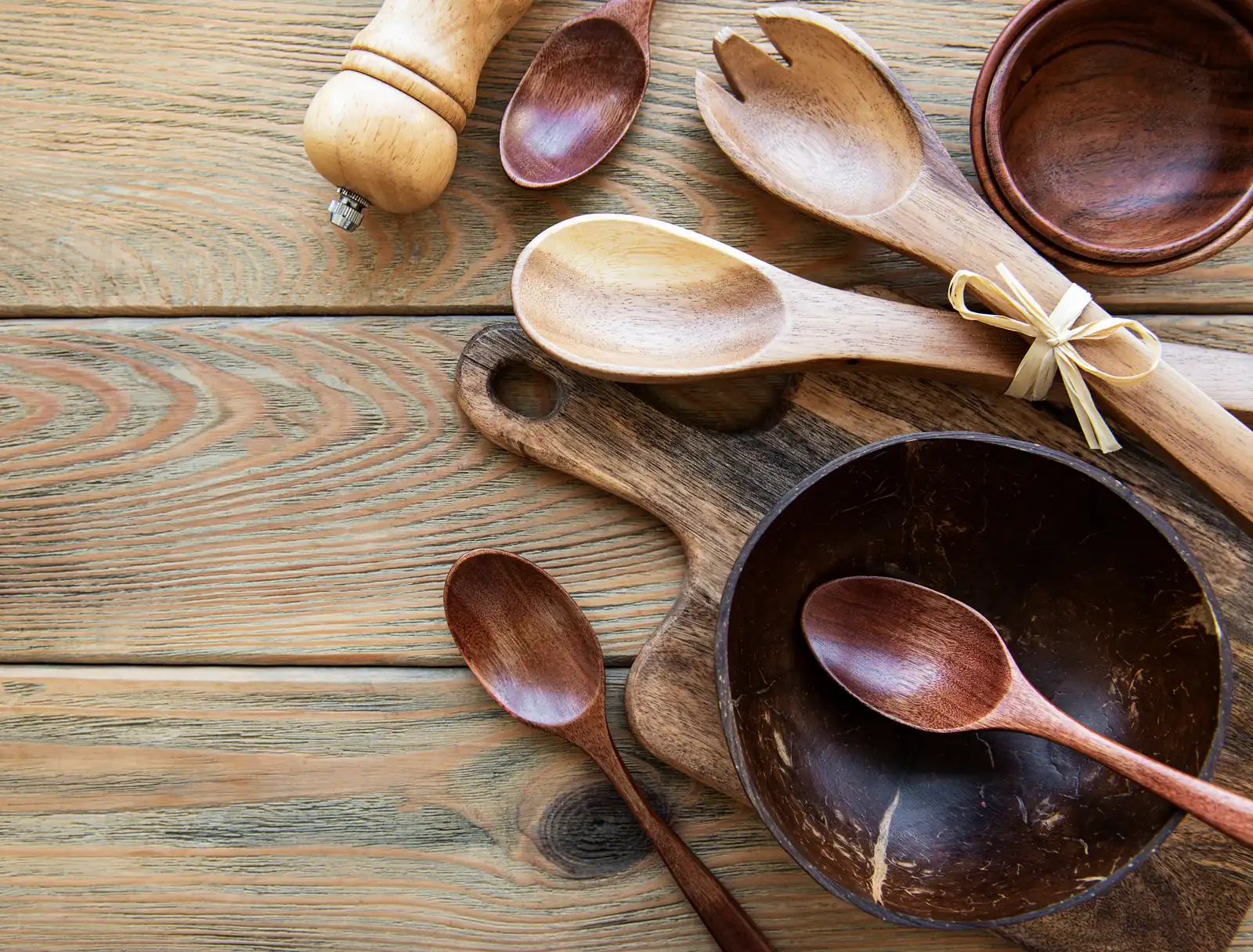
Everything on this page costs $0 if it’s already in your kitchen, linen closet or laundry basket. What you spend instead is a few minutes of setup and your attention while your child works.
That was the whole appeal for me. The baskets, clothespins, beans and boxes were already in our house. Nothing had to be ordered or assembled.
 Save
SaveLet’s be real: a colander was never going to look like the shelves in your feed. It doesn’t have to. Your child doesn’t know what anything cost, and they won’t care that the “material” also drains pasta on Tuesdays.
Montessori was never a shopping list. It’s mostly a habit of letting your child try.
When you do want to spend a little, the Montessori budget guide is where I add up what I really spent on toys in Will’s first year and what I’d buy first now. Skip anything sold mainly on the word “Montessori.” That label isn’t a quality check, and what makes a toy Montessori explains what to look for instead.
Frequently Asked Questions
Is there a free Montessori activities PDF or printable?
There’s no separate free Montessori activities PDF here, because the tables in this post are the printable. Print the page or screenshot the two tables and tape them inside a cabinet. They list what you already have or the job to hand over, what your child does, and the safety check to run first.
Can I do Montessori if I can’t afford a Montessori school?
Yes, you can do Montessori at home without a school or a toy budget. Montessori educator Simone Davies says you don’t need to buy anything to practice the principles at home, and parents on Reddit give the same advice: household objects, real chores, and the principles themselves.
What about free Montessori preschool activities?
Free Montessori preschool activities are usually aimed at kids 3 and older, and this guide stays with babies and toddlers under 3. Many of the jobs here grow with your child, though. Setting the table, sweeping and wiping still work at 3, with less help from you each time.
Conclusion
You don’t have to fix the budget or buy the shelf before you start. Tomorrow, put three or four safe kitchen things in a low basket, or hand your toddler a damp cloth and a table to wipe, and then sit back and watch what they do. That watching is a big part of Montessori. The rest can wait until you’re ready.
Wanting this for your child while counting every dollar takes real care. Start with one basket this week. You already have what you need.
Miri
Fewer toys, deeper play.
Further Reading & Resources
See all 13 sources
- Montessori background: The Montessori Method (Maria Montessori, 1912, Project Gutenberg) · Practical Life Exercises (Association Montessori Internationale, AMI) · Montessori Infant and Toddler Programs (American Montessori Society, AMS)
- No need to buy: Is Montessori parenting a fairy-tale? That’s what the Atlantic said. Here’s what I think… (Simone Davies, The Montessori Notebook)
- Small parts and safety: Small Parts FAQ and Resale/Thrift Stores (U.S. Consumer Product Safety Commission, CPSC) · 16 CFR 1501.1 and 16 CFR 1501.4 (Cornell Law School, Legal Information Institute) · Choking Hazards (Centers for Disease Control and Prevention, CDC) · Choking Prevention (American Academy of Pediatrics, AAP)
- Real parents: Montessori without a school (r/Montessori) · thread one and thread two (r/MontessoriForHome)