

Most bookshelves are built for people who can read. The books stand in a tight row, spines out, titles running sideways, and half of them sit higher than a toddler can reach. To a child who can’t read yet, that’s a band of colored stripes. So they do what makes sense to them. They pull books down one after another until the one with the bear turns up, or they bring you the same book they can already spot, again and again.
Then there’s the part that stings a little. You finally sit down to read together, and your toddler is off your lap by page two. A parent in r/MontessoriForHome asked about exactly that: their 14-month-old had been read to since before birth and still wouldn’t sit still for a story. If that’s happening at your house too, the answer further down is gentler than you might expect.
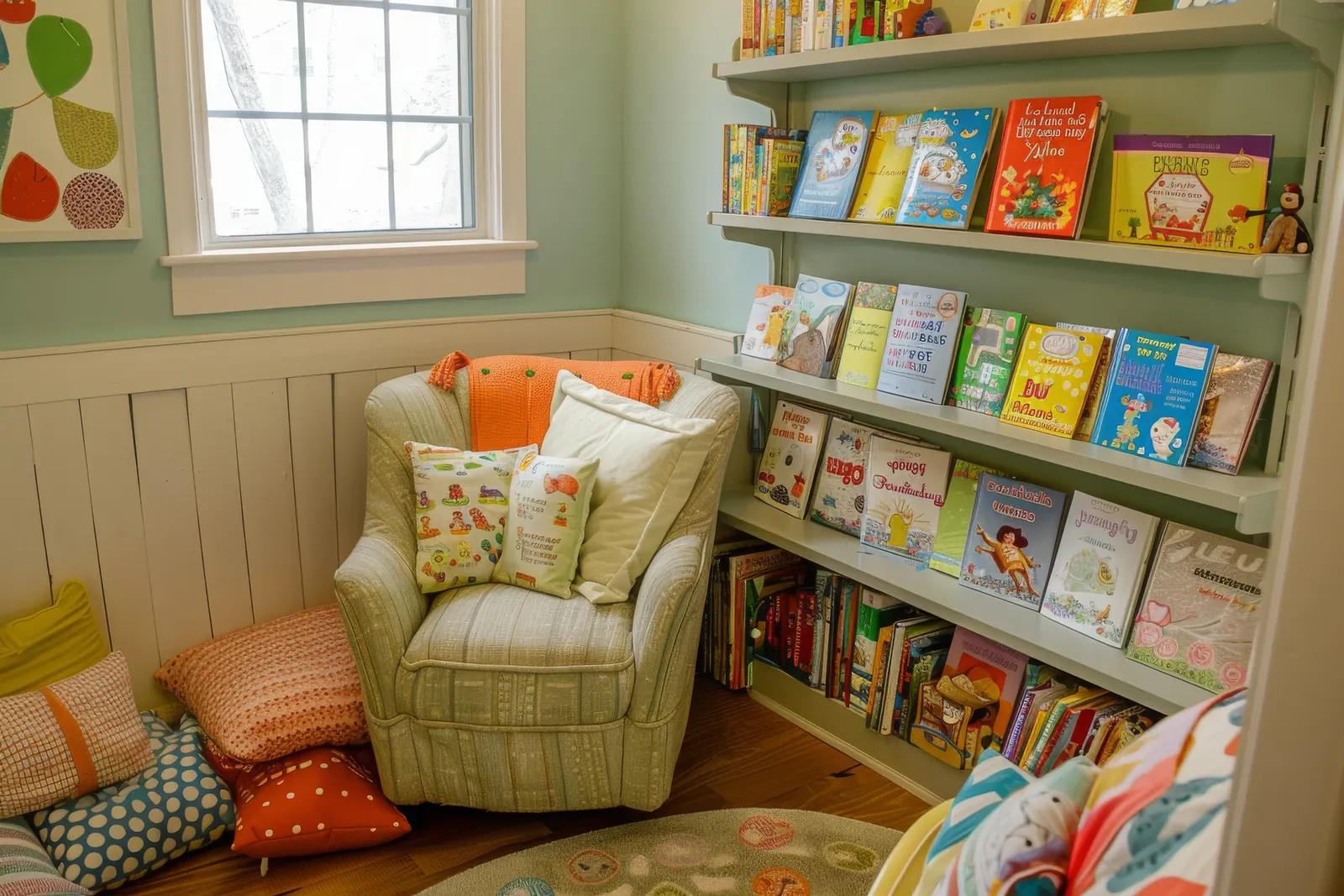
You don’t need much space to start on both. A low shelf with the covers turned out, in a corner by the couch, is one of the small spots that make a Montessori playroom work in an ordinary living room. Here’s my pick before we get into sizes, anchoring and the reading nook we actually use.
a low front-facing shelf your child can reach from the floor — they can see every cover, take a book down and put it back without calling you over.
you only have room for a tall shelf and no way to anchor it to the wall.
 Save
What is a front-facing bookshelf, and why does it work?
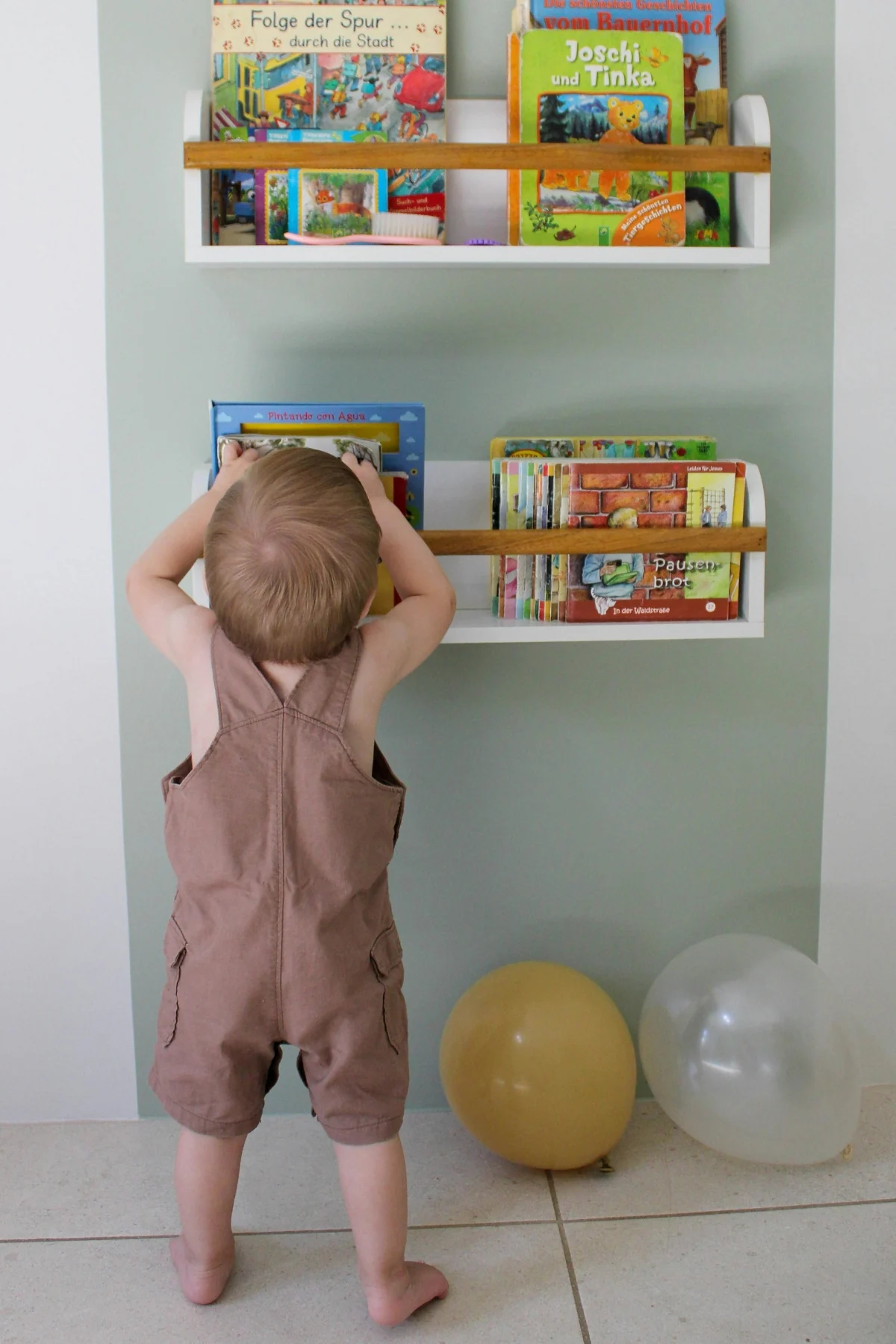
A front-facing bookshelf holds books with their covers toward the room, on low ledges your child can reach, so a toddler who can’t read a word yet can find a book by its picture and choose it alone.
Your toddler knows a book by its cover: the bear on the front, the red truck, the baby face they pat every single time. On a regular shelf all of that is hidden, and what’s left is a row of narrow spines. Turn the books around and your child can “read” the shelf on their own, long before they can read the titles.
 Save
IKEA describes its FLISAT book display in just those terms: low, so a child can reach the books, and easier to choose from because every cover is visible. That’s a maker talking about its own product, and I haven’t found a study that tested cover-out shelves in family homes. So treat it as something you can watch for yourself. Put a few books face-out and see which one your child walks over to.
Montessori classrooms keep the shelf small and the books easy to see. The Association Montessori Internationale (AMI) describes a classroom reading corner with one or two comfortable chairs and a small bookshelf holding around 10 to 15 books, ideally with the spine or front cover visible. That’s a Children’s Casa (also called Children’s House), AMI’s classroom for ages 3 to 6, so I take the idea and leave the number: a small, inviting shelf with far fewer books than you own.
The bigger reason has to do with what happens after your child picks a book. The American Academy of Pediatrics (AAP) urges pediatricians to encourage shared reading beginning at birth and continuing at least through kindergarten. It also favors print books for young children, because digital books don’t create the same back-and-forth between parent and child.
There’s research behind sharing books too, with a caveat worth knowing. A 2020 review by Dowdall and colleagues in Child Development pooled 19 randomized trials covering 2,594 children aged 1 to 6, all testing programs that coach parents on how to share picture books. The authors wrote that it “confirms the promise” of those programs for children’s language development. “Promise” is their word, and these were coached parents with children up to age 6. So it’s a good reason to read together, and a shelf on its own won’t teach your child to talk.
At Moje Montessori, we rate each row on the evidence behind it, so you can see which parts come from research and which come from Montessori practice.
| What it looks like | What it does for your child | Evidence |
|---|---|---|
| Covers out, on a low shelf | Lets them see the books and choose one alone | Montessori philosophy (not tested at home) |
| A few books on show instead of a packed shelf | Gives each cover room, so choosing is easier | Montessori philosophy (not tested at home) |
| Reading together from birth | Pediatricians are urged to encourage it from birth through kindergarten | Backed by research |
| Print books over screens | More back-and-forth between you and your child | Some research |
| Parents shown how to share picture books | Promising for language, in children aged 1 to 6 | Some research |
“Backed by research” means studies with babies or toddlers support that piece. “Some research” means part of it is supported. “Montessori philosophy (not tested at home)” means there’s little or no research on it in family homes yet.
If you’re hoping for a love of reading, the shelf is the small part. It just makes it easier for your child to bring you the book.
How to choose a front facing bookshelf for kids
Start with your child’s reach: choose a shelf they can use from the floor, with every cover in view, room for only a few books, and a way to anchor it to the wall.
Listings love tier counts and age ranges. Your living room cares about two numbers: how high your child can reach, and how much wall you have. Here’s what I’d check before buying any front-facing shelf.
- Your child can reach every ledge from the floor. Sitting or standing, no tiptoes, no step stool. I don’t know of a sourced height-by-age chart, so measure your child instead. Stand them against a wall, mark where their reach ends, and hold that number up to the listing.
- The covers stay put. Each ledge needs a lip or a rail that holds books upright and face-out, so they don’t slide off when a small hand grabs one.
- It doesn’t beg to be crammed. You’ll put out a handful of books at a time anyway, so you don’t need the biggest shelf on the page.
- You can anchor it. Look for an anti-tip kit in the box, or a frame you can attach to the wall with a bracket.
- You know what it’s made of. Solid wood, or a composite like hardwood plywood, MDF or particleboard. For composites, ask the maker which formaldehyde standard the panels meet, since limits set by the U.S. Environmental Protection Agency (EPA) have applied to composite wood sold in the US since June 1, 2018.
- It fits the corner you really have. Measure the gap beside the couch or under the window before you fall for a listing photo.
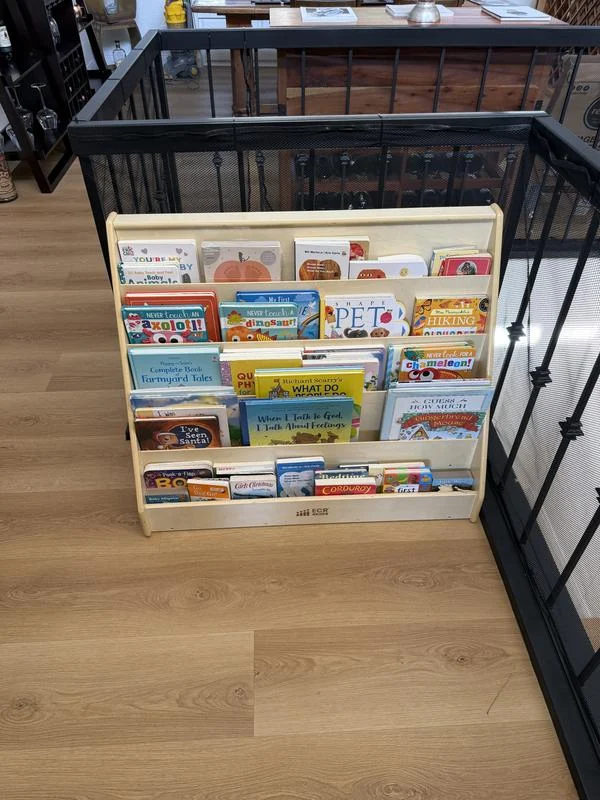
Ours is a five-tier wooden front-facing shelf from ECR4Kids that I caught on sale on Amazon when Will was just starting to walk. It’s about 30 inches tall and about 24 inches wide, and low enough for Will to reach. I’m sharing it as one real example. I don’t have a current price or the maker’s spec sheet to compare it fairly, so it isn’t in the table below.
 Save
Whatever the listing calls it (book display, book ledge, bookshelf front facing out), most setups come in three kinds.
| Setup | Can your child reach it? | Does it need anchoring? | How many covers show |
|---|---|---|---|
| Low, single-row book display | Yes, sitting or standing | Yes, like all furniture | All covers in one row |
| Multi-tier front-facing shelf | The lower tiers, yes; check the top tier against your child | Yes, every time | Covers on every tier |
| Spine-out shelf plus a book basket | The basket, yes; the shelf depends on its height | The shelf, yes | Spines on the shelf; covers only when flipping through the basket |
For a low single-row display with published specs, IKEA’s FLISAT book display is one example. As of October 20, 2026, IKEA’s US site lists it at $29.99. It’s 19 1/4 inches wide, 11 inches deep and 16 1/8 inches high, holds up to 22 pounds, and its main parts are solid pine with an acrylic lacquer, with a fiberboard bottom panel. Prices and stock change, so check the page before you order.
For most small homes, I’d start with a low single-row display, or a short multi-tier shelf your child can reach top to bottom, and let a book basket on the floor hold the overflow. A basket fits anywhere, even beside the couch, and flipping through it is half the fun for a toddler.
 Save
Once you know which kind fits your corner, the rest of the room can be built around it.
Do you need to anchor a front-facing bookshelf?
Yes, anchor it. The U.S. Consumer Product Safety Commission (CPSC) names bookcases when it tells families to secure furniture to the wall, and a front-facing shelf is a bookcase with its most tempting things on display.
A cover-out shelf is designed to pull your child in. That’s the whole point. It also means small hands reaching, tugging and leaning on it all day, and a toddler who wants the book on the top ledge may look for a way up.
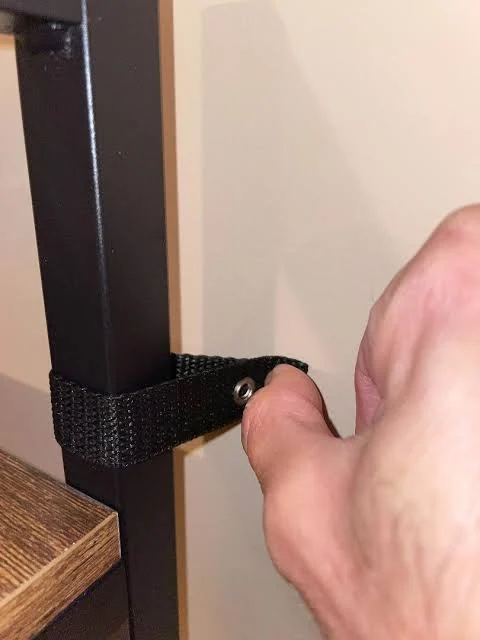
Anchor every bookshelf to the wall before the first book goes on, however low it is. The CPSC advises securing furniture such as bookcases and dressers to the wall with an anti-tip kit, following its Anchor It! steps, and keeping heavier items on the lower shelves. A taller, 5-tier front facing bookshelf has to be anchored too.
The AAP recommends anchoring all furniture with the anchors in a wall stud, even if that means moving the shelf, and suggests metal “L” brackets. Its 2021 page puts anti-tip devices at $5 to $25 and says they take minutes to install. It also says to keep toys, electronics and remotes out of high places, which can tempt kids to climb.
My husband anchored ours to the living room wall the same day we put it together, using the anti-tip kit that came in the box. If you go with the $29.99 FLISAT, a kit at the top of the AAP’s range could add another $25 to the bill, nearly as much as the display itself. Buy it anyway.
 Save
If you’d like the tip-over numbers and more on anchoring low furniture, my guide to choosing a Montessori shelf covers both.
How many books should go on a Montessori book shelf?
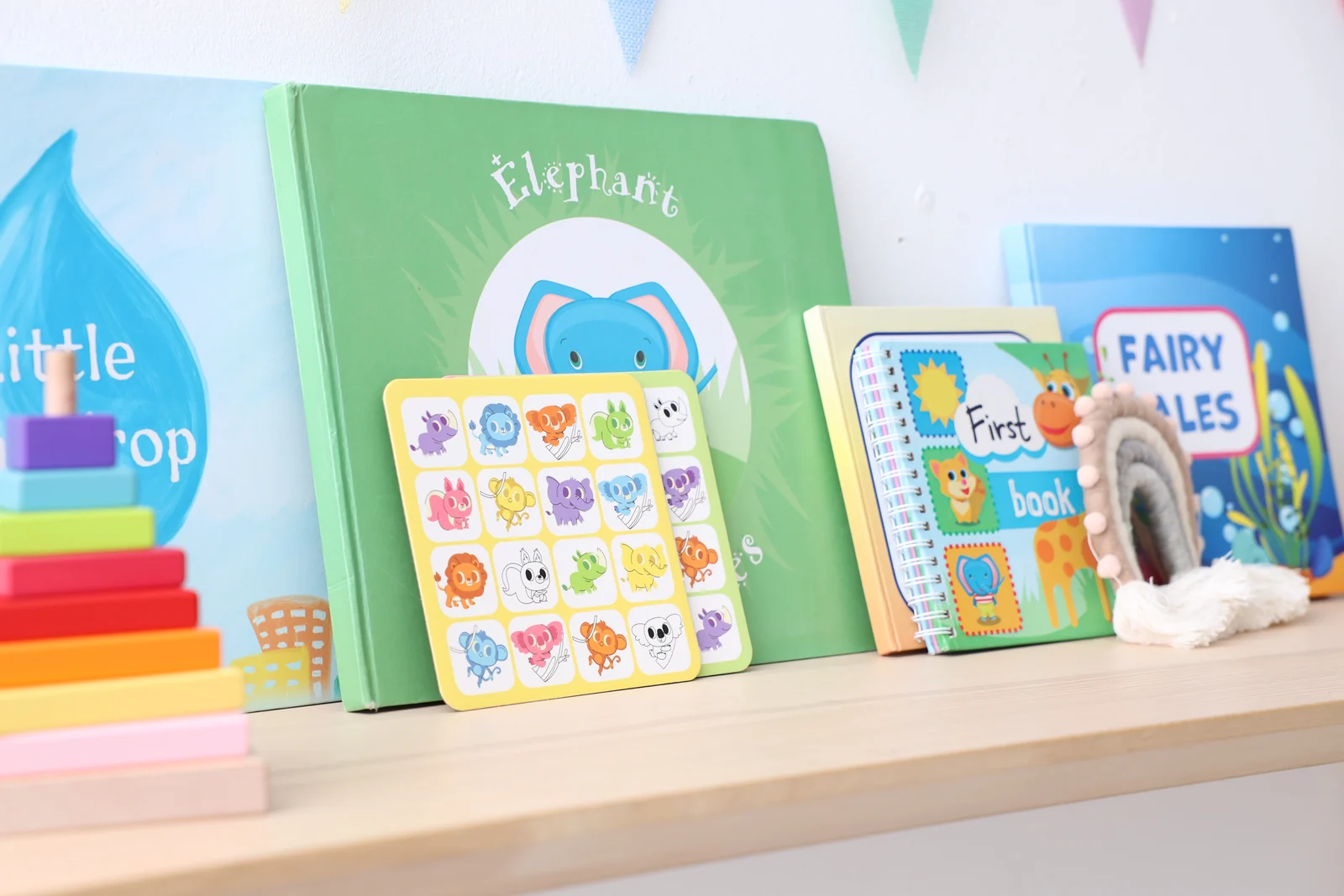
Keep it to a handful you can show cover-out. We keep 6 to 8 books out at a time, and the rest can wait out of sight until it’s time to swap a few.
That’s on a shelf with five tiers, so every cover gets its own space, and Will can look at the pictures and pick his own.
For comparison, the classroom reading corner AMI describes holds around 10 to 15 books, and that’s for older children. For a toddler at home, I’d stay lower.
 Save
When a cover stops getting picked, swap it for one from the closet. Book rotation works just like rotating toys: a few at a time, whenever interest fades, with no calendar to keep.
As for which books earn a spot, board books hold up to small hands, and in Montessori circles you’ll hear a lot about reality-based books, with pictures and stories about real things a toddler already knows, like animals, trucks and bath time. I’d treat that as a starting point and let your child’s picks guide the rest.
How to set up a Montessori reading nook
Pick the brightest spot where your child already plays, anchor a low shelf there, add something soft on the floor, and set out a few books with the covers showing.
You don’t need a spare room for a Montessori reading nook. In a small home, the best spot is often the gap beside the couch or the floor under a window, right where your child already spends the afternoon.
- Find the light. Natural light from a window is the easiest. Otherwise, choose the brightest corner of the room you use most.
- Put the shelf there and anchor it. Do this before any books go on.
- Add something soft. A rug or a floor cushion is plenty.
- Set out a few books, covers facing out. Pick ones your child already reaches for, plus one or two new ones.
- Let your child choose. Sit down nearby and wait to see which book comes to you.
Will’s reading nook is next to the big window in our living room, for the natural light. His low front-facing shelf stands there with the covers turned out, over a soft, fluffy rug. On snowy days, and a Colorado winter brings plenty of them, that rug is where the two of us end up, cuddled together with a book.
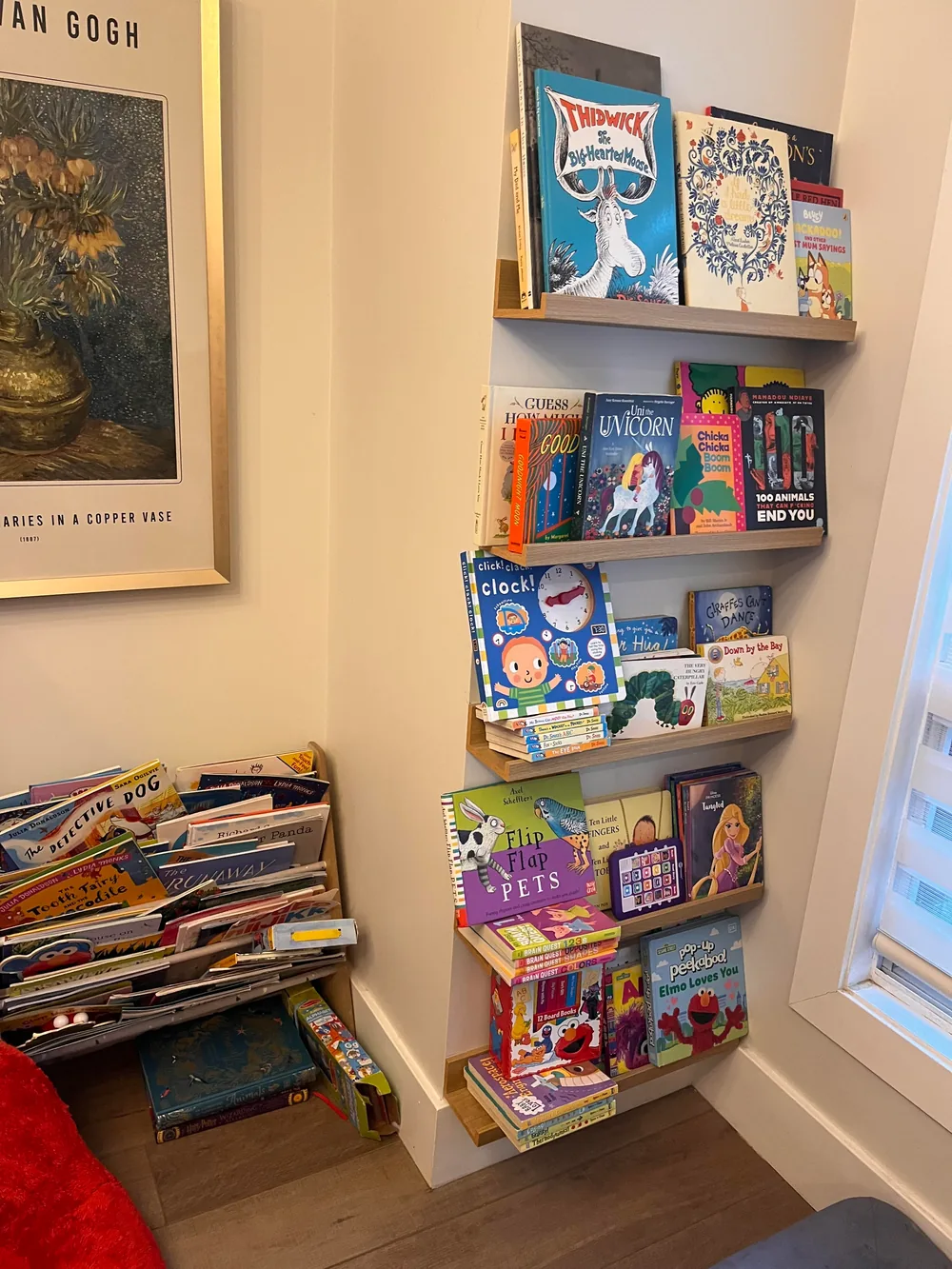

Our reading corner by the big living room window, with the covers turned out.
Something soft on the floor turns a shelf into a place to stay a while.
The coziest reading nook in the house is wherever your toddler drags the book.
What if your toddler won’t sit still in a toddler reading corner?
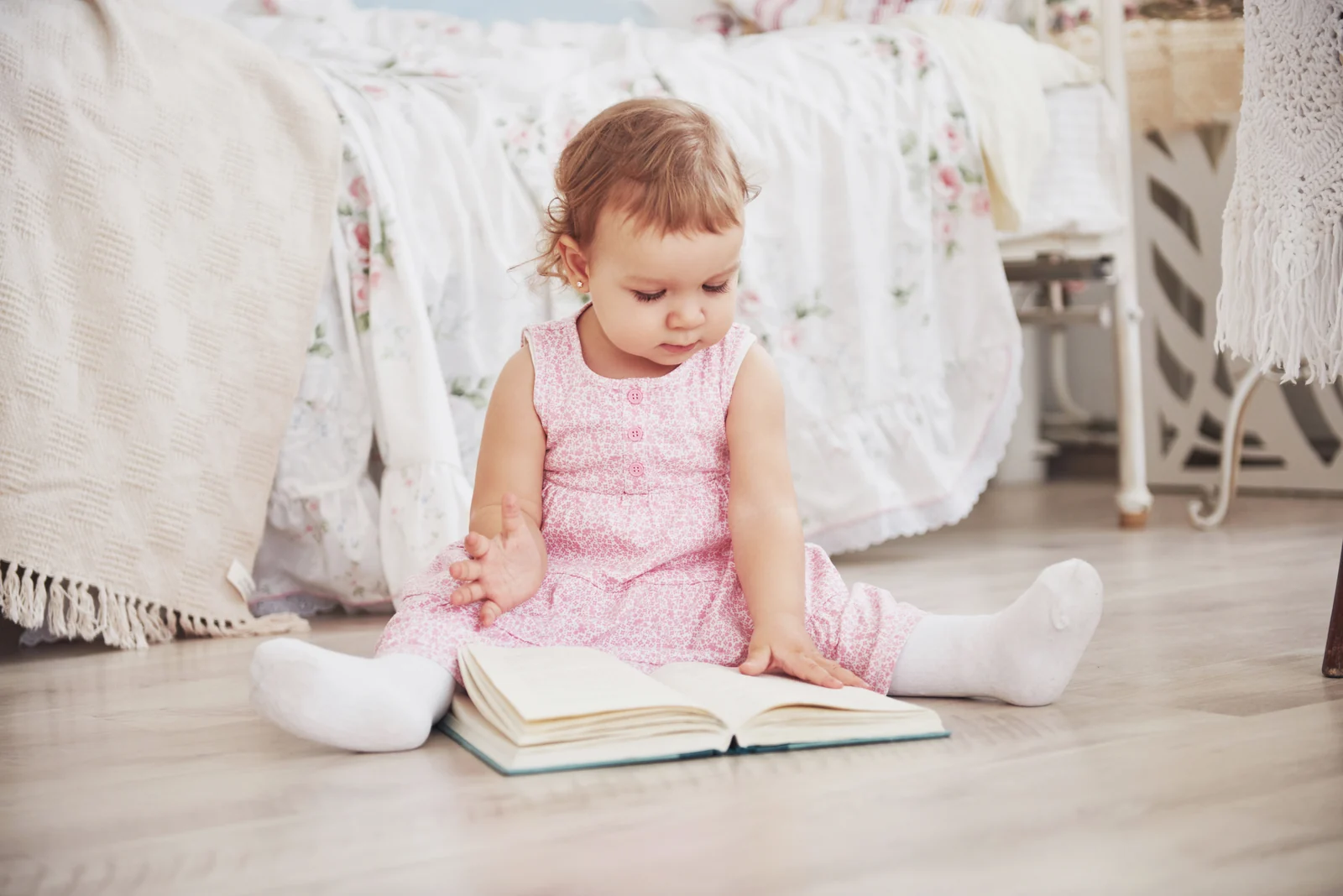
Wriggling off after a few pages is normal for a toddler, and ZERO TO THREE says so plainly. I’d keep reading anyway: a few pages at a time, even with a moving toddler, is still reading together.
Answering a parent with this exact worry, ZERO TO THREE calls it perfectly normal for toddlers not to sit still very long, since they’d rather explore by running, jumping and climbing, and says you may only be able to read or talk about a few pages of a book at a time. So a toddler who wanders off by page three is doing something very ordinary, and it doesn’t mean you started reading too late.
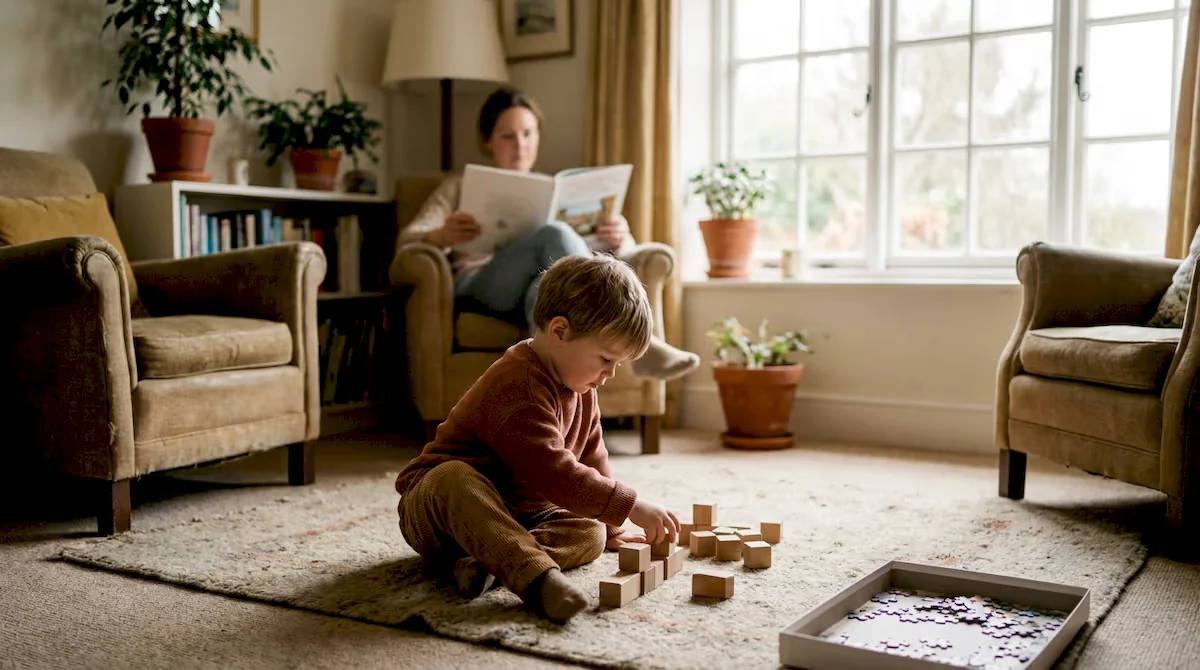
Will is the same. He snuggles into my side for the first 2 or 3 pages, pointing at the pictures, and then he’s up. He wanders around the room, pulls out his cars or starts stacking wooden blocks, and keeps listening while he plays.
 Save
The first few times, it stung. I felt a little hurt and a little annoyed, and I came close to closing the book. Now I let him walk and listen. If you’re in the thick of the page-two escapes, the stage is easier to work with than to fight.
ZERO TO THREE has a few ideas for active readers:
- Read at snack time, when your child may sit a little longer.
- Give them a soft toy to hold, like a squishy ball, so their body can keep moving while you read. Pick one too big to be a small part, meaning anything that fits completely into the CPSC’s small-parts cylinder, which approximates the fully expanded throat of a child under 3.
- Read in a dramatic voice.
- Choose stories with a word or phrase that repeats.
- Try pop-up, touch-and-feel and lift-the-flap books.
Pediatrician Perri Klass, lead author of the AAP’s policy on shared reading, puts the goal in everyday terms:
“Reading together with young children weaves joyful language and rich interactive moments into the fabric of daily life.”
Perri Klass, MD, FAAPlead author of the AAP’s policy on shared reading, HealthyChildren.org (2024)
She also suggests making books part of your bedtime routine, a way to connect and wind down after a busy day. And if you’d like a little reading of your own, I’ve gathered the Montessori books for parents worth your time.
When Will wanders off mid-story, I read a character’s name wrong on purpose. He turns around right away to correct me, which tells me he’s still with the story.
Miri’s Tip
What I’d skip
I’d skip a tall bookcase you can’t anchor, favorite books stored up high, ledges packed edge to edge, and any composite-wood shelf whose maker can’t tell you which formaldehyde standard it meets.
- A tall bookcase you can’t anchor. The CPSC and the AAP both say to anchor furniture like bookcases to the wall. If you can’t anchor anything where you live, keep the books in a basket on the floor instead.
- Favorite books up high. The AAP says to avoid keeping items like toys, electronics and remotes in high places, because that can tempt kids to climb. A favorite book is the same kind of temptation, so it lives where your child can reach it from the floor.
- Every ledge packed full. Even the classroom corner AMI describes keeps it to around 10 to 15 books, for older children. A crowded shelf brings back the wall of spines you were trying to get away from.
- A composite shelf with no answers. If the maker can’t say which formaldehyde standard its plywood, MDF or particleboard meets, keep looking.
 Save
Frequently Asked Questions
Is a front facing bookshelf worth it for independence?
A front facing bookshelf is worth it when your child can use it on their own. Seeing the covers lets them pick a book, carry it to you and put it back without help, which is one more small thing they get to do for themselves. If you’re unsure, start with a low display or a basket.
What makes a front-facing bookshelf different from a regular bookshelf?
A front-facing bookshelf shows covers where a regular one shows spines. It’s usually lower, with ledges or rails that hold each book face-out, so it holds fewer books. For a toddler who can’t read titles yet, that’s the difference that matters: they can see what’s there and choose.
How does a front-facing bookshelf grow with your child?
A front-facing bookshelf grows with your child through the books you put on it. The shelf stays the same while the covers change with their interests. Ours has been in the living room since Will was just starting to walk. He’s three now, and it’s still his reading corner.
Conclusion
You don’t need a nook that looks like the photos, and you don’t need a toddler who sits still. Tonight, after bedtime, pull 6 to 8 books off the big shelf and stand them cover-out on something low your child can reach. If it’s a shelf, anchor it before the books go on. Then see which cover gets carried to you first.
Some nights you’ll get three pages and a toddler doing laps around the rug. That still counts, and so does every night you open the book.
Miri
Fewer toys, deeper play.
Further Reading & Resources
See all 10 sources
- Reading with little ones: Beyond Literacy: Shared Reading Starting at Birth Offers Lifelong Benefits (American Academy of Pediatrics, HealthyChildren.org, 2024) · Does my toddler have a short attention span because she won’t sit still for a story? (ZERO TO THREE)
- Research: Shared Picture Book Reading Interventions for Child Language Development: A Systematic Review and Meta-Analysis (Dowdall et al., Child Development, 2020)
- Montessori background: Children’s Library? · Montessori 3–6 (Association Montessori Internationale)
- Furniture safety: Ahead of Sunday’s Game, CPSC Reminds Families to Tackle the Deadly Hazard of TV and Furniture Tip-Overs (U.S. Consumer Product Safety Commission, 2024) · Preventing Furniture and TV Tip-Overs (American Academy of Pediatrics, HealthyChildren.org)
- Small parts: Small Parts (U.S. Consumer Product Safety Commission)
- Materials: 40 CFR 770.10, Formaldehyde emission standards (eCFR, U.S. Environmental Protection Agency rule)
- Specs, checked October 2026: FLISAT book display (IKEA US)