

You’re folding a stack of tiny onesies, still warm from the dryer, with a parenting podcast in one ear. The guest says “the four planes of development” the way people mention the weather, then moves right along. You rewind. Birth to six, six to twelve, something about an absorbent mind. It sounds like a page from a teacher-training binder, and you’re left wondering what any of it has to do with the baby doing somersaults under your ribs.
Quite a lot, it turns out. And almost none of it is homework.
The planes of development are Maria Montessori’s map of growing up, from birth into adulthood. The first stretch of that map starts the day your baby is born, which makes it worth a few quiet minutes now, while your hands are full of onesies instead of a newborn. You don’t need to memorize the whole map. You only need the part you’re about to live.
This isn’t another to-do list. The hands-on side, from setting up a first corner to the safety basics, lives in the guide to starting Montessori at home. This post is the why behind it: all four planes in one table, a closer look at birth to 6, and what that means for your first years together.
 Save
SaveWhat are the four planes of development in Montessori?
The four Montessori planes of development are birth to 6, 6 to 12, 12 to 18, and 18 into adulthood. Each has its own needs. The first, the age of the absorbent mind, is the one worth knowing well while you’re expecting.
The Association Montessori Internationale (AMI), whose online archive keeps a glossary of Maria Montessori’s ideas, describes the planes in its entry on the four planes of development as “a framework or structure for understanding her theory of human development.” Put simply, it’s a lens for looking at childhood. It isn’t a checklist your baby has to pass.
Two details are worth knowing. The last plane comes in two versions: AMI’s glossary says 18 to adulthood, while the American Montessori Society, a US Montessori organization, gives 18 to 24 in a 2024 article on the planes. And every plane has two halves. The glossary divides each one into “3 years of creation and 3 years of crystallization.” Read literally, that’s three years of building something new, then three years of it firming up.
At Moje Montessori, we read frameworks like this with one question in mind: what does it mean for a parent at home right now? That’s the last column.
| Plane | Ages | Two halves | What’s happening | What it means for you now |
|---|---|---|---|---|
| First | Birth to 6 | Birth to 3, then 3 to 6 | Your child becomes independent and secure and acquires language. The absorbent mind takes in the world, unconsciously until about 3, then consciously | Everyday life is what they learn from. Talk to them, let them watch real life, and give them safe room to move |
| Second | 6 to 12 | 6 to 9, then 9 to 12 | Roughly the grade-school years | Nothing to prepare yet |
| Third | 12 to 18 | 12 to 15, then 15 to 18 | Roughly the teen years | Nothing to prepare yet |
| Fourth | 18 to adulthood (AMI) or 18 to 24 (American Montessori Society) | 18 to 21, then 21 to 24 (on the 18 to 24 range) | Early adulthood | Nothing to prepare yet |
Ages here are ranges, not deadlines. Nobody wakes up on their sixth birthday in a new plane.
Why does the order of the planes matter?
The order of the planes matters because Montessori saw each stage as the base for the next. That’s a good reason not to hurry through birth to 6: the later planes stand on it.
In From Childhood to Adolescence, Montessori described the stages as linked, each one setting up the next. The same glossary entry quotes the passage: “Each preceding phase prepares the one that follows, forms its base, nurtures the energies that urge towards the succeeding period of life.”
There’s a practical flip side. The entry also notes: “Each plane has its own special characteristics and needs.” So a baby isn’t a smaller version of a second grader, and there’s no prize for hurrying toward the next stage. The work of this one is enough.
Your baby isn’t behind on the second plane. They’re right on time for the first.
 Save
SaveThe first plane (birth to 6) and the absorbent mind
The first plane runs from birth to 6, and its big idea is the absorbent mind: a sensitivity that lets a young child take in knowledge, experiences, relationships and images quickly and without effort. AMI says only children in these years have it.
In AMI’s summary, the first plane of development is when a child becomes “independent and secure, acquires language, and then begins to learn consciously around age 3.” That’s a lot of growing for six years, and most of it happens in ordinary moments, on laps and floors and at the kitchen table.
The absorbent mind is Montessori’s name for how all that gets in. Picture a dry sponge dropped in water: it doesn’t decide to soak anything up, it just does. Montessori’s book The Absorbent Mind takes its title from the idea. Reading it before the birth is optional; the short version on this page is enough to start. And if you’re curious about the woman behind it, Maria Montessori’s own story has a post of its own.
 Save
SaveBirth to 3: absorbing without trying
From birth to 3, the absorbing happens without your baby trying, or even knowing. The glossary’s entry on the absorbent mind says it “unconsciously absorbs and incarnates all experiences in its environment” from birth to 3. Incarnates is a heavy word for a simple idea: what goes in becomes part of them.
So your baby isn’t choosing what to learn. They’re taking in the sound of your voice, the way your face moves when you talk, the clatter of dinner, and the rhythm of who comes home when.


Awake time with real life going on nearby. Naming what’s on the page, one picture at a time.
What that means at home is gentler than it sounds. Talk to them in real words as you go about your day, and let awake time happen where they can see people living. Relationships go in too, along with everything else.
In Montessori classrooms, the glossary describes these first three years as a framework of “freedom and limits.” At home, that can be as simple as a safe patch of floor to move on and a few limits you hold calmly.
If you’ve heard that Montessori is something that starts in preschool, the framework itself says otherwise: the first plane begins at birth. That idea comes up again among the common myths and criticisms of Montessori. And when you’re ready to think about a first toy or two, Montessori toys for newborns covers the first six months.
3 to 6: from absorbing to learning on purpose
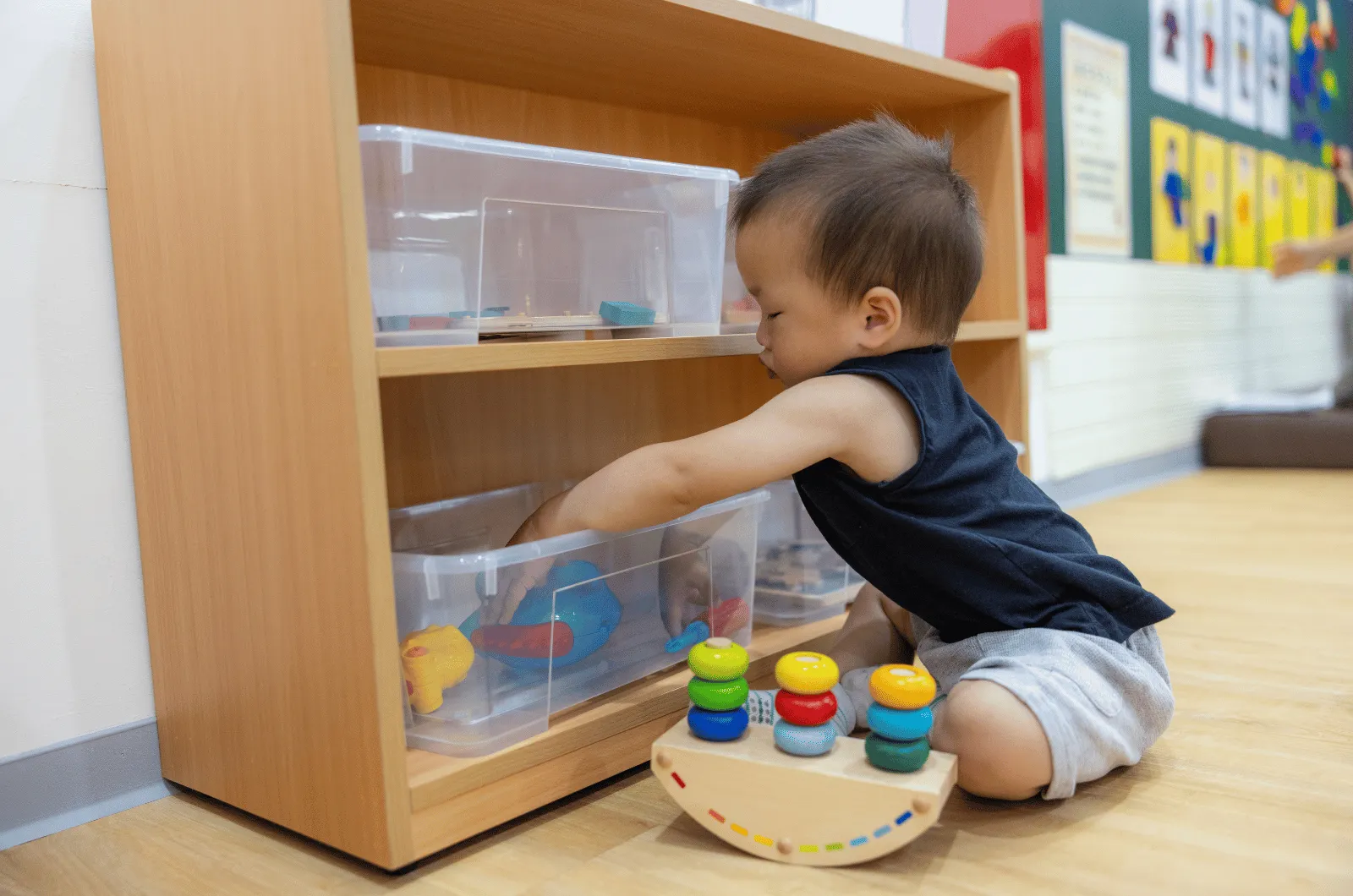
Around 3, something shifts. The absorbent mind keeps working, but now it absorbs “consciously,” and AMI’s glossary places the start of conscious learning “around age 3.” The same child who picked up words without trying starts learning on purpose.
 Save
SaveThe framework moves on too. The glossary goes from “freedom and limits” to “freedom and self-discipline” for ages 3 to 6. One way to read that at home: more of the limit-keeping slowly moves from your hands into your child’s.
If you’re still pregnant, all of this is years away. It’s worth knowing for one reason: both halves belong to the same plane, and the half you’re about to live comes first.
What are human tendencies in Montessori?
Human tendencies are natural inclinations that guide every person to survive, universal and unchanging in AMI’s definition. Montessori mentioned 25 to 30 of them, including the urges to explore, to communicate, to keep order and to work with the hands.
Because they’re universal, they show up in every plane, not only the first. A newborn and a teenager share them; they just express them differently.
In her 1946 London lectures, as quoted in AMI’s entry on human tendencies, Montessori’s list included the urge to explore, “to make a language to communicate socially,” “to maintain order,” and “to remain in one place and work, especially with the hands.” Before age 3, those four can look like this:
- Exploring. Eyes following a patch of sunlight across the ceiling. Later, a crawler heading straight for the one cabinet you hoped they’d ignore.
- Communicating. Cooing back when you pause. A toddler pointing at a dog, then looking at you until you say “dog.”
- Keeping order. A toddler who melts down because the cup is on the wrong shelf, or because bath came before dinner tonight.
- Working with the hands. Pulling a lid off a container and pressing it back on, over and over. Hauling a heavy book across the room for reasons only they know.
 Save
SaveWhere do sensitive periods fit in?
Sensitive periods are a related Montessori idea: stretches of time when a child is intensely sensitive to one particular activity or interest. AMI’s glossary names periods for language, movement and order, among others.
If the planes are the big map, sensitive periods are more like the weather on it: spells when one thing matters a great deal to your child. They deserve more than a paragraph, so sensitive periods in the first three years get a post of their own.
The second, third and fourth planes, briefly
After age 6 come three more planes: 6 to 12, 12 to 18, and 18 into adulthood, which the American Montessori Society puts at 18 to 24. None of them asks anything of you yet.
Each one splits the way the first does, into two three-year halves: 6 to 9 and 9 to 12, then 12 to 15 and 15 to 18. On the American Montessori Society’s range, the fourth splits into 18 to 21 and 21 to 24. Roughly, that’s the grade-school years, the teen years and early adulthood.
For now, that’s genuinely all you need. By the time your baby is heading off to first grade, you’ll know them far better than any chart does, and the second plane will be worth a closer read.
 Save
SaveWhat do the first and second planes have in common?
The first and second planes share a shape: each spans six years, each splits into three years of “creation” and three of “crystallization,” and each, in Montessori’s view, prepares the plane that follows.
What they share is structure, not content. The glossary is clear that every plane has its own characteristics and needs, so a toddler’s needs don’t simply carry over into the school years. In the first plane, the split between creation and crystallization falls at 3, the same age the glossary gives for the absorbent mind turning from unconscious to conscious.
Not every stretch moves at the same speed, either. The American Montessori Society describes some periods as “rapid growth and hormonally-driven changes” and others as “quieter, more stable periods of development.”
What the first plane means for you as a new parent
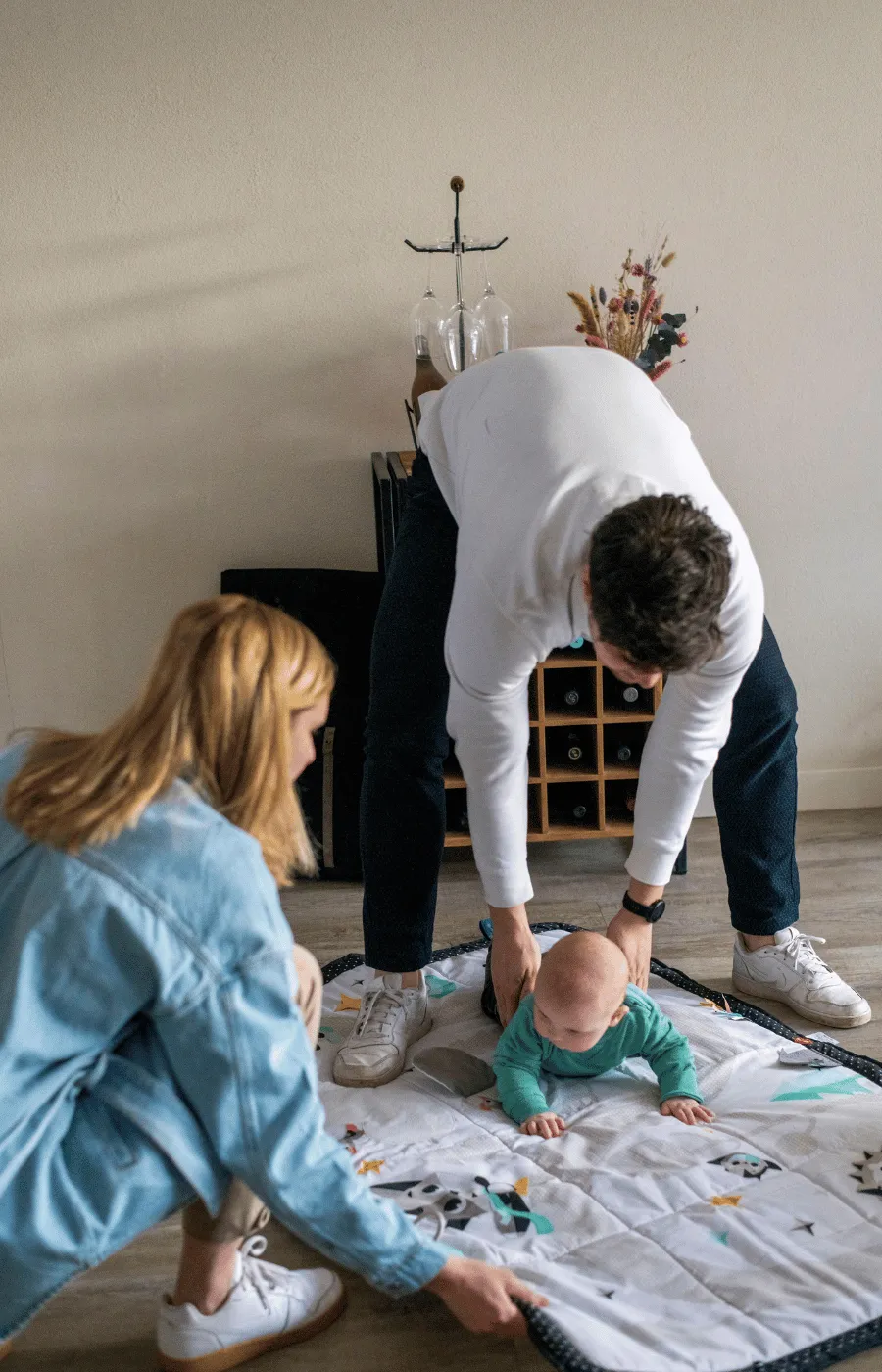
For a new parent, the first plane means your ordinary days are what your baby learns from. They take in the voices, faces and routines around them, so the job is less teaching and more sharing your life, within a few calm limits.
Lessons can wait. Your part is closer to hosting, because you’re most of what they take in. A few ways that plays out:
- Talk to them like a person. Narrate the diaper change, name the banana. Language is part of the first plane in Montessori’s framework, and your voice is where it begins.
- Keep them near the action. Awake time on a blanket in the room where you are gives them real life to watch.
- Hold a few limits, kindly. A safe space and one or two limits you keep, not a long list of rules.
- Watch first, then offer. Notice what your baby is working on before adding anything new.
- Let the later planes wait. They’ll keep.
 Save
SaveIn case nobody’s told you yet: talking to a baby who can’t answer back isn’t silly. It’s the first plane doing exactly what it does.
The first plane doesn’t need a curriculum. It needs your ordinary Tuesday.
When you do start setting up a space, safety comes before anything pretty, and the guide to Montessori at home covers it.
 Save
SaveFrequently Asked Questions
What are the four Montessori planes of development, in order?
The four Montessori planes of development are birth to 6, 6 to 12, 12 to 18, and 18 to adulthood (the American Montessori Society gives 18 to 24 for the last one). Each has two three-year halves and its own needs. If you’re expecting, the first plane is the one to read up on: it’s the age of the absorbent mind.
What similarities are there between the first and second planes of development?
The first and second planes of development are built the same way: six years each, split into three years of “creation” and three of “crystallization.” Montessori also saw each one as preparing the next. What differs is the content: AMI notes that every plane has its own characteristics and needs, so a toddler’s needs aren’t a schoolkid’s.
Conclusion
You don’t have to finish this post with a plan. If one idea sticks, let it be this: from the day your baby arrives, ordinary life is doing quiet work. Your voice during a diaper change, the room they watch from a blanket, the way you come back when they cry. Once you’re in the thick of the newborn weeks, that’s easy to forget. So tonight, pick one everyday thing you already do, like making coffee or folding laundry, and try describing it out loud as if to someone brand new. That’s the whole skill, and you already have it.
Be gentle with yourself in the months before the birth. You don’t need to master the first plane; you just need to show up for it.
Miri
Fewer toys, deeper play.
Further Reading & Resources
See all 6 sources
- Montessori’s framework: Four Planes of Development and Absorbent Mind (Association Montessori Internationale, AMI Montessori Archives glossary) · Planes of Development and Sensitive Periods: Foundations of the Montessori Multi-Age Classroom (American Montessori Society, 2024)
- Related Montessori ideas: Human Tendencies, Sensitive Periods and Freedom (AMI Montessori Archives glossary)