
It’s 2 a.m. The baby is finally milk-drunk and heavy on your chest, and you’re scrolling with one thumb so you don’t wake them. Then it appears in your feed: a tiny baby on a floor mat, gazing up at a slow-turning mobile of black-and-white shapes. Munari, week 3. Two posts later there’s a Gobbi, then an Octahedron. Each one costs around $35.
Your baby is three weeks old, and suddenly you wonder if you’re already behind.
You’re not. Montessori mobiles are a sweet extra, not a requirement. Below: which one comes first, when to switch, how high to hang it, and when every hanging toy comes down. For the bigger picture, the full newborn toy list picks up where this one leaves off.
 Save
SaveAre Montessori mobiles necessary?
No, Montessori mobiles aren’t necessary. They’re a nice-to-have that gives a newborn one calm, slow-moving thing to look at during awake time, and a baby without one isn’t missing a developmental step.
Instagram makes the four mobiles look like a curriculum. They’re really a thoughtful decoration with a job to do. What your baby needs most is you: your face, your voice, and safe time on the floor.
So why do Montessori families love them? A good mobile is hard to get wrong. It moves only when the air moves it. It doesn’t flash or sing. Your baby can study it quietly, with no one performing for them.
If your budget or living room says no, skip them without guilt. A window with moving leaves keeps young eyes busy too.
Why use Montessori mobiles for infants?
Montessori mobiles match what newborn eyes can do: babies see best at 8 to 12 inches, notice light, shapes and movement early, and follow moving objects by about 3 months.
According to the American Academy of Pediatrics, newborns see most clearly at 8 to 12 inches (20 to 30 cm). In the early weeks they take in light, shapes, faces and movement. By about 3 months they can follow a moving object with their eyes. By 4 months they’re better at seeing colors and shades.
Those findings also bust a myth repeated even on some Montessori school sites: that newborns see only black and white. The AAP doesn’t say that. Bold contrast is just easy for young eyes to pick out, which is why the first mobile, like most high-contrast cards for babies, sticks to black and white.
Montessori infant mobiles also skip the motor and the music. They just drift with the air. Montessori thinking calls windows of intense interest like this sensitive periods [CẦN URL: B1-03], and for a newborn, looking is a big one.
And if those eyes wander or cross now and then, that’s normal. The AAP says it should fade by 2 to 3 months; if it hasn’t, mention it to your pediatrician.
Montessori mobiles by age: the sequence at a glance
The four visual Montessori mobiles by age run roughly: Munari in the first weeks, Octahedron around 5 to 8 weeks, Gobbi around 7 to 10 weeks, and Dancers around 8 to 12 weeks, with tactile mobiles from about 3 months.
One honest warning first: the sources don’t agree. Across five popular Montessori guides, the Gobbi lands anywhere from 6 weeks to 3 months. Read these as ranges, and let your baby’s attention decide.
| Mobile | Roughly when | What your baby is working on | Time to switch when… | Good to know |
|---|---|---|---|---|
| Munari | First weeks to about 6 weeks | Focusing on one object; light against dark | They glance away fast or fuss underneath it | Named after Italian artist Bruno Munari (1907–1998) |
| Octahedron | About 5 to 8 weeks | First bold colors: red, yellow, blue | Same cues: quick glances away, fussing | Shiny paper that flickers as it turns |
| Gobbi | About 7 to 10 weeks | Shades of one color, light to dark | Their eyes stop traveling along the spheres | Designed by Gianna Gobbi, Montessori’s assistant in the early 1950s |
| Dancers | About 8 to 12 weeks | Faster, less predictable movement; depth | Arms start waving and reaching toward it | Metallic paper figures in two colors |
| Tactile (bell or ring on a ribbon) | From about 3 months | Reaching, batting, grasping | Hands and knees, or 5 months (AAP cutoff) | Supervised floor time only |
Real babies wander off the chart. When Nicole Kavanaugh of The Kavanaugh Report wrote up her daughter Nora’s mobiles in 2014, Nora stayed with the Octahedron until about 12 weeks before moving to the Gobbi. At 4 months she still loved the Dancers. That’s a baby with her own timeline, not a problem.
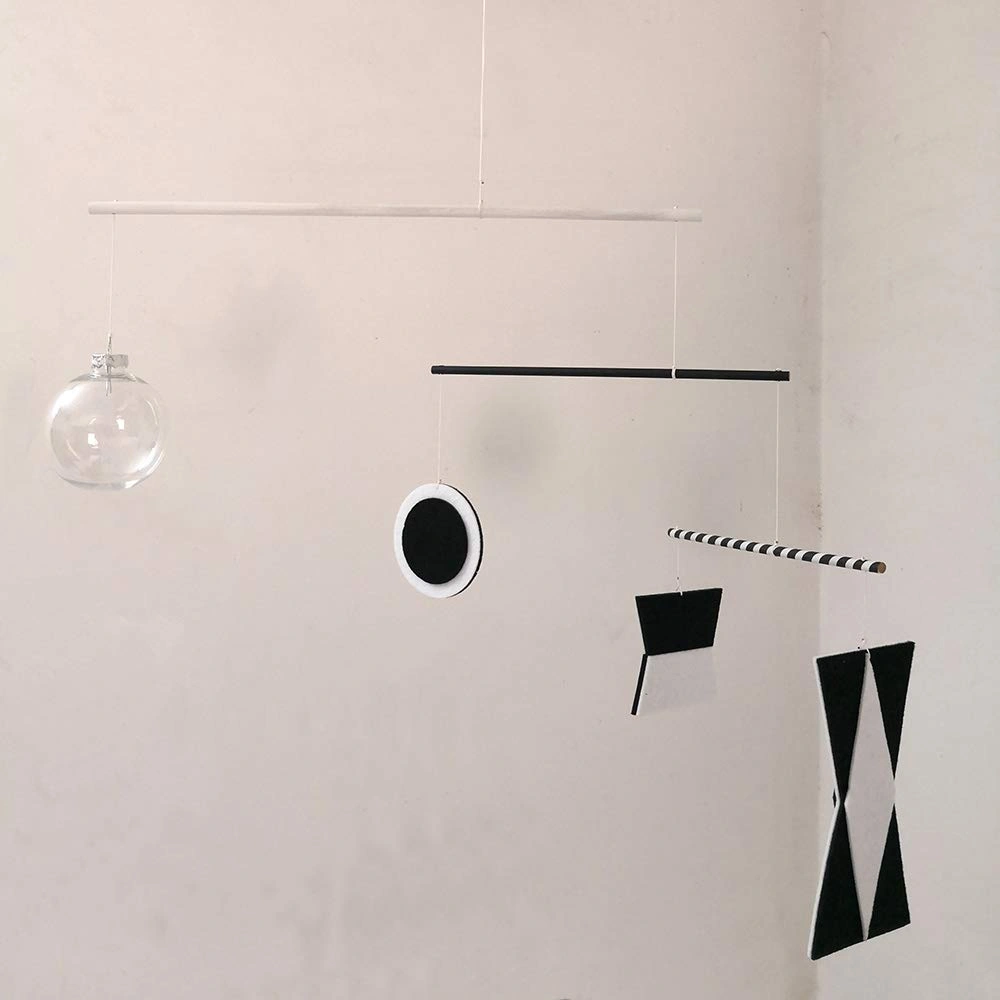
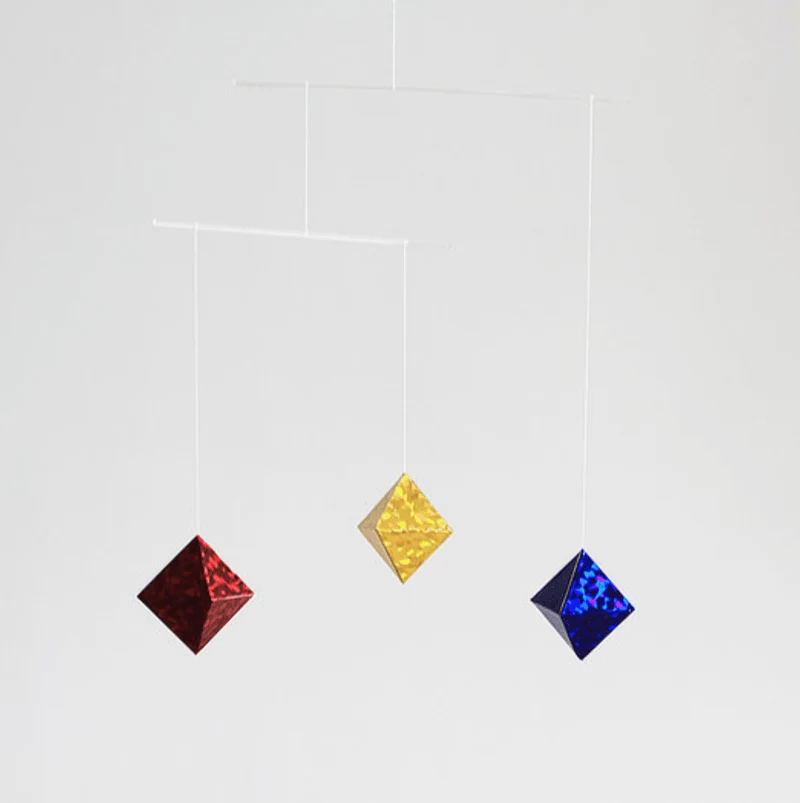
The Munari: black-and-white shapes and one clear ball. The Octahedron: three shiny shapes in red, yellow and blue.
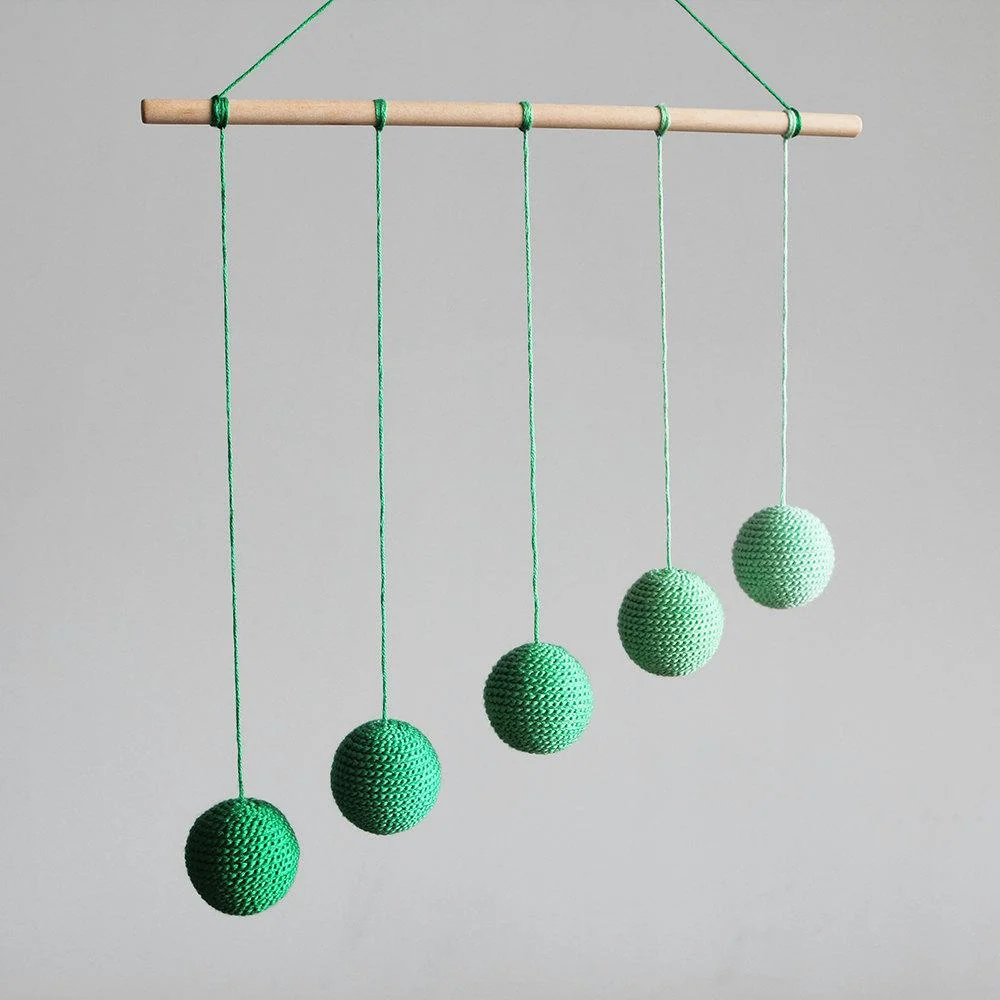
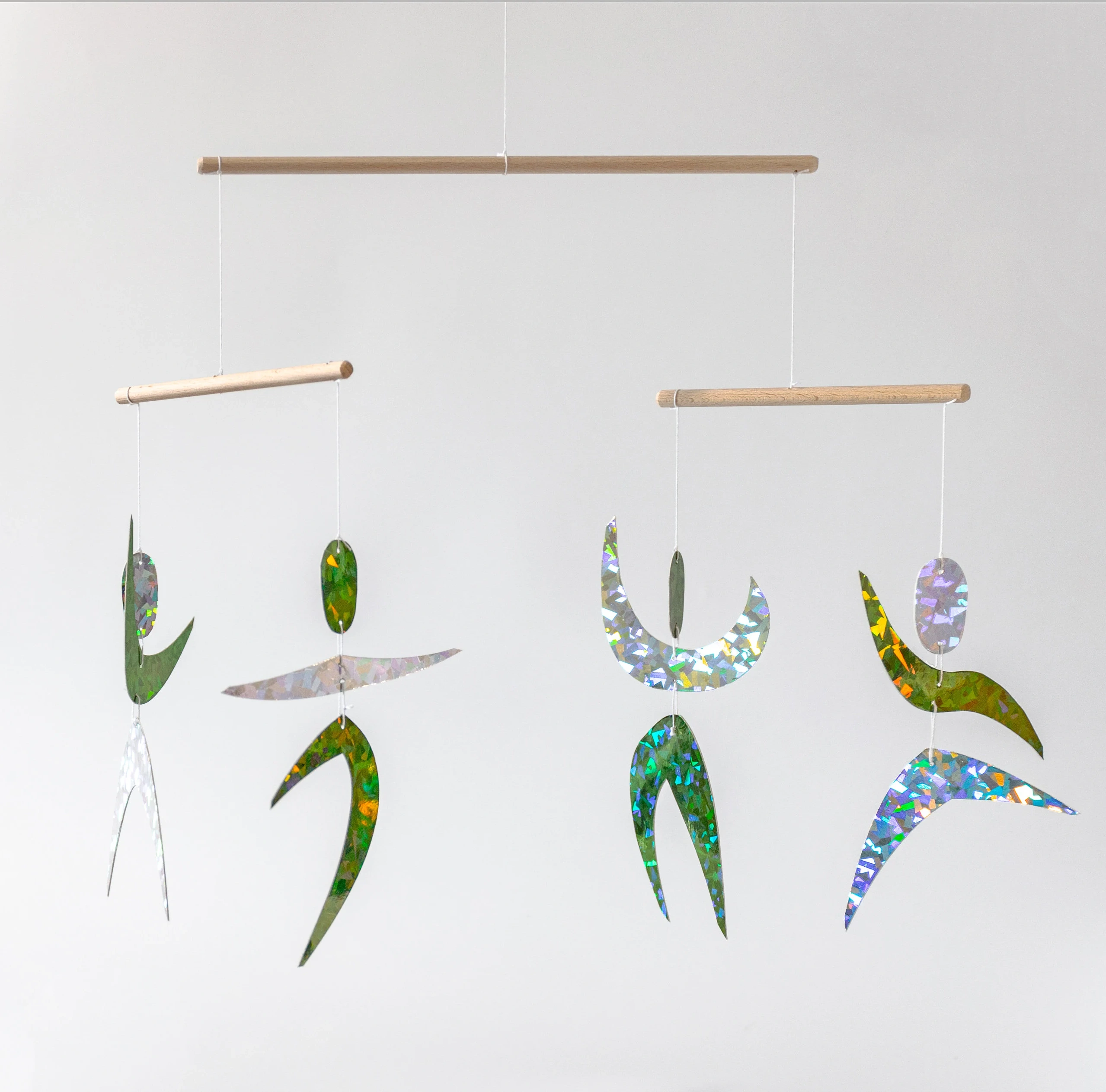
The Gobbi: five spheres in one color, pale to deep. The Dancers: metallic paper figures that catch every breeze.
The Munari mobile
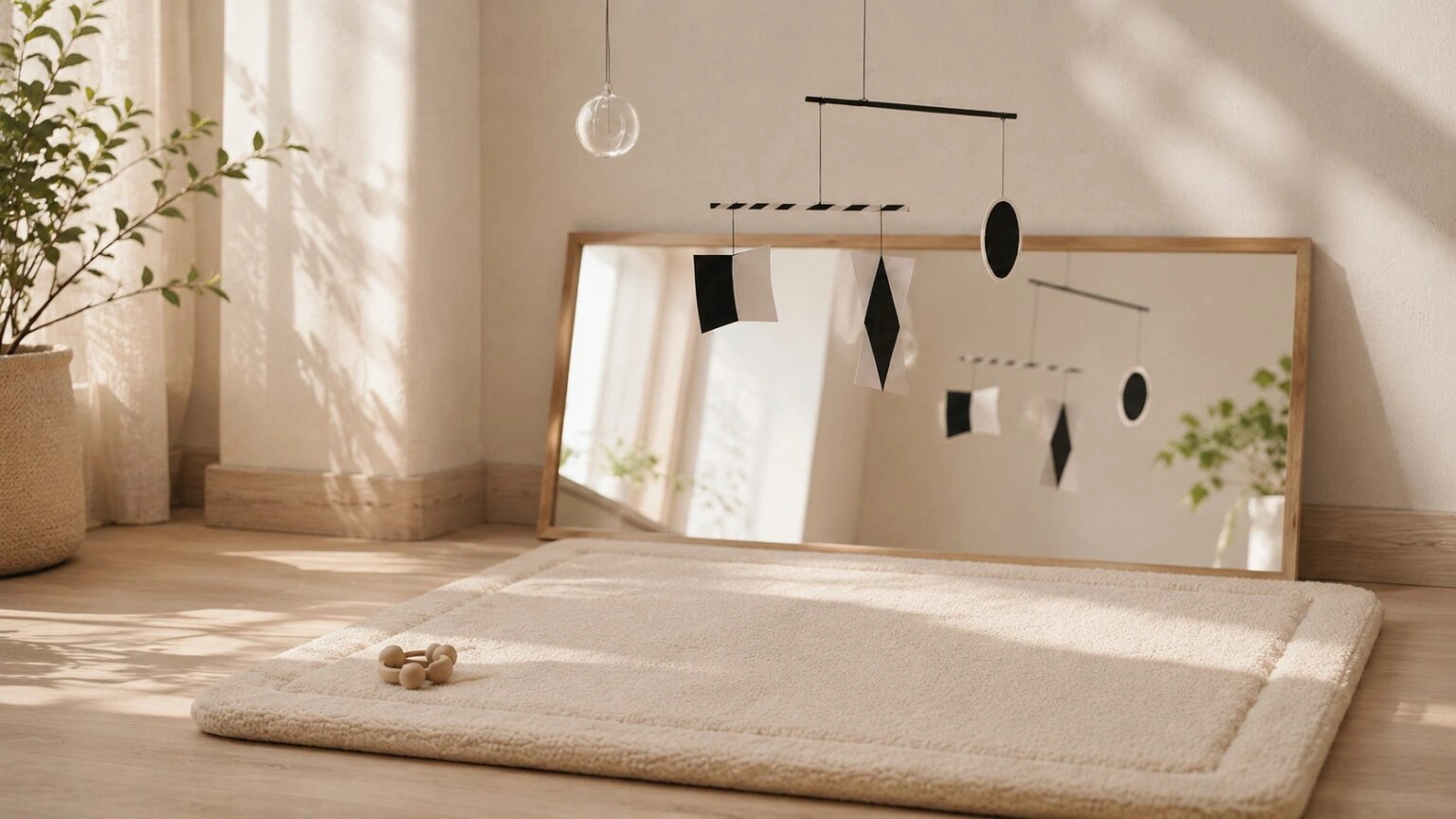
The Munari mobile comes first: black-and-white shapes balanced on thin rods, usually with one clear ball that catches the light. It’s named after Bruno Munari, an Italian artist born in Milan in 1907. In 1930 he began designing what he called Useless Machines, which the Estorick Collection describes as “the first ‘mobiles’ in the history of Italian art.” I love that detail. The first mobile many Montessori babies see is named after a man who called his hanging art useless. Babies seem to disagree.
Most guides start the Munari between birth and 3 weeks and move on by about 6 weeks. Choose a plastic ball over the traditional glass.
The Octahedron mobile
Around 5 to 8 weeks, the Octahedron brings the first strong color: three octahedrons (eight-sided, diamond-like shapes) in red, yellow and blue, traditionally made from shiny, reflective paper. As they turn, light flickers off them, and that flicker is often what catches a baby’s eye.
Timing is loose here, too. Berkshire Montessori School usually offers it around 2 months, but as early as 1 month for babies who seem ready for color.
Making your own? Brace yourself a little. Nicole Kavanaugh called it “the most frustrating of the mobiles to make,” and it took her several tries. Buying this one and making the rest is a sensible split.
The Gobbi mobile
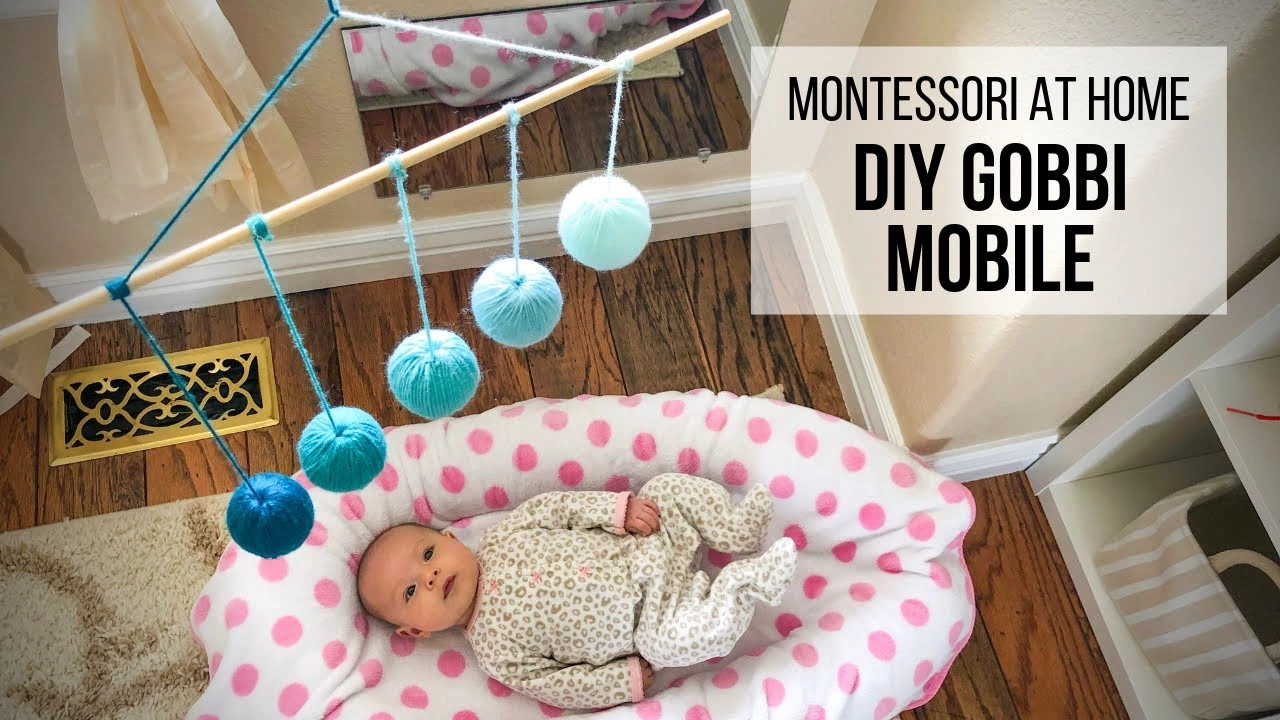
The Gobbi mobile is the one you’ve probably seen most: five spheres wrapped in embroidery floss, all one color from light to dark, hung on a 45-degree diagonal with the darkest sphere lowest. It was designed by Gianna Gobbi, Maria Montessori’s assistant in the early 1950s.
The color itself matters less than the gradation, those small steps from pale to deep. Watch closely and you may see your baby’s eyes travel along the spheres. Emma Zebro of The Montessori Twin Mama described one of her sons’ eyes moving “down and up the sequence of spheres.” Most guides place the Gobbi around 7 to 10 weeks.
The Dancers mobile
The Dancers mobile is the busiest of the four: figures cut from light, metallic paper in two colors, hung to look like four little dancers. Each piece moves on its own, so the mobile turns faster and less predictably than the earlier ones, throwing light as it spins.
That’s the point. After weeks of slow, simple shapes, your baby now gets movement that’s harder to follow, a fresh challenge for focus and depth perception. Most guides place it around 8 to 12 weeks.
Keep an eye on the arms. When watching turns into swiping, your baby is telling you what comes next.
Tactile mobiles: bell and ring on a ribbon
Around 3 months, when many babies start batting at whatever hangs above them, Montessori mobiles shift from things to look at to things to touch: a bell on a ribbon, a wooden ring on a ribbon or elastic.
At first your baby hits the bell by accident. Then, gradually, they reach for it to make the sound again. It’s a lovely thing to see.
Because these hang within reach, they follow stricter safety rules, below. For a wooden ring, feel for splinters, check that the finish is intact, and ask the seller for the Children’s Product Certificate. Once your baby wants to hold things, toys for reaching and grasping come next.
 Save
SaveHow do you hang a Montessori mobile?
Hang a Montessori mobile about 12 inches (30 cm) from your baby’s face, slightly in front of their chest, above a floor mat in the movement area rather than over the crib or changing table.
Twelve inches is one school ruler, right at the edge of the range where the AAP says newborns see best.
The movement area is a safe spot on the floor for awake time: a firm mat, a low mirror alongside, and something to look at above. The AMI-backed Montessori Guide puts it simply: “mats, mirrors and mobiles make up movement areas for the youngest children.” The mirror helps when your baby’s head is turned to one side.
- Pick the spot: a floor mat with natural light, away from where your baby sleeps.
- Choose the hardware: a hook in a ceiling joist, a sturdy mobile stand, or a plant bracket.
- Make it adjustable: a ribbon and a binder ring let you raise, lower or swap mobiles fast.
- Measure about 12 inches from your baby’s face, slightly toward the chest.
- Tug-test it before your baby lies underneath.
- Lie down and look up. If you can’t see the whole mobile, neither can they.
Tips on how to use a Montessori mobile
Offer one Montessori mobile at a time, when your baby is awake and alert, and let them watch without help. Switch when glancing away and fussing become the pattern.
Four mobiles in a row make a pretty photo, but one is easier for a baby to focus on. Store the rest flat until it’s their turn.
Pick a moment when your baby is fed, dry and alert. If you follow the EASY routine, as we did with Will, that’s the Activity time [CẦN URL: C3-01]. Lay your baby down, then step back. No spinning, no tapping, no narrating.
Then watch. A baby who’s working often goes still, eyes locked, sometimes cooing. A baby who’s done glances away, fusses, or suddenly prefers the mirror. That’s information, not failure.
One baby, two Munari mobiles: what Nicole Kavanaugh noticed
Nicole Kavanaugh, who writes The Kavanaugh Report, made two mobiles for her son Augustus and hung them about 12 inches from his face. By 6 weeks, he had opinions.
- Step 1: Her homemade “Munari-inspired” mobile of painted foam balls won. He would “stare at the mobile for 15 to 20 minutes at a time,” and he’d started cooing at it.
- Step 2: The traditional Munari held him for a few minutes before he got fussy and looked toward his mirror or the windows.
- Step 3: She kept offering it now and then, and let him choose.
“I do follow his cues. I will try a few more times over the next couple weeks but if he prefers the other, that’s fine too!”
Nicole Kavanaugh
Maria Montessori called it “follow the child.” The chart is a starting point; your baby gets the final word.
How do you make a DIY Montessori mobile?
A DIY Montessori mobile, usually the Munari, needs black-and-white card shapes, a few wooden dowels, fishing line and a clear ornament, plus patient balancing. Recruit a helper, and choose a plastic ornament over glass.
Cutting shapes is easy; balancing is where patience runs out. Emma Zebro’s Munari tutorial on The Montessori Twin Mama has full materials and measurements. The short version:
- Cut shapes from card or foam board, high-contrast black and white on both sides.
- Tie each shape to its dowel with fishing line and a secure knot.
- Tie on a clear ornament (Emma’s is 2.5 inches across), and pick plastic.
- Connect the dowels, top to bottom.
- Balance from the top dowel down. Once it’s level, the rest gets easier.
- Hang it in gentle airflow and check every knot.
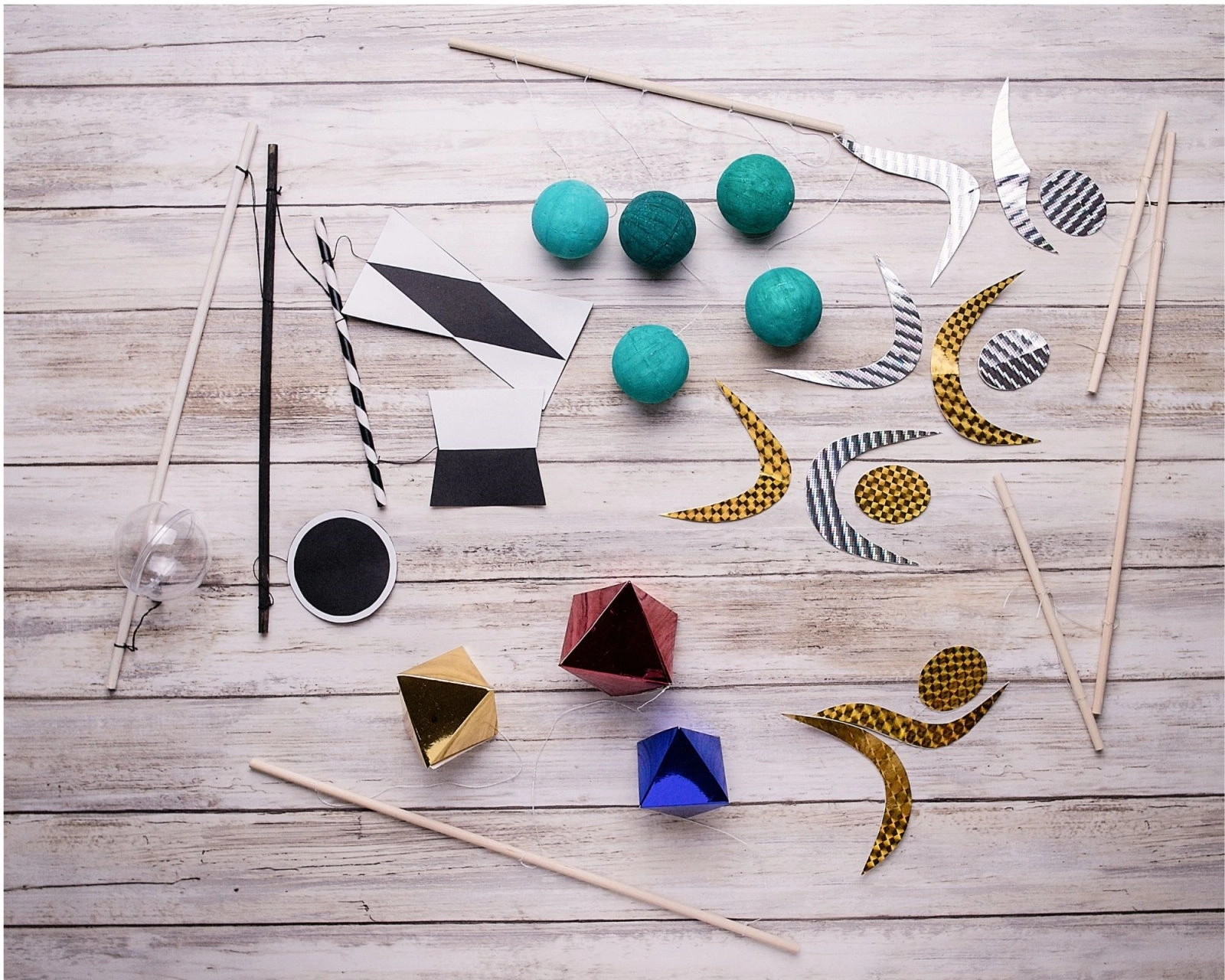
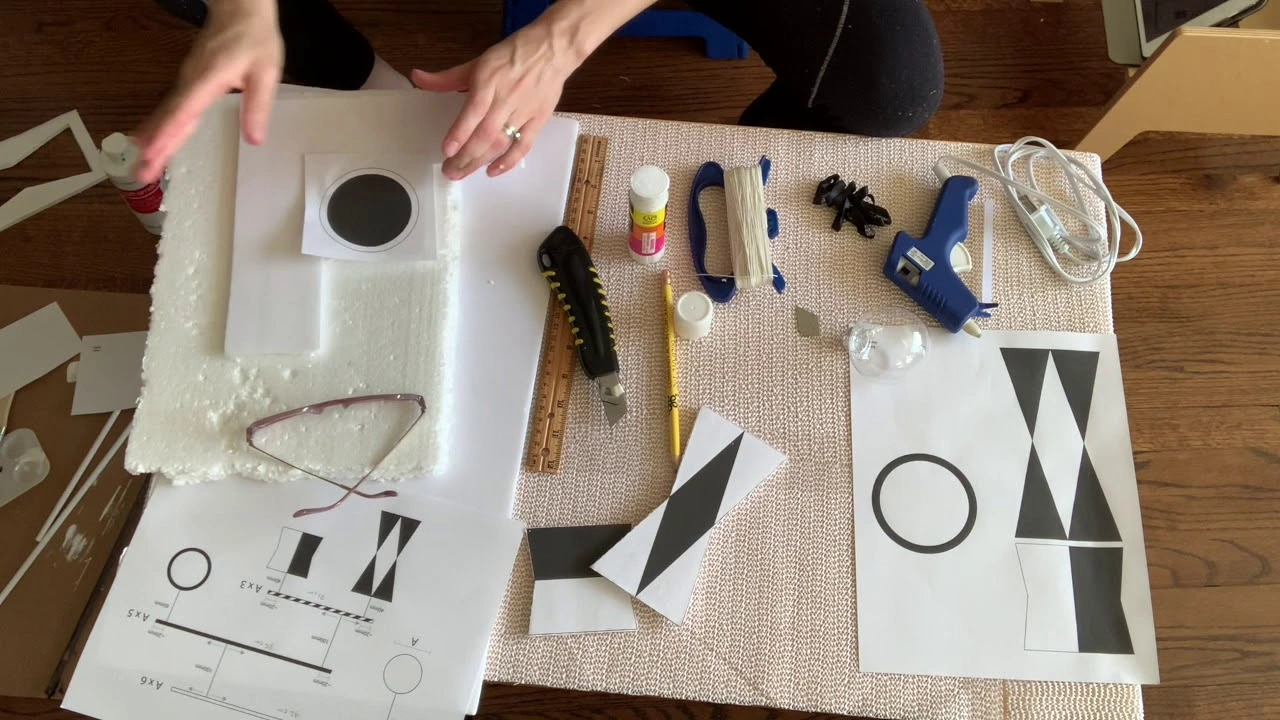
Everything a DIY Munari needs, laid out before assembly. Balancing from the top dowel down is the fiddly part.
Don’t balance a Munari alone. Emma Zebro of The Montessori Twin Mama handed that step to her husband, who got it level “way faster” than she could have. Line up a helper first.
Miri’s Tip
As of September 2026, a single Montessori mobile runs around $35 (a Gobbi was $34.90 at one shop), and an assembled set of four was $69.99 on sale, $89.99 at full price, at another. The accountant in me did the math: a set used for about 12 weeks costs roughly $6 to $7.50 a week.
| Option | Cost (as of September 2026) | Good fit if… | Trade-off |
|---|---|---|---|
| Set of four | About $70 to $90 | You want the full sequence without crafting | Each mobile is up for only a few weeks |
| One or two mobiles | About $35 each | You want the classic look on a smaller budget | You’ll improvise for the other weeks |
| DIY | Mostly craft supplies, depending on what you own | You like making things, or you’re pregnant with evenings to fill | Balancing takes patience; a Gobbi can take weeks |
| Skip it | $0 | Tight budget or a small space | You’ll lean on your face, a window and a mirror, which is fine |
Love a craft project? There are plenty of other simple Montessori toys you can make at home.
Montessori mobile safety: when they come down
The AAP says hanging crib toys like mobiles must stay out of your baby’s reach and come down when they first push up on hands and knees or at 5 months, whichever comes first. Tactile mobiles, which hang within reach, need an adult watching.
The AAP’s toy safety guidance is blunt: “These toys can strangle a baby.” A baby who can push up can reach, pull and get tangled. The AAP also advises taking off loose ribbons or strings.
Most mobile guides skip the next part. Tactile mobiles are designed to be grabbed. So at Moje Montessori, anything within reach is a toy you stay with, never a mobile you walk away from.
- Awake, supervised floor time only, with you within arm’s reach. Never in a crib, bassinet or sleep space.
- Take it down after every session.
- No loops or bows a hand or head could slip through.
- Anchor it in a ceiling joist or on a stand that can’t tip.
- Nothing small: bells and rings larger than your baby’s mouth, firmly attached.
- Plastic, not glass. Emma Zebro notes a glass ball needs care so “it isn’t at risk of breaking.”
- Respect the cutoff: hands and knees or 5 months, whichever comes first.
For perspective, the US toy safety standard, ASTM F963, keeps cords and elastics on toys for babies under 18 months shorter than 12 inches. A ribbon from hook to hand is longer, which is exactly why it stays up only while you’re right there.
Mobiles are traditionally paper, wood, thread and sometimes glass. There’s a reason Montessori leans toward natural materials [CẦN URL: B4-09], and it isn’t that plastic is dangerous. Light materials simply drift with the smallest breath of air.
Frequently Asked Questions
When do you stop using Montessori mobiles?
You stop using Montessori mobiles when your baby moves on, usually around 3 months for the visual ones. The hard stop for anything hanging comes from the AAP: hands and knees or 5 months, whichever comes first.
Can you hang a Montessori mobile over the crib?
You can hang a mobile over a crib if it’s out of reach and comes down at 5 months or hands and knees, per the AAP. But Montessori mobiles are meant for awake floor time; the crib works best as a calm, clear space for sleep.
Do I need all four mobiles?
No, you don’t need all four mobiles. One or two, offered while your baby is interested, do the job. If you choose just one, match it to your baby’s age now; in the first weeks, that’s the black-and-white Munari, the classic Montessori newborn mobile.
What comes after the Dancers mobile?
After the Dancers mobile come tactile mobiles, from about 3 months: a bell on a ribbon, then a wooden ring on a ribbon or elastic, for supervised floor time only. Then the action moves into your baby’s hands, with rattles, rings and other grasping toys.
Conclusion
If you’re reading this at 2 a.m., put the phone down in a minute and rest. There’s no test your baby is failing. Tomorrow, when they’re fed and awake, lay a blanket in one bright spot and hang one simple thing a ruler’s length above their eyes. Then see what they do. Watch first, then offer. Your baby will show you the rest.
Further Reading & Resources
- Safety and vision: Baby’s Vision Development and How to Buy Safe Toys (HealthyChildren.org, AAP) · Toy Safety Business Guidance (CPSC; ASTM F963-23 is the current standard) · ASTM F963, 2011 public text (section 4.14, cord length)
- Montessori background: Montessori Infant (Montessori Guide, AMI) · Materials Spotlight: Montessori Mobiles (Berkshire Montessori School) · Bruno Munari: My Futurist Past (Estorick Collection)
- Real parents: First Mobiles and Infant Mobiles: Visual Series (The Kavanaugh Report) · DIY Munari Baby Mobile and How to Use the Visual Mobiles (The Montessori Twin Mama)
- Week ranges: Living Montessori Now · Montessori for Today
- Prices, checked September 2026: Gobbi mobile (The Montessori Shop) · Set of four mobiles (M.Vita Montessori)